Podcast published: June 5, 2026
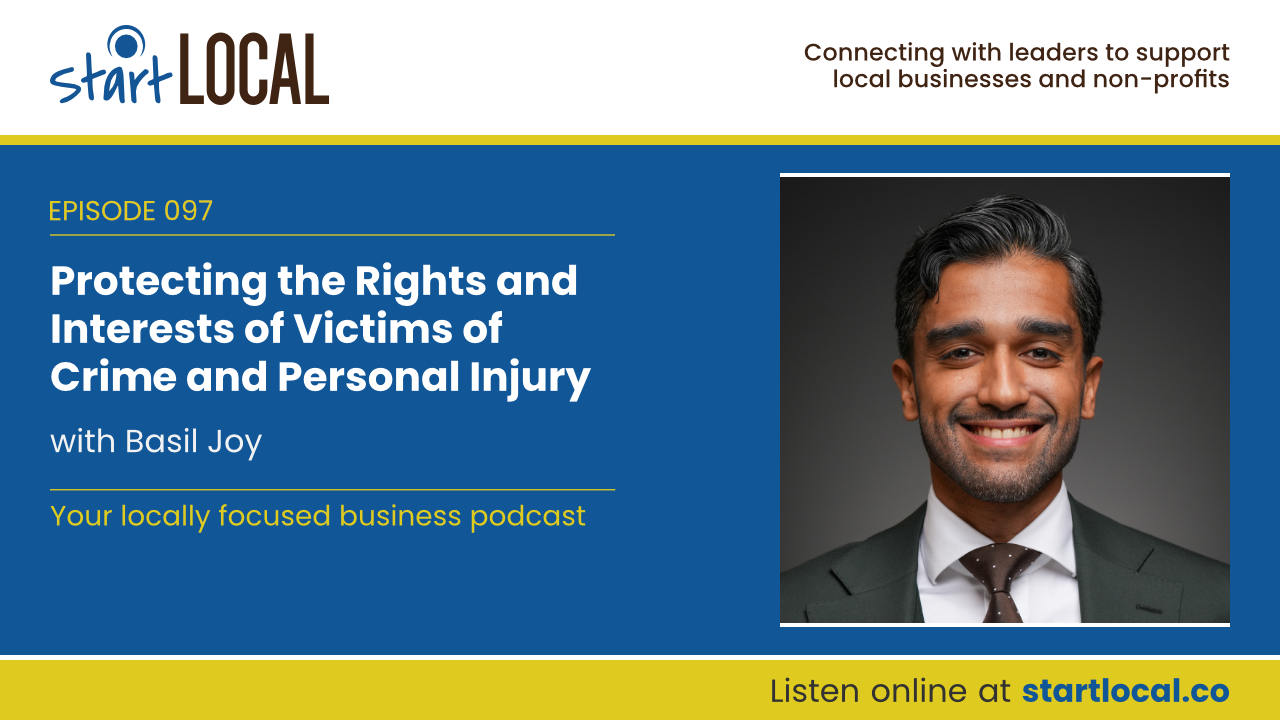
When people suffer serious injury, abuse, or trauma – either through criminal acts or negligence – it can prove challenging to rebuild their lives. We sit down with Basil Joy, an attorney with Goldberg, Goldberg & Maloney, to discuss his work representing victims of crime and personal injury. Basil explains how attorneys help clients pursue justice, accountability, and restitution. Basil reflects on his legal career and how that shapes his work advocating for and protecting the rights of victims. Chatting about a number of nonprofits, we also discuss the value of supporting local communities through board involvement.
Links
Goldberg, Goldberg & Maloney
- Website
- YouTube
- Basil Joy on LinkedIn
- Basil’s commencement speech (2013) on YouTube
Local Nonprofits
- Crime Victims’ Center of Chester County
- Gateway Horseworks
- Fox Chase Farm
- Safe Harbor of Chester County
- Chester County Fund for Women and Girls
- Chester County Bar Association
Additional Links
- Pink | Marked Foundation
- Unite for HER
- Fox Rothschild
- Unruh Turner Burke & Frees
- Suitsupply
- Concordville Cleaners
- Villanova University Charles Widger School of Law
Related Episodes
- Advocating for Local Communities: Law and Volunteerism with Rob Jefferson
- Setting the Example and Leading from the Front with Greg Nardi
- Supporting Victims of Sexual Violence and Other Crimes with Christine Zaccarelli
Transcript
Intro: Welcome to Start Local, where we talk with business owners, leaders of nonprofits, and other members of our community focused on doing business in and around Chester County, Pennsylvania. Each episode will provide insight into the local business scene and tell you about opportunities to connect with and support businesses and nonprofits in your local area.
The Southern Chester County Chamber of Commerce promotes trade, commerce, industry, and sustainable economic development while supporting a diverse and growing marketplace. The Chamber is proud to partner with the Start Local podcast to raise the profile of businesses and nonprofits throughout Chester County. Learn more about the chamber at scccc. That’s scccc.com
Liam Dempsey: Hey. Hey. Welcome to the Start Local podcast. I’m Liam Dempsey, and I’m here today with Erik Gudmundson. Erik, how are you?
Erik Gudmundson: Good, sir. I’m doing well. Summer is officially arriving, and we’re getting used to the humidity, so buckle up, buttercups.
Liam Dempsey: Yeah. Amen. Amen. Amen.
Folks, today we are pleased to welcome Basil Joy. Basil is an attorney with Goldberg, Goldberg & Maloney, a Westchester-based personal injury law firm. Basil, welcome to the StarLocal podcast.
Basil Joy: Thanks, Liam. It is great to be here. I’m happy to join you both on this podcast.
Erik Gudmundson: Basil, I’m glad you’re here because we met briefly at a Start Local event in the past, but I’m curious to learn a little bit more about you. So here we go.
Liam Dempsey: And so we do. And so we do. Basil, as we shared, you’re an attorney with Goldberg, Goldberg & Maloney, and that’s a firm based in Westchester, Pennsylvania, our county seat. Your focus, your practice. You’re practicing law, protecting the rights of victims of crime and personal injury in lay terms. Tell us about your job. What does your law practice actually look like on a day-to-day basis?
Basil Joy: So in a nutshell, we help people who are hurt, and we do that by holding responsible parties accountable. Now, the types of people that we help can be a really wide variety. You mentioned in the question that victims of crime and personal injury. Those are two avenues that most of our clients come to our office. They come to us after some of the worst days of their lives. So someone who’s been involved in a severe car accident, someone who was sexually abused, these are things that when they happen, the victims, the survivors, they’re looking for accountability. They’re looking for a way to put the pieces back together in their lives. Sometimes they have medical bills, sometimes they have legal questions about what they can even do, and how they can hold people accountable.
So what we do on a daily basis is we meet with folks, we protect their rights, we advise them on what the law can provide them as a matter of recourse. And then at the end of the day, we advocate for them to make sure that they get the justice that they deserve, that they’re compensated for the wrongs that they suffered, and that they’re able to take control back from a scenario in which control was taken from them.
Erik Gudmundson: Prior to joining your current firm, you were an assistant district attorney in Chester County. And that, I imagine, gave you some really interesting perspectives that led you to where you are today. So tell us a little bit more about your role in the DA’s office, and if you would, three key lessons from your time there that you learned.
Basil Joy: Sure. Yeah. I’d say starting my career at the DA’s office was probably one of the best things I could have done. For anyone out there who is interested in the law or the practice of law and wants to be a trial attorney, I’d say it’s one of the best ways to start your career.
Three things that I learned in being a trial attorney at the DA’s office.
1. Preparation is the foundation of everything you do. And I think this applies really across all industries, but to me, nowhere more apparent than in the law. Because everything that you do in court, every word that you speak to opposing counsel, even to victims, police officers, it’s all based on preparation. Knowing the file, knowing the evidence, knowing everything that exists in the universe of that case, so you can speak competently about it.
2. Professionalism is the expression of everything you do. So you build that foundation with preparation. And then when you show up to court or when you submit a brief, when you make an argument, you have to be professional in everything you do in your presentation. The way you look, the way you speak, the way you handle yourself when things go sideways in court, when someone makes an argument you didn’t expect, when someone gets under your skin or tries to, how do you come across in those really high intensity moments? How do you control your emotions and present? And how do you treat people when they are on the opposite side of the aisle, when they, when their job is to disagree with you vehemently? Can you maintain that professionalism? And can you still rely on the facts and the evidence and not get personal? I think that’s a huge part of what you do in the professional world generally, but it really gets exposed as a trial lawyer.
3. And then the last thing I’d say is that compassion is the key to advocacy. And that’s a personal one for me. And I think it’s a part of everyone’s personality. I think advocacy is really an expression of your personality. And for me, and what I learned is that when you learn to be compassionate about the people you speak for, the people that you work with, and frankly, as a prosecutor, even the people that you prosecute, if you are compassionate about everyone that touches the criminal justice system, then that makes you better at your job, and it makes you better at speaking about an issue. It makes you more believable. It makes you connect more with everyone around you, especially a jury, because jurors come from all walks of life, and they each have their own story. So when you’re in front of them as an advocate telling a story, and it’s based on compassion, then you have a much better chance of connecting with all the people that are listening to you.
Liam Dempsey: Boy, I feel like I could spend the rest of that podcast time together just expanding on that answer base. Thank you for that. We’ll, we’ll move on. But that was… That was a brilliant answer. I really got out a lot. Got a lot out of that. I intend to go back and listen to that a few times. But after you left the DA’s office, you spent, I guess, nearly two years with Fox Rothschild focused on health care and business law, that’s quite a different arena than prosecuting crimes and protecting victims through the local government. Tell us about your work as a healthcare and business attorney.
Basil Joy: Yeah. So it was about as different as you could get, and that was part of the goal for me.
After law school, I was really interested in being a trial attorney, and that’s what led me to the DA’s office. After I did that work for a while, I realized that, you know, I’m setting out on this endeavor to be an attorney, really, this profession for the rest of my life. But I wanted to see what else was out there, and I wanted to sharpen a different skill set. So in litigation, especially in trial work, you realize that a lot of your time is spent in a very adversarial process, breaking down a case and breaking down the other side’s case. Sometimes it feels like a zero-sum game.
And so what I liked with respect to the corporate practice, especially in healthcare, what attracted me at that point was working with organizations like hospitals, medical practices, working with doctors. I have a lot of doctors in my family. Growing up with doctors, nurses, etc. Working with those types of people in an industry that is still mission-driven. And if you’re working with a startup or a company, you’re still trying to build something. And so the purpose is there, but it’s a little different. Rather than being head-to-head, trying to battle it out in court, you’re helping folks to build something, build it properly, and make sure that they’re able to add value in the community. You serve more as an advisor role. You’re still negotiating, you’re still doing things like that.
Some of the softer skills that I think really help society in different ways, and it works different muscles as an attorney. So from a learning perspective, it was great as well. But I will say that after doing that work for some time and even having some personal things in my life, the death of a very close person in my family made me recalibrate and think about what it was that made me feel alive in a job. And it really, you know, it came back to standing next to someone and advocating for them, telling their story. And it pulled me back into that litigation and trial-type work, which is what led me back to Goldberg, Goldberg, & Maloney.
Erik Gudmundson: You went exactly where I wanted to go, Basil. Let’s go back to your current work at Goldberg, Goldberg, & Maloney. On your bio, on the page’s website, or on the firm’s website, rather, you’re described as an advocate for victims of crime, abuse, and catastrophic injury. That’s a bold statement, I say. And so unpack how personal injury attorneys can bring value to victims of crime, abuse, and catastrophic injury.
Basil Joy: Sure. So when you think about a victim that goes through some horrific event in their life, a lot of times what happens is one, they are forced to deal with it on their own, and they have medical bills, therapy appointments, they have circumstances in their life that may have changed drastically, and they’re left to pick up the pieces. There are mechanisms in some situations, like in a car accident, where everyone knows there is an insurance policy, that the person who hits you probably has vehicle insurance, and maybe there is some compensation you can get for medical expenses.
Even in those clear examples, what typically happens is that an insurance adjuster on the other end is going to call a person instantly. If they’re severely injured, they’re going to try to give them a low-ball offer, resolve this case as soon as possible, and as cheaply as possible. And some people without the advice of counsel may fall into that. And if they have future medical treatment, surgeries, planning for life, like adjustments to their home, building accessible portions of their home, planning for future treatment needs, they may not consider all those things, and they may be left shorthanded if they’re compensated at all.
What an injury attorney can do is think about the total value of a person’s injuries over the course of their life. They can ask the right questions, and they can find the right facts to start building a case. And building a case means collecting the evidence that will be persuasive either to an insurance company or, at the end of the day, to a jury. If an insurance company doesn’t treat you right, once you collect that evidence and you build a case, then an attorney can advocate for you. And so that can be the negotiating table. It can be in a courtroom.
An injury attorney is able to hold an insurance company’s feet to the fire if they don’t treat a person right. So, and that’s why whenI summarize what I do in a nutshell, it’s you help someone who’s hurt, but you’re holding someone else accountable, whether it be the person that committed the harmful act or the insurance company or the company that is really holding the purse strings.
And so that is something that can help in the simplest scenario, like a car accident or in institutions or situations where people are abused, crimes are committed, that a person might not even know that there’s an avenue for recourse. From our perspective, we know the law well enough to know that people can be held accountable for the harm that they cause. And it’s our job to find a way to hold them accountable.
Liam Dempsey: Your offices are in Westchester. As I shared earlier in this conversation, you know, I was reading on your website that you and your colleagues at the firm have secured jury awards and settlements for clients in Lancaster County, Montgomery County, and Schuylkill County. And I expect if I kept on reading, I would have found other counties as well. So that makes me wonder, what do you consider your client base from, you know, from where do you draw cases? Where do you limit your projects in a kind of geographical sense, if you do it all?
Basil Joy: So, everyone in my firm is licensed to practice in Pennsylvania. So generally speaking, we will handle cases all across Pennsylvania. A large majority of our clientele comes from the greater Philadelphia area. So we’re based in Chester County. We have a lot of cases here. Philadelphia County, Delaware County, Berks, and Bucks, that general area. But depending on the cases, they can take us all across Pennsylvania. And really, the breadth of our cases, we’ll have plaintiffs and clients that are located in Philadelphia, but sometimes the defendants can be located anywhere.
When we talk about crime victim cases, especially with large companies, one of the things that we’re looking into now, we have active cases, and we’re investigating more, is cases against social Media companies. There are cases against tech and Internet companies I’ve handled in the past. These are huge international organizations with very broad implications on kind of what the law says they can do, what the impacts of certain cases do to impact really our country and our world. And so in that sense, you know, I’m really excited to take on big cases, things that have those kinds of implications.
But the people that we represent very much are folks in our community and local Pennsylvanians, and that’s the majority of our practice. I will say I’m in the process of waving into the New York bar as well. So sometime in the coming months, we will likely start accepting cases in New York as well.
Erik Gudmundson: Wow, that’d be an interesting change. I’m thinking of TV law dramas as you’re talking there, Basil. And if TV law dramas are anywhere close to accurate, we expect that those trials you experience are a mix of hard work, integrity, intense stress, and maybe some adrenaline rushes. Tell us about the real trial experience that you have had, both criminal and civil. What challenges you the most about going to trial, and what maybe do you enjoy most about going to trial?
Basil Joy: Yeah, so it is definitely a mix of all of those things. And I’d say the biggest challenge is that a lot of trials are kind of like herding cats. It’s the least sexy part of it, all the logistics and the scheduling, because what you have to do is coordinate a bunch of people, witnesses. Some are what we call lay witnesses. So the people who just happen to see the bad thing happen, but they have real lives, they have schedules, they have jobs. Then you have your expert witnesses, people who may be in a lot of different courtrooms and a lot of different trials, and you have to pay them for their time. So you have to coordinate what day are they likely to testify, what travel arrangements you need to make.
And then you’re coordinating with the court’s own calendar and with jurors’ calendars, in case, you know, an alternate steps in or someone can’t be here certain days. All of those things are the, you know, the things you don’t see on TV and in the shows. Just the pure logistical effort of it. Maybe the closest to making that look exciting was a movie like Runaway Jury. I don’t know, because then you’re seeing some of the logistics of jury selection. But a lot of it is really just, just, just planning, planning, and communicating with folks.
The best part of trial work is storytelling. I think at its best, when you’re in the courtroom, you are a storyteller. It’s A little bit of art, it’s a little bit of theater. But when you are putting together any presentation in court, you are taking the evidence and putting it together in a way that’s meaningful to the jury and anyone who hears it. And it is the most meaningful part of being an attorney, because that story is someone else’s, and you are entrusted to tell it. And, you know, there is something very powerful about being able to do that for someone and doing it well.
Erik Gudmundson: So, Basil, I have a confession to make. I have never been called for jury duty in all my years until just recently. I have to serve next month, and I say have to, but the reality is I’m actually kind of excited to serve because I’ve never had the opportunity and sort of curious to see what it’s all about, and, of course, believe that I want to be a positive contribution to the legal system. So, do you have any tips for someone who’s going to serve their term on jury duty, and how they can be a more effective juror since you know it so well from the other side?
Basil Joy: Yeah, I would say just be a good listener and have an open mind. Those are the types of things that I think make a good citizen, and that’s what makes a good juror. Don’t go in there with your preconceived notions. But I mean, frankly, we all do. But then at least be mindful of them.
And what every juror will be instructed is that even if you have certain preconceived notions, can you listen to the evidence that’s presented and make a decision based only on the evidence that’s presented? And that’s what we’re all called to do, just to focus on the facts and on rationality and make decisions that have really important impacts on people’s lives based on it.
Liam Dempsey: My advice, Erik, would have been to bring a book, because I can’t tell you the number of times that I’ve been called to serve on a jury and always get sent home. And that might be more of a me thing they take a look at. No, thank you, please. But bring a book.
Erik Gudmundson: Yeah, the novelty has not worn off on me yet. So, you know, ask me again in a month, and I might have a different answer for you. But I’m excited. I’m looking forward to it.
Basil Joy: Yeah. Well, I think the question was how to be a good juror. If it’s how to kill time, definitely bring a book. I agree.
Liam Dempsey: Don’t read the book. If you make it to the jury while you’re in the waiting pool area.
Basil Joy: Yep, definitely. I mean, that’s one thing with every aspect of court. And could probably say, you know, in the last question as well. When you’re talking about what the court process involves, there’s a lot of waiting. You know, you are serving at, you know, at the court’s pleasure, so to speak. And the court has a million other things going on.
To everyone who goes into that courtroom, their case is the only case, and it’s the most important case. As an attorney, we treat it that way as well. The reality is, in that courtroom, there’s dozens of other cases on any particular day, hundreds or thousands in any particular month or year. And that can sometimes be frustrating for litigants, but it’s something that we all have to be mindful of.
Liam Dempsey: Basil, you’re an active leader, to say the very least, and you’ve got an impressive record of significant leadership roles with a number of highly respected local nonprofits. You’ve led boards for Safe Harbor Unite for Her in Gateway Horseworks. You currently sit on the board of the Crime Victim Center of Chester County.
So the question is this. When you’re considering an organization, you want to do something good for your community, you want to give back in some kind of meaningful way, and you’ve identified causes that matter to you. What are you looking for in the organization to make the call as to whether or not you want to serve on that board? How do you discern what organization might be a good fit for you to approach about board service?
Basil Joy: So I think one of the most important factors is whether you connect with the cause. And for me, throughout my life, depending on what I’m doing, where I sit in my typical day-to-day, I’m often informed about certain problems, certain solutions, and it’s easy in your day job to get very focused on that.
What I find in nonprofit work that’s helpful is that it lets me step out of that role sometimes and approach problems in the community in a more creative way, with a different solution. It helps me give back in a way that’s not, you know, strictly as a lawyer, but it helps me use the knowledge that I have, the way that I think in ways that can help the community and in different ways. And for me, it helps kind of, it helps scratch an itch that I have. It helps me to learn, and it helps me to make an impact in a broader way. So that connection is still very important because it’s what leads me from A to B.
The second part, and I think what makes it energizing is when the organization has the right people. So leadership is important. Other, other, the members of the board are important because when you are part of an organization like that, you’re, you’re, you’re devoting more time to it. And in all these sit, it’s volunteer hours. And so it’s important that the people that you work with are folks that you want to work with, that people that you believe in, people that you think need support or that you can work well with to amplify the good work that you both want to do. And then sometimes in these organizations, you have the opportunity to bring on new folks or recruit additional people. And you know, you really just, you kind of multiply the energy in a room that way. So I think first what draws you in is the connection. What keeps you there are the people.
Erik Gudmundson: I think that’s good advice about serving on nonprofit boards. I’ve served on several nonprofit boards myself, and yeah, those are very true words. I would also say that it’s important that board members get really invested in the organization and maybe even serve on a committee or have some sort of graduated approach before they become full-on board members and get committed to something they don’t fully believe in and don’t fully understand. So all good things to think about, but board service is definitely to be celebrated. So thank you for everything you’ve done.
One of the boards that Liam mentioned is Gateway Horseworks. And that perked up my ears because I also like to ride horses myself. In a previous episode, we heard from Rob Jefferson, who is now an attorney with Unruh, Turner, Burke and Frees about his experiences with Gateway Horseworks. So he said it’s a local organization that more folks should know about. So since you’re an insider there, let me take this opportunity. Would you spend a few minutes going into the details of what Gateway Horseworks does and what community it aims to serve?
Basil Joy: Sure. And, this is a perfect example of what I mentioned earlier, where in my day job had a particular role. And I learned about Gateway when I was a prosecutor at the Chester County DA’s office. And every day I’d be in court working on cases that sometimes led me to believe that the solutions, the tools that we had in our criminal justice system, weren’t as effective as we wanted them to be. There would be folks that I would see going through the system almost cyclically. And there was, you know, certain types of sentencing conditions, certain tools that we would use to try to help people in a process that’s rehabilitative that changes life for folks in a helpful way.
But what you realize is you’re kind of limited in your ability to do so with some of the traditional methods in the criminal justice system, whether that be incarceration, certain limited mental health programming, the types of programs that are available or were available in prison at that time.
When I was there, I learned about an organization, Gateway Horseworks, that was trying to get funding for a pilot program in which they were going to have women in Chester County’s reentry program coming out of prison and doing equine therapy, therapy with horses, to help them address the deep-seated trauma that really led to a lot of their compulsions in the criminal system. I’d never heard anything like that before.
The idea of taking people out of prison, putting them in a green space with horses, just sounded like off the wall. And I didn’t really even know what to make of it, right? So at first, they had my curiosity. I was part of a grant-making organization called the Chester County Fund for Women and Girls. And as part of that organization, we did site visits.
And one of the site visits I did was Gateway. And they put me through a kind of quick 10-minute demonstration of how it works. It involves no riding. It involves horses in an arena or in a field or pasture. An equine specialist and a therapist and the equine specialists and therapists are working with the client or a group of clients, talking to them about what they see in the field, how the horses are interacting, and how the horses are interacting with each other and with the clients. The clients may try to do certain things like lead the horse from one pasture to another, or to drink water or to, you know, eat some hay, whatever the case may be. The therapist then is trained to come back and ask questions and talk to the client about what they’re seeing, why they’re seeing the horses interact this way or the people interact this way. And what ends up happening is that people start to talk about their own worldview in the context of what they’re seeing in the arena in front of them.
But suddenly they don’t have to talk about their own trauma. They’re not sitting on a couch telling someone, this is what happened to me when I was sexually abused. They’re saying, I don’t think that horse is approaching me because it’s not ready to trust me yet. And maybe in the past things have happened that makes it not willing to trust people so quickly. And as they go through this process, it’s almost like a metaphor. They’re able to engage with their own traumas and with their own processes in a way that’s not forced, it’s not defensive, and it’s extremely natural.
And the folks that go through our program, and this is, you know, ever since I learned about it, eventually got on the board. I’ve been on the board now for about seven or eight years. The folks that go through our program are often people who traditional therapy wasn’t enough for or sometimes were completely unable to engage with it. They have seen life-changing results. Folks that were impacted by the criminal justice system, youth that had disciplinary issues in school, and veterans. We help a lot of veterans who suffer from PTSD over the years, like people from every walk of life, have found successes through here.
Now we’ve expanded our programming from Chester County. We have our headquarters in Malvern. We actually have a physical enclosure built at Chester County Prison, where prisoners now come outside and receive our services. We have a farm in Philly that we provide services to kids in the Philadelphia school district at Fox Chase Farms.
Delaware State now is doing some piloting of our programming. So it’s something that a lot of people are seeing value in. And, you know, it’s just. It’s a creative solution to a problem that is very pervasive. So I think it’s. I think it’s worthwhile.
Erik Gudmundson: One of the cliché jokes in horseback riding is that riding is cheaper than therapy, which I might disagree with. But nevertheless, it might be able to say rioting is cheaper than incarceration. So, yeah, all sorts of possibilities there.
Basil Joy: Yeah, I mean, it’s definitely cheaper than incarceration. Like the reduced recidivism that we see out of our program. It’s measurable, and so those numbers play out. The endeavor itself in an organization like this is not a cheap one. And so I think that gets to your point of how expensive horses can be.
I had a fellow board member who joked with me that the fastest way to become a millionaire with horses is to start as a billionaire. And you know, it’s very true with an organization like this, but it actually is even more empowering or energizing because what we do is we’re taking a usually elite experience, and we’re trying to give access to that to people who never would. People who have been incarcerated multiple times, or people who, kids who are living in an area where they might not even see green space for most of their life. And so when you give folks access to a space they didn’t believe they could access, they also start seeing themselves in a way that they never believed them, that they could be seen. And I think that’s the key. It’s like when you give someone that space, they suddenly start to look at themselves differently and that unlocks all the possibilities that no person could ever hand them. It really just. They unlock the possibilities themselves.
Liam Dempsey: Thank you for that. I appreciate you walking us through that so thoroughly. Thank you. Thank you, Basil. In the run-up to today, I was looking around at your professional history on LinkedIn and elsewhere, and I noticed that you served on a board for an organization called the Pinkmark Foundation. And I learned that that’s a Long Island-based nonprofit supporting young women diagnosed with breast cancer. Tell us a little bit about that organization. What’s your connection to it? And I guess try to ask it another way. Why did you choose to support that organization with board service?
Basil Joy: Yeah, so I mentioned earlier the upcoming New York bar. The reason why I’m connected to New York Long Island is that I’m originally from there. My family still lives in Long Island. I’m very much rooted there in that sense. This organization, my family started a few years after my sister passed away from breast cancer.
So back in 2018, one of my sisters, after an 18-month battle with breast cancer, passed away. And she was a young mother. And you know, fortunately, they were in a position at that time with enough support and financially to manage some of those things. But know you, even in that position, it was quite a stressful time.
And so after she passed, there was a conversation about what could be done to help other women in that scenario, especially for the types of costs that insurance doesn’t necessarily cover. So outside of just traditional medical bills, whether it’s, you know, some sort of assistance with paying for rent because they’re not able to work the same way they would while they’re going through chemo, paying for wigs, and the types of things that, you know, someone might consider, you know, it’s not necessary, it’s not part of someone’s medical care, but it’s very much connected to someone’s sense of how they see themselves, how they feel, and how they move through the world.
Child care, a lot of these other types of ancillary, I’ll just say expenses, but are really not really core and essential to a person’s experience when they’re literally fighting for their life. And so we had some relationships with hospitals, specifically Sloan Kettering, some hospitals in the city, in New York that would refer folks to us that, hey, they’re having some trouble paying for these things. And a social Worker would refer them, and we were able to assist with things like that. So it was very much a family connection to the cause and a question of just what else we can do to help.
Erik Gudmundson: Well, let’s lighten it up a little bit. When I first met you, Basil, it was like I said, at a networking event here for Start Local and I saw you across the room, and I was like, wow, who’s that sharp-dressed guy over there? Like he is, is, is really well put together and I’ve since, you know, seen you out and about and you’re. It’s well-tailored three-piece suits, you know, very common when you’re on the clock, I feel like. So two questions for you. Why do you dress so smartly when you’re on the clock? And can you name a local haberdasher or tailor that we step up our own wardrobe game, as Liam and I sort of sheepishly look across the room at each other here.
Basil Joy: Well, as far as why, I think maybe someone made a comment that I dress well, and now I’ve just had to meet the bar every single time. So if I’m in shorts and a T-shirt, I’m just hiding at home, frankly, and hoping no one sees me. But I think part of what we do as lawyers is presenting a case, and presentation is everything from the way you look to the way you speak. And so from my perspective, it’s an important part of the job to present well and to make that an aspect of everything that you do in life.
If it’s a matter of where, you know, where I’m going for suits and things like that, I actually really like a place in the closest location, which is King of Prussia. It’s called Suit Supply. They have locations in a lot of different places. But for me, I love their suits. Whenever someone asks me, I always recommend Suit Supply. My wife always jokes that, you know, if you just gave me an endless supply of money, I would probably make Suit Supplies day because that’s where I would funnel it all.
One organization or one company that I will plug through, because they’re actually the ones that help me take care of everything as far as my wardrobe, and whenever I need anything tailored. Concord Cleaners is right down in the Glen Mills area. Phil Rowe is the owner there. That’s a great place. So I’d say for folks that are, you know, if you have suits, you have dress clothes, you have things you need to get taken care of, especially if you’re in the Westchester area, they’re great service and really friendly folks. They come and pick up, drop off, and I’ll always go there for tailoring. And they’re fantastic. So, I’ll give them a plug for anyone in the area looking for assistance with their threads.
Liam Dempsey: Excellent. And we’ll be sure to include notes to both the suit supply and the tailor over at startlocal.co. startlocal.co. So listeners may not be surprised to understand that you sit on the board of directors for the Chester County Bar Association.
In a previous episode, we talked to Greg Nardi, the Executive Director of that association. So folks can listen to that episode to learn all about what the CCBA is doing for our local community. But within this context of bar associations, Basil, let’s focus on young attorneys just graduating from law school in May.
So they’re just out, right? They’re probably sitting at the bar or preparing to sit for the bar exam, probably pretty stressed. But they’ve got their eyes focused on the Barizer. The question for you is, should young law, should young attorneys really join a bar association? How might they find value in engaging with their local bar? Or is that for more seasoned attorneys or those who’ve been around the block?
I think it’s worthwhile. And I’ve actually, I’ve talked to different attorneys about it, and I’ve heard a lot of different opinions. For me, and it may be based on the fact that I’m a litigation attorney, someone who goes to court and someone who very much deals with folks in person. I’ve always found it to be a tremendous benefit to know folks who are part of my bar. These end up being friendships throughout the years, but also folks that you can learn from and ask questions to.
If you, if you meet attorneys that are ahead of you in the game. Older folks, you know, there’s not a lot of other environments that you would do that more naturally, other than joining organizations like a bar association or like these other boards if they happen to have attorneys. But you can learn so much from other people in their professional walks that I think it’s a huge value.
I’ve heard folks who are sometimes either in the corporate, more corporate type legal jobs, or whose jobs are, you know, if you’re dealing with mostly clients that are far away, international businesses, things like that. Those are the types of folks that say sometimes I don’t get as much of a value add, but from my perspective, it’s one of the most meaningful ways to build connections with people who do the same type of work as you in the same locale.
Erik Gudmundson: Well, as an attorney with a valid law license. I’m sure you would say that words matter. And at the risk of asking you for advice a third time on this interview, and Liam and I are racking up a big bill with you, Basil. Let’s talk about language a little bit. I mean, contracts are all about the words in the document, and trials are all about talking to the judge and jury. So what is your guidance on how we should speak our words in ways that we will not regret?
Basil Joy: I think just broadly speaking, it’s to know your sources and know your purpose. Whenever we open our mouths, right, we’re conveying information. And I think implicitly, there’s two parts of that that are really important.
One is to know that the information you’re imparting is accurate, to know the source of that information, and two is to know the purpose. Why are you saying what you’re saying? And what does the person who’s listening to you need to hear to make their decision?
And so if it’s a bench trial and you’re talking to a judge, your argument’s going to be a little different than if you’re talking to a jury, depending on who’s in that jury, because you have little bits of information based on their jury questionnaire and how they’re reacting to you and the different evidence throughout the trial, you’re going to speak to them differently. Whether you’re speaking to your client or to the attorney, whether you’re cross-examining someone versus direct examining someone. Every single person you talk to, there’s a purpose. And I think as long as you keep that in mind and you keep all of the sources that you’re drawing from in mind, then it gives you a lot more liberty to be artful.
And you don’t have to be as rote in your memorization. You know, you’re kind of grounded in where the information’s coming from, and you are guided by where you’re trying to go with the information. So I think that’s helpful across, you know, anywhere that words are used.
Liam Dempsey: So when you graduated from Villanova Law in 2013, you spoke at the commencement ceremony, and we watched your talk on YouTube, and in that talk, you shared that lawyers have a duty to be exceptional people and not only or not limit themselves to just being skilled professionals. So they have to be exceptional people on top of being skilled professionals. You also spoke of how your fellow law school graduates must remain true to themselves and their communities. So the question is, do you still believe or agree with what you shared more than 10 years ago?
Basil Joy: I do, and I think I’ll just, I’ll explain it in a way that I’ll try to be kinder to myself. Where to be exceptional, I don’t think it requires being better or greater than anyone else. To be exceptional means that you don’t fall for the, I think very easy avenue of accepting things the way they are. And that if you see something that isn’t right, you speak out for it and that you take exception and make exception where it’s warranted.
And I think that ties very much into being true to yourself and to your communities. Because as you move through the world, you carry those values with you. And if you see things that don’t seem right or that should be changed, that’s when you have the duty to be exceptional and to encourage the people around you to make an exception. Even when it seems like the black and white just would encourage people to move on and roll over. That part to me is as true today as it ever was.
Erik Gudmundson: Basil, you’re a long way from Long Island, and you’ve made a home for yourself here for many years. So what do you enjoy most about living in and working in Chester county the most?
Basil Joy: So one of my former bosses used to always say, Chester County is a great place to live, work, and raise a kid. And all of those things have proven to be true. I think one of the reasons is there’s this incredible sense of community here. It is large enough that you never feel stifled. There is, there are things to do, there is natural beauty, there are places to eat, drink, arts, whatever you are into, you can find. But it’s also small enough that you can walk down, at least in Westchester. You walk down the street, and you’ll bump into folks that you know, you can go to events, you’re part of organizations, you’ll meet people, and then you’ll run into them later on. And it’s easy to find like-minded people in that regard because you don’t get so lost in a large place or a place where so many people are leaving the community on a daily basis.
And I mean that in the sense that when you grow up in Long Island, Queens area, there’s so many people that are in and out of Manhattan commuting for hours a day, and people, it just sometimes feels so scattered. And when you’re sitting in traffic or train, or whatever, not to say that certainly those things come in and out of Philly too, but it always felt a little different there. And so things are sometimes feels a little bit more of a tight-knit community, a small town.
Sometimes I have buddies that visit from New York, sometimes I’ll walk them through Westchester. And I had a friend who’s like this, you look like you live in a Hallmark village, like what is this? And, you know, it’s one of the things I enjoy. And so, you know, if I, if I’m, if I’m driving to work, I’m driving down a one lane road with some farms on both sides, but it doesn’t, I never feel like I’m in the middle of nowhere.
So all of those little things I think add to the charm here. And it’s nice to raise a little girl here because she gets the best of all those worlds, too. And she has goats at her school and chickens and ducks. So she is exposed to nature every day of her life, but still very much connected to the museums and culture and arts and theater and all the other things that we want her to learn. So it really is a nice best of both worlds scenario in my view.
Liam Dempsey: So you’ve talked about the firm Goldberg, Goldberg & Maloney in ways that make me sometimes wish I had a law degree. I do not, and I am not going to law school. But I wonder, it’s a firm hiring. Are you looking for additional attorneys, additional staffing?
Basil Joy: So we’re not advertising any positions right now, but I’d say one of the things when you’re in a small business is generally you’re always on the lookout for talent. So we’re not hiring now, but we are always looking for folks who might help our mission. And if the right folks come along, we always take a look.
Liam Dempsey: So what’s the best way for somebody interested in maybe asking you to take a look at what they can bring to you? Is there a page on the website? Is there a form or something?
Basil Joy: I would say it’s usually to just reach out to one of the attorneys directly. And you know, you can find us at our website, www.goldbergmaloney.com, you can find our contact information. But it again goes back to one of the ways that I think the law and the work that we do is a very people-oriented way. It’s a people-oriented business. So we’re always looking to connect with folks. To us, it’s very important how people get along with our clients and get along with the judiciary, get along with members of the justice system that we interact with. So the right person and fit are always super important.
Erik Gudmundson: Now, I know you’ve already mentioned several local businesses and nonprofits that clearly show you’re an active part of this community, but we always ask our guests for another, give them another opportunity, I should say, to briefly mention another business or nonprofit that maybe you’re on your mind that you haven’t had the opportunity to mention just yet. So you have a minute if you want to. If you want to fill us in on one.
Basil Joy: Yeah. I think the one other organization I’ll plug is the Crime Victim Center of Chester County. And it was mentioned briefly before, but I’d be remiss if I didn’t show them a little bit of love because they are really one of the most impactful organizations touching the criminal justice system in Chester County. And again, it’s one that I find in my day job. I have one role with regard to helping clients who have been impacted by crime victims and survivors. And when I’m wearing my attorney hat, there’s only certain things I can do to help them get compensated, help them get justice under the law. The Crime Victim Center of Chester County, when I serve as a board member there, it’s an opportunity for me to put on a different hat and to help people who are passionate advocates.
So what they do is they provide educational services regarding issues impacting crime, victims of crime, and violence. In Chester County, they provide advocacy services. So if someone is the victim of a crime, they will actually send an advocate to meet with the person to go to a hospital visit, sometimes sit with them through a sexual exalt assault examination. They’ll attend court with them. They will actually hold their hand through the process every step of the way. They have therapy services that they’ll provide to folks at no cost. So, people, no matter what their level of resources are, they really do help in so many ways at a critical juncture because the criminal justice system so often will focus on what needs to be done with the defendant and the perpetrator, and they focus on standing next to the victim and the survivor. So their work is so important, and with a lot of the issues around government funding and nonprofit funding generally, I think organizations like that really need our support.
Liam Dempsey: Yeah, agreed. Big fan of CVC. I was sent on a volunteer committee as Erik suggested I do in this episode. Not historically. I’m just trying to tie it back to the earlier in the conversation. And folks may recall that we spoke to Christine Zaccarelli, who heads up to CVC in a previous episode. So we’ll be sure to link to her episode over on the show notes page at StartLocal.co.
Basil, it’s clear that through your law practice and through your role on so many different boards, you’re giving back to our local communities in pretty significant ways. How can our local community support you and your law practice?
Basil Joy: I would say generally it is by supporting victims, supporting people who have been injured or harmed. There is a general notion, I think, that when you’re in the realm of plaintiff’s work or helping people who’ve been injured by any of these scenarios, that the number one thing that I hear most from my clients when they’re sitting across from me at a table is I’m not a litigious person. Because we have this idea in society that if someone is hurt or harmed and they look to be compensated for that, that they are, somehow, there’s something wrong with them, that they are, you know, they’re a money-hungry person. But the reality is, no one who sits across from me at my table ever ended up there because they wanted to be there. They were harmed, hurt, their lives were changed in some way because they never wanted to be.
And I think if we all as a society understand that, and when you see the person that’s hurt, and your instinct is more, hey, what can we all do to help this person? What are the resources? Who are the people that they can talk to to help them? Then we’ll all be in a better place. And I think that is the broader way. I think we, as a community, can support the people we serve. And ultimately, if we’re able to help those folks, then, you know, it makes our mission worthwhile.
Erik Gudmundson: Basil Joy, an attorney with Goldberg, Goldberg, & Maloney, where can listeners connect with you and learn more about your programs? In our corner of the Delaware Valley.
Basil Joy: Yeah, so you can reach us at our website, which I mentioned earlier. You can, you can find my contact information there. To email me, call me, or connect with me on LinkedIn, Basil Joy. I’m always happy to connect with folks, talk about the work that we do, talk about how we can help. And like I said, it’s often even broader than what I do on a day-to-day basis. What I can happily say about all the attorneys in my firm is, you know, we just, we want to make the community that we live in better. And so if there’s folks out there who want to do the same, I’m always happy to connect.
Liam Dempsey: Basil, thank you so much for joining us. I’ve really enjoyed spending time with you and getting to know you a little bit. I can’t thank you enough for being here today.
Basil Joy: It’s really been my pleasure. Thanks, guys.
Erik Gudmundson: Thank you. Yeah, thank you. And I know I learned a lot, too, so I totally agree with you, Liam. And thank you also to my co-host, Liam Dempsey. I’m Erik Gudmundson.
The Start Local podcast is published every two weeks. We invite you to subscribe to Start Local using your favorite podcast app or ask your smart speaker to play the Start Local podcast. You can visit the Start local website at startlocal.co for show notes, including links mentioned on this show and summaries of past episodes.
We hope you join us for the next episode. Thank you for listening.