Podcast published: April 3, 2026
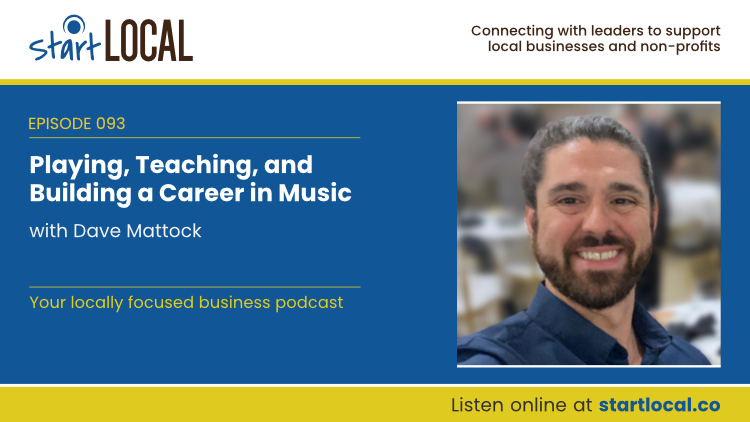
Music carries an intangible, immeasurable value – shaping how we connect, express ourselves, and experience the world around us. In this episode, we sit down with Dave Mattock, owner of Mattock School of Music and a working jazz pianist, to explore what it really means to build a life in music. Dave shares his journey from college professor to opening his own school of music, reflecting on the challenges he faced learning to run and grow a business. We talk about the many paths available to aspiring musicians, the importance of mentorship and community, and how a vibrant local arts scene strengthens the region for everyone.
Links
Dave Mattock
- Website: davemattock.com/music
- YouTube: youtube.com/@davemattockjazz
- Instagram: instagram.com/davemattockmusic/
- Facebook: facebook.com/share/17j9Jhduwu/?mibextid=wwXIfr
- Bandcamp: Music | Dave Mattock
- Knucklebox on Bandcamp
- Knucklebox on Spotify
Mattock School of Music
- Website: mattockschoolofmusic.com
- Facebook: facebook.com/MattockSchoolofMusic
Additional Links
- Kennett Jazz & Funk Fest
- If Not for Music
- Philadelphia Trusted Advisors
- Philly Jazz Scene
- Canine Partners for Life
Local Music Venues
- Kennett Flash
- Andréa’s Jazz Café
- Slow Hand
- Will’s + Bill’s Brewery
- The Nomad
- Spence Café
- The Creamery of Kennett Square
- Kennett Library
Artists to Explore
- Brad Mehldau
- Jason Lindner
- Mike LeDonne
- John Medeski
- Lionel Loueke
- Esperanza Spaulding
- Kokayi
- Miho Hazama
- Hiatus Kaiyote
- Alarm Will Sound
Related Episodes
Intro: Welcome to Start Local, where we talk with business owners, leaders of nonprofits, and other members of our community focused on doing business in and around Chester County, Pennsylvania. Each episode will provide insight into the local business scene and tell you about opportunities to connect with and support businesses and nonprofits in your local area.
The Southern Chester County Chamber of Commerce promotes trade, commerce, industry, and sustainable economic development while supporting a diverse and growing marketplace. The Chamber is proud to partner with the Start Local podcast to raise the profile of businesses and nonprofits throughout Chester County. Learn more about the chamber at scccc. That’s scccc.com
Liam Dempsey: Welcome to the Start Local podcast. I am Liam Dempsey. I’m here again with Erik Goodmanson. Erik, greetings and salutations.
Erik Gudmundson: Greetings and salutations. Back to you, my friend. Liam, how are you today?
Liam Dempsey: I am super fantastic. Good. Super fantastic. Good. Folks, it doesn’t happen very often, but since nobody can see what we’re wearing, I just wanted to flag up that I am wearing a tie. I have a tie on for the first time ever recording this podcast.
Erik Gudmundson: That may be the first time I’ve ever seen you in a tie, period. Not just for this podcast.
Liam Dempsey: I mean, a tie.
Erik Gudmundson: It doesn’t matter.
Liam Dempsey: Isn’t that where I went to Sweet Charity when we saw each other earlier this month at the Chester County Community Foundation’s fantastic event?
Erik Gudmundson: That’s right. You’re absolutely right. Yeah. It’s just when I think of Liam, I don’t think of Tie. That’s not your normal business uniform, that’s for sure.
Liam Dempsey: Well, that means I’m doing it right. If I’m doing it right.
All right. Folks, we are really pleased to welcome Dave Mattock to the show today. Dave is the owner of Maddock School of Music and frankly, so much more. Dave’s a working musician, an actual working musician, and he calls Kennett Square home. And as we’ll soon see soon hear over the course of the conversation, Dave is a leader in the music and performing art scene across the southern end of Chester County. Welcome, Dave.
Dave Mattock: Hi there. Thanks for having me.
Erik Gudmundson: Dave, It’s a pleasure to see you here today. And even if you’re not wearing a tie, I think we’ll let it pass because you and I are non t in solidarity.
Liam Dempsey: Dave, as we opened, you’re working musician, and that absolutely amazes me because I can’t play any instrument. I can’t even clap along consistently with the tune. So that just impresses the heck out of me. But let’s start with this. What instruments do you actually play professionally versus other instruments you might play for just practice or hanging out with friends and the like. What are your tools of choice, if you will?
Dave Mattock: Sure, sure. So I’m a pianist by trade. That’s what I do. That’s what I’m trained in. I also specialize in playing Hammond organ as a… There’s a kind of a niche sub genre in the jazz world called, you know, Hammond organ jazz. And so I do that as well. So those are the only two things I play professionally.
As far as other stuff, I occasionally will sit down at a drum set and have some fun and bang away at things, but I would never let anyone hear me do that publicly.
Erik Gudmundson: We know that you have a music school, the Maddox School of Music, and your school is in Chaddsford. What instruments and skills aspiring musicians learn at your school. And I also want to hear the story of moving to your current location on Kennet pike and Chadds Ford, because I hear there’s some perseverance involved.
Dave Mattock: Sure. So basically, if you can think of it, it’s not a really weird instrument off the beaten path. Then we teach it all the strings, all the woodwinds, all the brass piano, guitar, bass, drums. We also teach audio engineering. We teach, we have ensembles. We have basically all the different things you would want if you’re trying to learn how to play music as either professional or as an amateur.
The backstory to coming to our new location, our relatively new location, I mean, we’ve been there for five years now, but was that if I go all the way back, I had originally moved to this area specifically to open a music school.
Back in 2011, my wife and I decided to leave Philadelphia specifically to open up a music school. We bought our house with the idea that we would have a… The house has a large in-law suite attached to it, and we planned on renovating that right when we got out here. So that’s basically what happened. We started out by moving here. I started teaching private lessons as soon as I could. I had all of four students. That seemed like a big success at the time.
About a year into it, I realized that I would need to add and expand, and I brought in a friend of mine to teach guitar. And at that point, I also did a renovation on the in law suite to add an extra room. That room allowed me to continue to expand over the course of about six more years. And at one point, we had about 90 students. And I had seven or eight teachers that were teaching at my house, basically. And that at that point, I then had one kid and I had a second on the way and I realized that my house was no longer adequate to, you know, to sustain such a business. And we started looking for a new space.
After looking around all of the kind of Kennett, Chadds Ford area, we landed on a house that is right across from the Mendenhall Inn that was zoned as a commercial space. And we moved. We started to… Well, I’m sorry, I’m getting ahead of myself. We purchased it in 2017, and that is the beginning of the rest of the story that you’re probably alluding to.
To put it succinctly, it took us five years to get that building open. From getting the renovation started to getting the permitting, to going through state permitting, to reevaluating how we were going to finance the whole thing. And then at some point finding out that there was a global pandemic that was going to land on us. On top of all of that, we didn’t open until the summer of 21, so it was about a five year span between purchase and actually moving in and opening it.
Erik Gudmundson: Wow. Perseverance may be not even the right word. We’d have to probably use some expletives, I suspect. But that’s a difficult journey and I’m glad your business was able to stay open at least, you know, during that time working out of your own home, I suspect. Right?
Dave Mattock: And during that time, you know, first there was, you know, just. We sustained the business for those few years before the pandemic. Just we kept working on what we were doing here while we were also working on that space. But during the pandemic, we were able to make a very, very quick shift into virtual lessons. And not every school was able to do that. But I had some really, really great, the teachers working for me at the time, and they made that transition quickly. I made that transition quickly. And we actually managed to grow over the course of the pandemic and add students rather than lose them.
You know, some of that is just the natural aspect that people were looking for lessons. And some of it I, you know, I credit a little bit just to the great teachers I have and how they were able to, you know, just keep building upon things and giving kids an opportunity to keep learning. So when we opened the doors in 21 at the new space, we’d actually gotten bigger than before the pandemic happened.
Liam Dempsey: That’s amazing. I just love that. I love that. So we understand that being a successful working musician probably is as much about business as being a skilled pianist or guitarist. Or singer or what have you. You just shared a few moments ago that when you first opened your school, you quickly realized that you needed to offer more than piano lessons. So I wonder if you can share that insight with you. What was the realization that made you say, hey, I need to get somebody to teach guitar? Perhaps you can share a few other business lessons that you’ve learned over the, I guess since 2021, when you opened the school, what else have you learned about business that would be helpful for other folks to know about?
Dave Mattock: Sure. You know, the first question there that opening it up to multiple instruments was it’s twofold. One is just the practical aspect of very few siblings want to play the same instrument. It’s just something that I’ve seen over the years. And so if I have a piano student, their brother wants to play guitar. It’s just kind of the nature of it. And so that is a lot to do with personality types and things like that and the way families work.
And so right away, I immediately had parents asking me, oh, you’re a good piano teacher. Do you have anybody? Do you teach guitar? And I’m. No, I don’t. So that was just a very practical application. Just bring in a new teacher. And of course, I’m well connected in the music community because I’ve lived here for a long time, and so it was easy to find people that were looking for that kind of thing. So I was able to bring in a guitar teacher right away, and then a drum instructor and so on and so forth.
You know, from the business point of view, when I started this whole thing, I didn’t know anything about any of this stuff. From the most practical, practical things about how to do an invoice or how to advertise something or whatever. I mean, in 2011, this was not the world that I really lived in at that point. So there’s all of the basic, basic business things that come with. This is a very, very different world than being a gigging musician, per se, or a college professor, which is what I was before this. So that was a big part of it.
You know, as I’m going on and I’m thinking about all the different things, I think the biggest lesson that I’ve learned over the years is that, you know, at first, all these. The business requires that I wear every hat, many, many hats. There’s so many things that I have to do and I had to do to get this business off the ground, Whether it was, you know, like I said, invoicing or just communication with parents. Or mowing the lawn outside of the studio, or, you know, fixing a guitar that broke overnight, whatever it is.
There’s a million things for me to do. But what I’ve. My most recent kind of challenge is kind of getting past that and allowing myself to let other people in and people with other expertise help me with some of these things so I don’t get so bogged down in what I’m doing.
Erik Gudmundson: One of those things your school does is a mentorship program. And that’s something that I think doesn’t come often with somebody who teaches music lessons. And so in our conversations before we hit the record button, you spoke about your focus on helping young people see the many avenues open to those who want to be working musicians beyond the performing artist star. Tell us more about your mentorship program, because that’s just fascinating to me because I’m very much a music consumer. I love to buy albums, I love to go to shows. But the thought of making money in the music world seems like it’s very, very difficult and be a hard walk to follow. So I’m curious how you mentor people.
Dave Mattock: Sure. The beginning of all this comes from whenever I was still teaching at a community college and I was asked to offer a business class, a music business class, which was a really eye openening experience for me because it allowed me to kind of just think deeply about what it was that I’d already done in my own life and what I’d seen around me to see what we would call successful musicians.
Whenever we think about success in the music industry, a lot of times people who are outside of it, they think about fame, basically they think about fame or they think about stability and, you know, education. And that is often the only view that many of us have about what it means to be a, you know, a capable musician or someone who has made it in the industry.
I always used to ask my students, what is the definition of making it to you? And so that has always kind of lingered in my mind. And whenever we started teaching more and more and my students started to get older, I started with a lot of younger students. And then as they were getting older, some of them started to express interest in the idea of being a musician.
And I found that right away they were very hung up on those two exact things. They either have to be famous or they have to get into education. And for the most part, none of them either wanted to or had any idea how to do either of those things. But the reality is that I know hundreds of musicians who make a very, very comfortable living wage, what we call kind of blue collar musicians. And we want to make sure that our students understand that those options are out there for them.
And the first thing is we have to expose them to those options. We have to let them know what they are. And that’s not just like telling them, but also firsthand, giving them opportunities to talk to, work with, work beside people who work in other places in the industry, and then giving them real time experience with it. It’s like if someone says, oh, I really love that, you know, walking, you know, hanging out with that piano tuner that one day, okay, well, let’s find you a way to get an apprenticeship with that piano tuner. I love working in the recording industry. Okay, let’s get you an internship at a recording studio. So acting as that kind of conduit for both the students and also for the parents who oftentimes are very, very nervous about their kids getting into this world because they don’t know either, and they’re scared and they, you know, they’re looking out for their kids and they want to make sure that they do the right thing. And so we’ trying to provide them with the information that this is a real thing, that this is something a kid can do.
Liam Dempsey: Dave, you still play 70 to 100 gigs a year, and by my Math, that’s about six to eight shows or performances a month. So there’s two questions here. First, especially this one’s for Erik. Where and when can we see you perform? He loves to go out and watch live music. So where and when? Please be specific. And I guess the bigger question really is, you know, you’re trained, professionally trained. You’ve been to school for it. I can’t imagine how many hundreds, if not thousands of gigs you’ve played over the last 20, 30 years. What does playing to a crowd still hold for you some 20, 25 years into your career? What excites you about getting up there?
Dave Mattock: I’ll answer that first, because that one, whenever I think about that, it kind of stumps me too. It’s like, how does this just continue to work after all this time? It doesn’t get old. I still love doing it. I might love it more because, you know, after all those years, every, every gig, every year that goes by, everything that happens, I get more entrenched in it, better at it. I enjoy it more. Rather than the opposite. It just doesn’t ever kind of die off. I mean, I play jazz, and jazz is all about improvisation and creating something new at all times. So it’s inspiring.
I work with great people and I get to be around them, and they inspire me to play more and vice versa. And so it just continues to go on and on and on like that. And I was thinking about this before we started 25 years ago. One of my piano teachers told me that, and this has always stuck with me for that whole time. He said, the gig that you’re on is the most important one, because gigs can be anything from the worst, most awful background thing or a terrible bar or whatever. And there’s all these. Or it could be something where you’re on the stage in front of 5,000 people. Amazing.
And all those things, those factors kind of like weigh on you whenever you’re playing. But what he was saying was, is it doesn’t really matter because in the end, you’re lucky enough to get to do this, and the worst gig is still the best gig you’re ever going to have. So it’s important. I’ve tried to live by that my whole life and try to keep that going and that mentality happening.
Your first question, where do I play? So I’m lucky enough to have a couple of what you might call residencies. And I love to brag about these places because I support them in the way that they support me. So, the first is Slowhand in Westchester. Excellent bar, restaurant right downtown. They have, since they opened, I’ve been performing there monthly on the first Friday. So you can come hear my jazz group there on the first Friday of every month.
And then the Nomad Bar in Wilmington is another place. Same thing. I have the third Friday, so I always have a jazz group of some kind, usually a trio, playing there every month. I love both those places. They are the type of places that make the music industry continue and can move on because they support the music, they allow the musicians to do what they do best. They don’t interfere. They just let us go. And it’s a wonderful experience. So both of those are great. I play regularly there.
I also play at a piano bar in Malvern called Wills and Bills, and I play there twice a month. These are all great establishments. Again, they support the musicians, but they also, you know, they pick good musicians to play there. If I can pat myself on the back a little bit, I like to be proud of the fact that all the other musicians I see at these places are also excellent. So you go to any of them any night of the week, and you’re going to hear great music.
Erik Gudmundson: Well, in addition to everything else you do, you’re also a recording artist. You have four full length jazz albums which you released under your own name. You’ve also played on dozens of recordings as a sideman. You even have composition credits for tv. Knucklebox is your latest release. I read Knucklebox came out in 2020 in March, so about a year ago from when we were recording this. And it features you and two colleagues in an organ trio, Funk Tap. According to Glenn Asteria who reviewed your album over on allaboutjazz.com’s the band moves as a single organism, pivoting from bebop influence lines into “deep funk grooves without breaking a sweat”. What were the sources of inspiration for the music on this album? Because that’s a very interesting quote that makes people want to listen.
Dave Mattock: Sure, yeah. Yeah, I love that quote. There are two really important factors that kind of came together for that album. The first was just my normal explorations of music. I’m always trying new things and learning new things. I practice a lot and I’m always trying to learn about new styles of music. And at the time I was very interested in the idea of rhythm just as kind of a blanket term. So that album is full of very, very angular, jagged, unpredictable rhythms.
There’s a lot of odd meter, there’s a lot of circular forms. There’s a lot of things that are just compositionally were on my mind. The entire album is through composed. It’s supposed to go from one end to the other. I mean, each track is individual but they reference each other. If you listen carefully. And there’s a lot going on there.
The other side of it is that I personally, I was going through kind of a hard time. I was going through some health problems. I was having eye surgery and I had years of eye surgeries. And I was constantly laid up where I couldn’t go anywhere. I couldn’t perform, I couldn’t play. The only thing I could really do was stay home and basically just write music. And a lot of the music is influenced by it. There’s a certain kind of stress to a lot of those songs that you can hear. There’s a kind of an angst to it and some of it comes from that. It was in some of the references, the title names and everything like that are part of that whole thing.
And then lastly that band. And as Glen so accurately intuited during that, he realized just how tight that group is. I’ve been playing with those guys since 1999. There’s a lot. There are thousands and thousands of hours of us playing together, and there are almost no one that would have been able to perform that music, except for the two guys I was with. So shout out to Josh Orlando and Jason Herman, the drummer and guitar player, respectively, who were on that it.
Liam Dempsey: Dave, I love hearing the story about the album, as stressful and sad and concerning as those experience must have been for you, because I’ve listened to Knucklebox probably five or six times since I first had about it and. Yeah, no, my pleasure. Thank you. You did all the work. I just click on play over on Band Camp. So, yeah, I hear that stress and, you know, I never know, is that me just bringing myself to the music or is that there? And I really enjoyed hearing about that. Sorry it was such a tough time in your life, but I appreciate knowing that. The backstory to the album. Thank you for sharing that with us.
Dave Mattock: Of course.
Erik Gudmundson: Yeah.
Dave Mattock: And I mean, that’s kind of how art works, right? I mean, you don’t realize it even at the time. It just. You come out the other side of it, and you realize how much influence it has on you. And it’s okay for you to hear whatever you want in that album. If it made you feel the complete opposite, that’s all right too. Whatever works for you.
Liam Dempsey: Yeah, I love that. I love that about music. It is what we want it to be in the moment. And sometimes the same song means something totally different, depending on us, depending on where we are in life and at the time of listening. So, yeah, music is powerful like that.
Dave, you’re very active in the music and performing arts scene in the Kennett area. And I don’t mean just as a teacher of music and as a performing artist. You do a lot that we’ll get into in a little bit. The specifics of it, sitting on boards and organizing things, and the like, for the community. But the question is this, beyond economic viability for both the musicians, the blue-collar musicians as you describe them, what value can a vibrant music scene deliver for a region?
Dave Mattock: It’s so hard to put your thumb on that. Like, what does that actually mean? Because it’s obviously just so important to me, but how is it important to other people? And I struggle with explaining that to people all the time.
But I think the most succinct answer I can give is that the arts in general are about community. Right? They bring us together. They help us bridge the gaps between age, gender, nationality, all of the different aspects of our lives, and that we can all kind of come together on those things. Whether it’s music or, you know, visual arts or any other performing art, they all do that for us. And that whenever we have that kind of sense of community, everyone’s life is just better, you know?
And what’s the point of all of this work we’re doing and all these other things if we don’t have the arts? Right? I mean, that’s kind of what makes us human. So bringing us all together that way is what I really see. And that’s what I’m trying to do, just to, by joining, like all these different nonprofits and things like that is to kind of normalize the idea that music is just what we. It’s just part of life, you know, we just have it, and we should make sure that it’s there. And we can’t ever let that go because we’re lucky enough to have that ability.
Erik Gudmundson: You hold leadership positions with a number of local efforts and nonprofit organizations supporting the local performing arts, as Liam just alluded to. But specifically, you’re the President of the board of the Kennet Flash. You’re also on the board of, if not for Music, which is a Unionville-based nonprofit focused on supporting musicians and aspiring musicians, the Kennett Flash. I love going to see shows there. The sound quality is amazing. It’s always a wonderful vibe in the audience and among the performers. Tell us about these organizations from your perspective.
Dave Mattock: Sure. The Kenneth Flash is a unique space. I mean, as a performing musician, I know what they’re all like. There aren’t a lot that sound as good as it does. It is a 100-seat listening room. The focal point is the music and listening to the music. It’s not a restaurant, it’s not a bar. It’s not anything other than a place to listen to music.
And that’s what makes it so special because those are hard to find and they’re very hard to sustain. Believe me, I have been on that board since 2017. It is a lot of work to keep that place running, but it’s an amazing space. It’s a great jumping-off point for up-and-coming musicians. It’s a great place for musicians who are maybe on the back end of their careers to continue to sustain themselves as they’re, you know, maybe, you know, the former third guitar player from, you know, you name it, a famous band or something like that. Like, where do they perform these days? Places like this, you know, it’s a great place for kids to see music. It’s a great place for us to be able to access it. In a way that, like, maybe you can’t if you live outside of an urban area. So the Kennett Flash is a wonderful thing for the Kennett community, and I hope that we can spread the word about that more.
Erik Gudmundson: How about if not for music?
Dave Mattock: Sure. That’s a newer organization that I’m a part of now, for me at least. And my association with them came specifically because I had some students who were just going through hard times in their lives and were no longer able to continue their lessons, just financially. And that’s as simple as that.
And I was desperate to find a way to get them, you know, to allow them to keep them on and make sure that they can continue to take lessons. And so I was just digging around and looking for something, and I stumbled across this group, and they are doing wonderful things with raising money for kids to take lessons, to have access to music to. For you know, the musicians who are in that transition period between, you know, amateur and professional, giving them opportunities to perform in places, things like that. And they do a great job with it. And they’re continuing to. And they’re starting to grow. And it’s just a wonderful organization in that way.
Liam Dempsey: Let’s swing back around to your career here a moment. And you’re a gigging musician, as you said. You have the school tell us about your revenue streams, really. So you’ve talked about mentoring students and to be able to have a fulfilling career in music beyond what we see in the headlines. How are you paying your bills? Where does all the money come from? How does that all work? How do you tie that all together in a way that pays the bills and supports your family?
Dave Mattock: Yeah. This is the conversation I have with my students all the time. I mean, I’m fortunately in a place in my life now where I have the history and the built-up kind of connections and just the business that I can able to sustain myself with a little bit less stress than I used to. Most of my life today is the music school. That’s what I do. I teach a lot of… I still have about 30 students myself. The school has many, many students. And so that creates the income that I need to be able to have my family and do the things that I do in my life.
I also gig and I make money at that. Of course, that’s part of it. And there’s a little bit of kind of the random stuff of being a musician. We always have so many different small things that come in. I might end up doing an audio engineering gig, or I might do some live Sound for somebody, or I might get called to write a jingle for a commercial or something like that. There’s still a lot of that kind of stuff going on in my life.
Formerly, before I had kind of studied things and leveled things off with the music school, I spent a lot of time running around being a college professor, an adjunct professor at multiple schools. At one point I was at three different colleges. I was playing in a cover band, I was gigging in whatever random place I could find. I was doing small recordings, and the same thing, I acted as a booking agent for a little while. There was some, you know, there’s some things with. Just from writing, there’s some royalty income that comes through like from that kind of stuff. So, you know, it kind of changes and evolves over the years. But currently it’s mostly the school.
Liam Dempsey: So I’m curious about now, now that you have this I’ll call steady income. Right? Is that when working for ourselves, does income ever really steady? Yes, generally is sometimes. Yeah. You know, but this, this. Write a jingle, come do some sound, help out, I don’t know, with a band that you don’t normally play with. Is that kind of like the money’s right? I really like those people. That sounds really fun actually. Is it some of, oh, you know what? The bathroom broke last week. We know we’ve got that heaters going. I need to do some of that. Maybe I’ll take this extra work. How do you decide with all these wonderful opportunities that come, how do you decide which ones to take and which ones to say no, thank you, please.
Dave Mattock: If you’re one of my students listening, the answer is yes. You always say yes. That is just what we do as gigging anything. It’s just. That’s the world. It is. Even if you don’t know how to do it, just say yes. Figure it out along the way.
But you know, the reality is today I have a lot more to balance. I have my kids lives, you know, I have to, I have to be there for lacrosse practice. I have to, you know, make sure that I’m not working constantly. And then there’s also the stress of some of these things. I mean, that work can be hard. You get a call to sub in for a band and it can be three hours of actual work, but it could be 12 hours of prep work, learning new material, or it could be going out and researching how to use a particular piece of technology that you’ve never used before so that you can, you know, get the job done. So there’s all these like other factors that you have to add in and see if you can actually fit them in.
And there’s a lot to that. There’s a lot that goes into it. And you want to say yes to things and you want to stay connected to the community, the arts community and be a part of things, but you also want to not completely stress yourself out all the time. And travel is a big part of it. I think about that a lot. I used to travel a lot more than I do today. I’m not as likely to drive two, three, four hours at a time for a gig, for anything as much as I used to. Whereas today I tend to stay home for the most part. But I used to drive a lot. So those are also things that kind of go into it all.
Erik Gudmundson: Something that a lot of people may not realize is that Kennett has a jazz and funk festival. Tell us about the origin story of that festival and what artists and musicians are you most excited to see there in 2026?
Dave Mattock: Sure. Five years ago I got a call from a drummer that I did not know saying basically I’ve got this idea for a kind of like he called it a jazz festival but it was mostly just an opportunity for the local jazz musicians to get together and play all on the same day so that we could kind of socialize and just kind of, you know, be around each other and whatnot.
And that was at Kennett brewing company which unfortunately is gone now. But that fest, that first year of the festival and I’m sorry I forgot to mention his name, it’s Jeff Pichitiello is the drummer and he’s the founder of the jazz festival originally and he’s still with the group and he still runs the whole organization. That first festival was I think eight bands consecutively on the stage of the Kennet brewing company and it was a huge success, at least in our minds. It has continued to grow over the years. So we’re now in our fifth year. We are now utilizing multiple venues.
We’re going to be in the Kennett flash. We’re going to be in the library, the Kennet library and there’s going to be an additional day at the creamery and the to kind of like the big thing that I’m excited about this year rather than any particular performer is that on the one hand we’ve gotten rid of having like a so called headliner act, like a bigger act.
We were always striving to get some kind of big name in and this year we decided we didn’t want to do that anymore. We really wanted to go back to the roots of the festival, which was to only use utilize local musicians and to really showcase them because they’re so amazing. You don’t have to be famous to be a great musician. So we wanted to make sure that we were true to that original idea. And so all of our musicians are local and they’re all just wonderful and fantastic.
The other side of it is the Sunday, the third day of the festival, which is going to be at the Creamery, is exclusively up and coming artists who haven’t quite made it yet. As you know, even within the local scene, they’re mostly college kids or just post college and they’re just getting themselves going. So it’s kind of like a showcase for them. So it’s really exciting to be able to like, you know, get them off the ground. Because a lot of jazz festivals are so exclusive. There’s no access point for new musicians to play at them. And they’re great, they’re fantastic musicians and they’re ready to perform and play. And so we’re doing a third day specifically just for those types of acts.
Liam Dempsey: I spent probably an hour on the festival’s website listening to the 30 and 40 second clips of all the different performers. And I even got to the point where I was starting to map out my… Well, I would go from this theater to go over to there. Could I make it back in time? And I’m really looking forward to getting there this year. I’ve never been, so I’m super excited.
And folks out there in listener land, we’ll be sure to include the links all of all of these festivals and things that Dave’s mentioning over on startlocal.co over on the show notes page. And just one last note. The jazz fest tickets are really economic. They’re very cost effective. Don’t hold me to this, but it was something like 25 for a day or 40 for the weekend for I don’t know, it looks like about eight or nine hours worth of music.
Dave Mattock: I would love to say something about that if I can go.
Liam Dempsey: Please do, please do.
Dave Mattock: We are so excited about that. And there are two things that helped with that. One is, you know, not having a huge main headliner helps reduce some costs and that helps a little bit. But the second part was, is if not for music has stepped in and has acted as an intermediary to help us raise funds for the festival, they were able to raise money to lower the price because their whole goal is to give access to kids to allow them to be at these shows or to perform at these shows in some capacity or another.
And so by meeting their mission statement, we were actually able to lower the cost of the festival so that it’s more accessible for more people. We want to see families there. We don’t want it to be an exclusive thing just for, you know, adults only. It’s like now, instead of, you know, just a couple going now, maybe a whole family can come to this thing.
So we’re really excited about that. And I want to mention that all the proceeds from the festival because we’ve already managed to pay for all of the costs and the performers are taken care of and they’re all like paid for, all of the proceeds will now go back to, if not for music, and it will go back into their budget for next year.
Liam Dempsey: That’s a beautiful thing. You’re never too old to learn an instrument. We expect that most of our listeners are well beyond the age currently are well beyond the age of whatever age you started to play piano. But I wonder, you know, you’ve taught music for a long time, you’ve studied it even longer, you’ve been playing it even longer than that. Is the old adage that it, you’re never, it’s never too late really true? Can folks as old as me really play an instrument?
Dave Mattock: Yes, 100%. You can do this. It just takes time. It’s like anything else. And do our minds learn the same way as they did whenever we were kids? No, I mean, they’re just, you know, we are built differently than a 7 or 8 year old. Right. But what we do have now is we have knowledge and wisdom and it allows us to learn faster at this age in many ways.
But the biggest constraint for anybody learning an instrument later on is just time. You don’t have the time to devote to it. That say a 14 or 15 year old who is like really into it, they might have two or three hours in their life every day where they can like set aside. And the reality is most adults can’t, and that’s where they usually stumble is they don’t have the time to do it and they can’t devote enough time to it.
Speaking from experience, I actually didn’t start, not as an adult, but not at a young age either. I started whenever I was 15 and that’s way past the age whenever you’re supposedly able to learn physical piano. Right. And I spent years playing catch up to my peers. And that’s the reality of what it was in college at times was very frustrating for me whenever I was like, trying to like, keep up with kids who had been playing since they were four years old and this and that.
But the reality is that I did learn it. I did figure out how to play piano, and it took a lot of hours. And now I’m… Well, I’m pretty good at it. So, you know, so if I can do it at 15, anybody can do it at any age. And you know, at this point, I have a lot of adult students, a lot of people, you know, they get to that point where their kids are maybe leaving for college or something like that, or they’re in retirement and they want to learn an instrument. And whether they’re going to become a great pianist or not is beside the point. It’s really, it’s like, do they get the personal joy out of it and do they find something in it that helps them, you know, gives them, I don’t know, something new and valuable in their lives?
Erik Gudmundson: You’re clearly a professionally trained and educated jazz pianist. How does that focus on formal music education in the backdrop of what you just described of really, really starting at age 15 to learn the piano and all that influence your teaching style with your current students? Assuming your, your current students are all different age groups. So how do you, how do you relate to them? How does that, that impact your teaching style?
Dave Mattock: Sure. The biggest thing about being a trained, so called trained musician, whatever that actually means. But let’s say just with this college education is that I’ve been exposed to things that I wouldn’t necessarily have found on my own, things that I wouldn’t have ever, ever found. I never would have gotten to those places. So, you know, I don’t know that I would have studied Back if I hadn’t gone to college. Right. And I don’t know that I would have learned about certain things.
And I’m able to build upon the shoulders of the previous hundreds and hundreds of years of educators and utilize what they already figured out and then pass that down to my students. I don’t want to reinvent the wheel constantly. Not that it’s any knock on a musician who doesn’t have that education. There’s a lot to be said for people who are self taught. But from my point of view, this is what it gives me and what it gives my students is access to more than what your normal person might find on their own.
Erik Gudmundson: Speaking of things that people might find on their own, it’s interesting to me to hear jazz come through in pop culture in different ways. To a lot of people, their first introduction to jazz might have been the old Peanuts cartoon. Recently, it was the Showtime series Homeland. Jazz was featured very, very prominently in that show throughout all the seasons. How do you find jazz hitting people through pop culture these days?
Dave Mattock: I think that it’s one of the best times in history for jazz in the sense that because it’s so accessible and there’s such the financial barriers have gone down so much. It really is. It’s more accessible for students. If you have an ear for it and you’re interested in, you can get it now, you can find it. You can live in a rural place that doesn’t necessarily maybe promote music directly to you, then you can get to it.
There are almost no barriers anymore, which is wonderful. And so it shows up in all kinds of places that it wouldn’t have before. A lot of the kind of gatekeepers of the past are gone, for better or worse, and there’s a whole conversation around that going on. But right now, at least we have access to those things, which is wonderful.
Liam Dempsey: So I’m going to invite our listeners to pull their pen and their paper out, at least pull up an empty screen on their computer and get their keyboard ready. Because I’m going to ask Dave, what musician, band or artist really thrills you these days? And please feel free to share a few, a few, as many as you want. And upset lots of other performers you’re not going to mention.
Dave Mattock: But that’s all right. I mean, it’s just so I’m going to leave out anybody that I personally know, know, because that’s just, there’s just too many of them, and I don’t want to mess anything up. And really, this question is, like, impossible. Whenever I go through my particular, you know, my weekly pattern of music, it’s constant. I’m always listening to things, so I might have maybe more than you want to hear, but
I’ve got a kind of a short list here. My favorite piano players. I’m a pianist first and foremost, and I love, and I will always continue to love the work of Brad Meldow, Jason Lindner, Mike Ladonn, John Modesky. These are just wonderful musicians that are currently still putting out music. They’ve been doing this for decades, and it’s just like, it seems like endless, the amount of stuff they can do on a more kind of modern vibe or a little bit more mainstream vibe, I should say.
I’m a big fan of Hiatus Coyote, which is a great band out of I think New Zealand is where they’re from. Lionel Lewecki, who is an African guitar player. Esperanza Spalding, the great bass player, is somebody that I check out a lot. So these are all cool things.
There’s a dc. I don’t even know what to call him vocalist, for lack of a better term, because he’s a spoken word hip hop singer named Kokue that I listen to a lot. That’s really amazing. So these are some of the things I do.
And then kind of on the more world and classical side, you should check out, Miho Hazama is a great composer out of Japan. Alarm Will Sound is my favorite, like, modern classical group that I listen to. I check them out for everything they do. They’re just absurdly talented. Just crazy stuff that they’re doing. I think I could stop there. That’s probably enough for now.
Erik Gudmundson: I was gonna say Liam. Liam’s fingers, I think are getting a little bit cramped from like typing all the show notes.
Dave Mattock: I’ll send it all to you later. You gotta have it all. Prepare the list.
Liam Dempsey: Oh, I love it. I love it. Thank you for that. Yeah, I could have just had you. Keep going. I love hearing music that they’re listening because it’s like I’ve never heard of them.
Dave Mattock: Oh, I’ve got 100 more of the…
Liam Dempsey: Oh, my God, this is great. Adding everything to my list.
Dave Mattock: Yeah, please do.
Erik Gudmundson: Well, maybe a shorter list for you, but equally potentially offensive to our local listeners. Where do you go locally to see live music? I’m curious what you think. Our venues are super cool and bringing exciting acts. I’ll tell you. I’ve even seen some really amazing jazz performances in Westchester at Spence’s Cafe, where they have jazz nights going on there. So I feel like it’s probably in a lot more places than people take notice of. So where do you like to go?
Dave Mattock: Sure. And I gotta admit, I’m not a good person to answer this question because for all the time I can spend listening to music while I’m at home, I don’t have a lot of free time to go see shows. I just… I’m either performing or trying to take a night off from performing. So I don’t go out a whole lot. But when I do, I utilize a great website called phillyjazzscene.com. They are… This group has just nailed it with finding all the local jazz music where they’re playing because those places are completely underground and you’re never going to find them on your own. And it’s always hip and upcoming and new stuff, and it’s amazing.
So that’s what I utilize to find things. I go on there and I just go looking for whatever’s playing and just find it. And they have really managed to cover a ton of ground in all of the Philadelphia and area around Philadelphia. So that’s just a great utilization. And that’s one of my. You know, it’s also run by local musicians who are, you know, active performers themselves. And so there’s just like a real, there’s a purity to it that I love. So I use that to get around to different places.
And then personally, I’m so steeped in the jazz community and in the rock community and funk and all that when I go out to see stuff, I don’t go to see any of that anymore. I almost always go to see classical music. So I’m either gonna go, you know, maybe see the Brandywine Symphony, or I’m gonna go to the Kimmel center and I’m gonna see the Philadelphia Orchestration. And that’s a regular thing. And you talk about an inspiring place to realize, like kind of a, you know, a testament to what the arts community can become at times. It’s just a wonderful, wonderful place to go.
Erik Gudmundson: And since you didn’t do it, I have to give you your own plug to go see you at Slow Hand, Nomad or Wills and Bills. So there you go.
Dave Mattock: Thank you.
Liam Dempsey: Speaking of new places and exciting places and new, the jazz scene in Philadelphia, there is a new jazz cafe in Coatesville, Andrea’s Jazz Cafe. It’s right there on the main drag, Lancaster Avenue, Route 30. And it’s been open. Jesus, if it’s been a full two weeks, a full fortnight, I’d be surprised. And so, Dave, I don’t expect you to have been there already, particularly in light of the fact that you just shared. You tend not to get out and about for obvious reasons that you’ve shared here. But the question I’m gonna ask still stands, and I still think I want you to address it. What is a new venue, a new jazz venue, a jazz club opening in our little corner of the world right here in Chester County. It’s not in Philly. It’s right here for us, in our own neighborhood. What does that say about the music scene in Chester County?
Dave Mattock: It’s only a good thing. That’s what we need to see. For too long, we’ve had to rely on these urban centers for so much of the music community. And Not that there hasn’t been venues outside of the city, but we’ve seen a decline in them. I mean, the pandemic was brutal for places outside of Philly and New York and D.C. i mean, it just crushed them. And we’ve lost a lot of great venues. So to see a new venue coming up, it’s just a great thing.
And one venue after another rising up like that allows the whole kind of micro economy of the music industry to continue to thrive, because musicians need to have more than one place to play, because audiences need to have variety in where they see people. And the two combined, we really need to have that happening. So another jazz group or another jazz performance venue is just such a boon to the local music and arts culture.
Erik Gudmundson: Dave, tell us about a local business or nonprofit that more folks should know about. You’ve listed a lot already, but I’m curious if there’s any that maybe haven’t hit any of the categories we explicitly asked you about or.
Dave Mattock: Sure, sure. I mean, so much of my life is spent, you know, thinking about music and in the arts community and everything. So, I want to kind of step outside of that.
An important group for me in this area is Canine Partners for Life. They are a wonderful organization that’s doing some great things, providing service animals for people with disabilities. I come from a family where disabilities are a major impact in our lives and something I grew up with. And it’s important to us. And then, you know, who doesn’t love dogs and puppies and the people around that and who want to be a part of that? And they do a great job with what they’re doing. So I want to give them a shout out.
Liam Dempsey: Yeah, absolutely. We were lucky enough to have Kirsten Downey on the show from K9 Partners for Life. She was on back in September of 2024. So we’ll be sure to not only link to their website, the organization itself, but we’ll definitely include a link to our conversation with Kirsten. It’s such a great, such a great organization down there.
Dave Mattock: Yeah, super cool. Every year, my kids, when they set up their lemonade stands, they always set aside the money for Canine Partners for Life. And it’s not a lot, but just the fact that they get to do that and then they go there and they get to see the dogs and hang out and do the whole thing. It’s just great.
Liam Dempsey: So you’ve talked about your music school so much, and the way you talk about teaching and learning your students makes me wonder, are you hiring?
Dave Mattock: Hiring I’m always hiring in some capacity or another. You know, the nature of what I do requires a lot of people. I need a lot of different people to do a small amount of work. You know, a teacher, I’m always in need of another piano teacher or a guitar teacher or something like that. So for sure.
And I’m always looking to kind of help someone. You know, a lot of the people who work for me are, you know, kind of in transition points between maybe college and moving on to another part of their career. And I love giving them an opportunity to do that for a few years. So, yes, I’m hiring.
Erik Gudmundson: How can our local community support you and all the many efforts that you have going on there?
Dave Mattock: Sure. The best thing is, you know, both the nonprofits I work with, they always need support, whether it’s spreading the word about them. Could be financial, could just be donations or just attending events and being at things. We have seen a decline in attendance across the board at almost all venues, in every capacity. People kind of got out of the habit at some point and the world has changed a little bit. We would love to just see people back out again and doing things and supporting, especially the local economy when it comes to music. You know, don’t, yeah, maybe go see a big show or something like that with 40,000 other people, but please go out and see music locally and support those bands. Those people are hardworking and they’re just as good as anybody else you’re going to see. So please just get out there and be a part of things.
Erik Gudmundson: Dave Mattock, jazz pianist and owner of Mattock School of Music, where can listeners connect with you, find out where you will be performing next and sign up to take music lessons from you and your team?
Dave Mattock: Oh, fair. So for me personally, I have my own website, it’s davemattock.com and I try to keep that updated with any performance stuff that I’m doing. And then separately for any educational needs you’d have, please reach out to the website for that is Mattock School of Music
Liam Dempsey: And folks out there in listener land, absolutely. Go check out Knucklebox as an album, pull it up on whatever your preferred platform is and give it a listen or two. It’s fantastic.
Dave, thank you so much for your time. I’ve really enjoyed getting to know you, talking to you, learning about music and all the things you’ve been sharing.
Dave Mattock: Thank you, sir, of course. Thank you so much for having me.
Erik Gudmundson: Thank you very much, Dave. And thank you also to my co-host, Liam Dempsey. I’m Erik Gudmundson.
The Start Local Podcast is published every two weeks. We invite you to subscribe to Start Local using your favorite podcast app or ask your smart speaker to play the Start Local podcast. You can visit the Start Local website at startlocal.co for show notes, including the many links mentioned on the show and summaries of past episodes.
We hope you join us for the next episode. Thank you for listening.