Podcast published: March 20, 2026
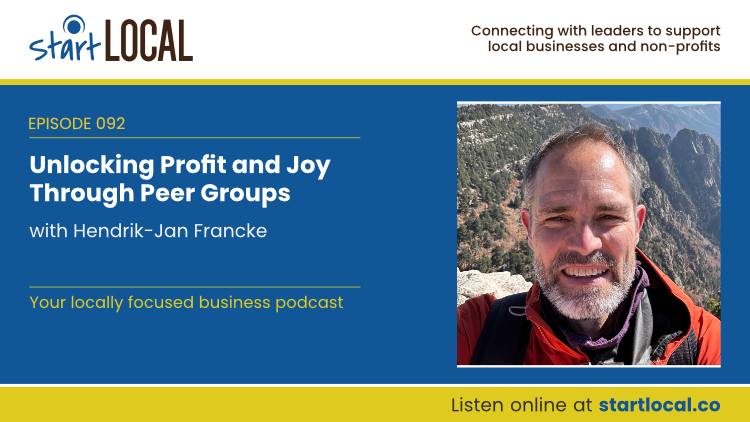
Business owners and leaders face many challenges, questions, and hurdles. Leaders at smaller businesses and organizations often address these issues alone. In this episode, we speak at length with Hendrik-Jan Francke, owner of Bright Orange Thread, to explore how peer groups can aid business owners and leaders to unlock both profit and joy in their work. Hendrik-Jan shares how these structured learning environments give leaders the space to step away from daily operations, think more strategically, and learn from the experience of others. We also discuss how the right group dynamic – shaped by thoughtful facilitation, diverse perspectives, and mutual trust – can lead to better decision-making, stronger leadership, and more fulfilling growth for both the leader and the business.
Links
Bright Orange Thread
- Website: brightorangethread.com
- Careers: brightorangethread.com/careers
- Remote job shadow: brightorangethread.com/remote-job-shadow-program
- LinkedIn: linkedin.com/company/bright-orange-thread
- Facebook: facebook.com/brightorangethread
Peer Groups
Additional Links
Related Episodes
- Empowering High Performing People and Teams with Bob Cox
- Changing Careers and Building a Local Business with Jason Feller
Intro: Welcome to Start Local, where we talk with business owners, leaders of nonprofits, and other members of our community focused on doing business in and around Chester County, Pennsylvania. Each episode will provide insight into the local business scene and tell you about opportunities to connect with and support businesses and nonprofits in your local area.
The Southern Chester County Chamber of Commerce promotes trade, commerce, industry, and sustainable economic development while supporting a diverse and growing marketplace. The Chamber is proud to partner with the Start Local podcast to raise the profile of businesses and nonprofits throughout Chester County. Learn more about the chamber at scccc. That’s scccc.com
Liam Dempsey: Hey. Hey. Welcome to the Start Local podcast. I’m Liam Dempsey, and I am here in our recording studio today with my friend and co-host, Erik Gudmundson. Erik, greetings, friend.
Erik Gudmundson: That’s me. How are you doing today, Liam?
Liam Dempsey: I am very well today, thank you, sir. I am very well. It’s bright and sunny, and I’m liking that a lot. It’s good to see the sun in the sky. I’m grateful that it’s still there for many, many reasons.
So before we get started, I feel like we do have to share this, Erik. That Erik is having some tree work cleanup done around his home today, and we may hear chainsaws in the background, and it’s not because there’s another massacre movie being filmed, but it’s just guys getting the job done for them. So, if you hear that in the background, that’s what’s going on. The studio is not under attack. We’re just having some maintenance work done.
Erik Gudmundson: Be nice if we could have a chainsaw or chipper shredder come in right on cue. But of course, Murphy’s Law dictates it will come in at the worst possible times. That’s just the nature of live recording, folks.
Liam Dempsey: Yeah, good luck with the mute button, Erik. Good luck with the mute button, folks.
Today, we are absolutely thrilled to welcome Hendrik-Jan Francke. He is the owner of Bright Orange Thread. Welcome, Hendrik-Jan. Welcome, welcome.
Hendrik-Jan Francke: Hey, thanks for having me. Very cool, very cool to be here even with tree problems.
Erik Gudmundson: Hendrik-Jan, I’ve known you for many years between Tech form of Delaware and all your marketing services at Bright Orange Thread. So thank you for all that over the years, and it’s a pleasure to talk a little bit more in detail today.
Hendrik-Jan Francke: Cool. Very cool.
Liam Dempsey: So, before the chainsaw starts, let’s jump in. And for folks listening, the bulk of our conversation is going to focus on community-based learning, and we’ll explore that in more detail as the conversation progresses.
But to kind of center our conversation, we’re going to tell you a little bit about Hendrick-Jan and his business. Hendrik-Jn, you are the Founder and owner of Bright Orange Thread, and that’s a user-focused digital marketing agency. You work with family-owned businesses to help them grow. So the question is this. Tell us about the work that you perform with your clients. What are you doing for them?
Hendrik-Jan Francke: In my 30-second pitch, I always talk about helping them end their random acts of marketing because we’re helping those family-run businesses. Maybe they have five, maybe they have 20 employees, but they’re coming to us because some of their tactics aren’t working.
And the very first thing we’re going to do very much on a marketing program is lay the foundation a little bit. Who are the clients that bring them profit? Who are the clients that bring them joy? And when we can do that, when we can sort out who their ideal client is, then we can figure out what tactics are likely to work, we can figure out what messaging is likely to work, and then we’re going to help them execute the strategy into the tactics and make that a fruitful opportunity for growth for them.
Erik Gudmundson: Staying with your client work at Bright Orange Thread, we open by sharing that you focus your services on family-owned businesses. How did you identify that niche as the right area for you to dive into?
Hendrik-Jan Francke: A lot of small decisions over time is really what it comes down to. You know, in the early days, you took business to have enough revenue to cover payroll from time to time. But then, in working with what we’re going to talk about later, with the Mastermind group, I learned how to be a little more financially astute, more organizationally smart about what I’m doing. And that, and also working on my own pipeline and sales process, allow me to start to look at my client list.
Where’s the profit coming from? But then I don’t recall exactly when and where, but okay, where’s the fun coming from, right? Where’s the people you enjoy having a monthly meeting with? You don’t mind calling them out, calling them up to follow up on things. So over time, I just said, I realized, found, figured out these are family-run companies, the CEOs of these family-run companies. So I very much focus all my marketing and messaging on attracting those types of businesses.
Admittedly, we’ve tracked a few folks outside that lane, but they’re really in the adjacent lane. But we don’t, I don’t work for the Fortune 500, you know, I don’t work for Restaurants, because there’s certain firms that just aren’t the right fit for us in certain ways. You know, we tend to work for clients whose lifetime value of their clients is like north of $10,000, you know, so $10,000 at a restaurant over five years would be a lot for one family to spend. But if you’re buying propane for the winter, five winters in a row, you’re easily spending, you know, that $10,000, or more so. Yeah, that’s how I got there. Lots of small decisions over time.
Liam Dempsey: Yeah, I like that. But before you got into starting your own agency, owning it as well, you were an assistant professor of art in the Department of Fine Arts and Visual Communications at the University of Delaware. As I understand it, you taught courses in portfolio preparation, advanced graphic design, interactive media design, graphic design, and I expect probably a little bit more that didn’t quite make your old resume or LinkedIn profile.
Hendrik-Jan Francke: Right.
Liam Dempsey: So if you had to narrow it down, Hendrick-Jan, to just one single item, and I appreciate this can be a difficult question, what is a single most fulfilling thing that you found about teaching, teaching design at that university level?
Hendrik-Jan Francke: Well, teaching overall and working with students as bright as the University of Delaware tracks and as hard working as the students going through vision vacations are, there’s that big picture that was really great.
The one thing, though, I think would probably be my favorite semester, let’s say, was probably the fall of senior year. I’ve already had them for four semesters straight. This is their fifth semester. This is the start of the portfolio class. And it’s when they really are stepping out into their own. They’re shaping a portfolio where they want to go someplace very specific with it. And I can remember a few students where, you know, I can help in this way, very specifically, being very provocative on certain areas of helping them choose the right kind of projects.
But for some other students, it might have been actually figuring out how to step out of the way and ask, did you think this through? Kind of questions just help them stay a little bit organized versus completely scattered. But that was always so much fun when they got into that mode. And there are just so many of them I can think about. They’re so different, you know, Brooke versus Andrew. They’re so different in terms of their life experiences and what they were doing. But it was phenomenal to watch. Yeah, that was just really neat to watch those kids get ready to go out in the real world with their real own ideas. I mean, kids with real ideas about what they want to do. It’s a lot of fun.
Erik Gudmundson: As I think about all the CEOs, I know many of them started in sales, but you were an educator and a designer before you opened your own company. So what made you decide to open your own business, Bright Orange Thread? And I’m also curious, how did you get its name? Because I remember that story ties into your educational roots as well.
Hendrik-Jan Francke: Okay. So, the – How did we get our name? I decided to leave the university. So this is like a year and a half out. I think it was like a homecoming weekend, but in the spring, and they all show up on Monday in class, and they got nothing. And it was, so supposed to be critique day, and they had nothing. And if I’d known better, I would have realized that, right? If this was, I know it had a lecture or something.
So I said, well, okay, I’ve been trying to rename my company, and I was failing at it being too close to it and everything else. So I said, okay, we’re going to just do one hour class. I’ll leave. But I need you to rename my company something better than what I had, which was Fran Bock Creative. And you’re like, what? Don’t even ask. But I said, as long as it’s better than that and as long as my friend agrees that my friend Ray agrees, then I’ll take it carte blanche. I was done emotionally fried. And they came back, and they said, ” Bright Orange Thread.
And this was the time when I was busy learning about the Internet, and it was a new thing, and almost every web design studio on the planet used a spiderweb as a logo. And this is how long ago we’re talking, right? And they’re like, well, you can’t do that. You can’t just do what everyone else is doing, which is exactly what good marketing is, right? You’ve got to find a way to stand out.
So they came up with the idea of Bright Orange Thread, which connects to the fact that I have a Dutch heritage. And if you ever see the Dutch at the Olympics or at the World Cup, you’re going to see a whole section of the stadium in orange. And the thread was that kind of linking, cobweb type thing they were connecting the dots on. And it’s been fun ever since. People give me orange stuff all the time.
I sew my business cards. I’m out of those. My logo. All I did was I found some ad in some fashion magazine. 100, no, 1,000 free labels for the back of your shirt that, you know, that gets stuck in the Back of your shirt all the time. I just typed that. I went in orange and gave them the name, and that was my logo. Boom. So, Bright Orange Thread. It’s been fun and easy ever since.
Erik Gudmundson: Well, that explains why you have such a great company name. But, tell me about how that educational background, that design background led you to becoming a CEO and actually opening your own business in the first place.
Hendrik-Jan Francke: I was always going there. I took Accounting 101 probably in ‘88 with my friend Sheidel. I think the only thing I learned from that class was basically a weed-out class for business majors was to hire an accountant and hire a bookkeeper. Stay out of the books. That’s the thing. The one thing I learned from a business class for me, because you don’t know.
Erik Gudmundson: Yeah, right.
Liam Dempsey: Yeah.
Hendrik-Jan Francke: And all that double. I mean, it’s just so I always knew I was going there, so it was just part of it. And then the day I started teaching, I opened my studio as a half-man studio. Right? A biology professor teaches two classes and goes off into the lab. Well, I taught my three classes, and I went back home and started designing and so forth. So that was always just going to happen.
Liam Dempsey: So now that we have this context in place, let’s turn to your work about group learning and, more specifically, group learning for business owners and business leaders. And some folks will know these groups as masterminds, peer groups. They have all sorts of different names. We’re by and large talking about the same thing, realizing that each group brings its own identity and its own kind of structure, if you will. Hendrik-Jan, the question is this, why do you embrace these group learning environments as an avenue for business growth and success?
Hendrik-Jan Francke: I think for a certain set of people, and I’m one of them because I’ve been in them for many, many years now, since 2007 or 8, they provide an environment for you to stop and think about your business instead of getting lost in your business, working in.
I mean, you literally show up, and you’re blocked away from the world, you’re blocked away from your company, and you can’t answer emails, and you can’t write all that stuff, and you can focus on thinking about your business. So, and they offer you a chance to bring your issues. What are you struggling with this month or the past quarter that you want the power of the group to talk about? You have a diversity of perspectives that people will share. And it’s uncanny how often you’re listening to someone else process their challenge. They’re struggling with an employee, they’re struggling with profitability, and they’re struggling with finding a new facility to move operations to. How much you can learn, even though it’s not your moment right now, it’s not your issue, but you can learn from what they’re going through.
And that, all those little lessons are just phenomenal. I often say that I got my master’s in business administration, right? My MBA. I often feel like I got that from my mastermind groups, just all the little education lessons I’ve gotten from it.
Erik Gudmundson: I’m in full agreement with you about the utility of peer groups. I find them professionally rewarding as well as personally rewarding because there’s no other better group of empathizers than your peers. So it really helps to just be a sanity check or sometimes a reality check when you need one. You need to adjust a little bit.
And one of my favorite things to do from them, and listeners have heard me say this before, but you know, learning from other people’s mistakes is a wonderful opportunity because you’ve been involved in these business learning groups or peer groups for such a long time. I won’t ask you to recommend one group over another, but I would ask you to tell us about which group had the most profound impact on the development of your business’s success, both as a business itself and your personal growth as a business leader.
Hendrik-Jan Francke: It’s impossible to pick one. I’ve been a part of two significantly. One was run by Vistage, which is a corporate version of it. All that really helped me on the strategic side, the operations side. A few of the folks in there helped me with hiring. They helped me with certain kinds of financial tools to really help move forward as well as just strategic decision-making kind of things, really important for…
And I really got so much out of that group. But I did. I had grown. I had employees, and dealing with employees and being a leader. Those things were not as front and center for that group’s like there weren’t a lot of challenges for me to learn from others, with people who weren’t talking about that very often because there were a lot of solopreneur consultants in that group. So, I switched to another group run by Stan Diver. Very different vibe to it. I mean, still a mastermind group, very differently done, and a different set of people in the group. Much more diverse in terms of types of businesses. The roles people play in those businesses, as well as gender diversity, were significantly different.
I left kind of the, you know, the white male-dominated group into a much more mixed group, which is very phenomenal. Because that diversity of perspectives was really helpful. And considering how many of my employees have been females over the years, that was just significant to sit in that room with three other women business owners and how they think about things and so on. So both are very fundamental in different ways to how we’ve grown, how I’ve grown as a business owner and leader.
Liam Dempsey: Yeah, yeah. You run at least two mastermind groups, the Roundtable via the Southern Chester County Chamber of Commerce, of which we are all members, and this podcast is a partner. And you also run a group called the Ascend Group. And these two groups bring together different business leaders to learn from each other and to grow with each other. And given what you shared so far, I expect that these two groups will have different focus, different structure, different emphasis. But tell us how these two groups differ, really. We know they’re masterminds. What separates the two from each other?
Hendrik-Jan Francke: The round table from Southern Chester county is really a group for the… And the chamber is full of the younger starting up type businesses. And there’s not, there’s almost no consultants in that group. It’s just they’re business owners, they’re working in the business, they’re working on the business. They’re probably one to two years into their journey as starting a business, maybe even a little bit more. But I often think about the definition being under five years of experience and all kinds of things from catering to accounting and so on.
So…And we meet for two hours on a Friday, one Friday morning a month, and we share. I sort of set up little exercises, thought exercise is really the best way to, you know, five minutes of homework, walk-in, be prepared and share kind of thing.
The Ascend Group is much more targeted for consultants or leaders of companies with 20 or more employees, people with 10 years experience in the, in a particular area of the field in consulting or the business itself. There’s a lot more business vocabulary thrown around in that group. And you know, I fake it when they start talking about EBITDA and some of those other things like earnings before interest, something and something, you know, but I can rely on someone in the group to help me get caught up in certain ways in those aspects. But yeah, bigger business vocabulary in there. So it has a different, they both have different tones, but…
And then in the end, I think one of the big satisfactions is exactly the same for both groups. Walking into an atmosphere where people understand you, where your significant others don’t understand you as well, where you can talk about issues without the pressure of like, oh, does this, is this going to be risky for us? Does this mean we’re going to have to sell the house? Right. None of that, you know, safe discussions that allow people to share and vent and get a backbone and so forth. So it really, really does help them both. The end result, ROI of both is sort of the same, right? People helping each other move their companies forward.
Erik Gudmundson: And time is so important for members of groups like that because they’re all entrepreneurs, they’re all being pulled in a million different directions. And that time in the peer group is a time to focus and really be there and truly work on their business. So for group learning to bear fruit in the most efficient way possible for its members, like you were saying, the conversations require structure and curation.
So two questions on that for you. Why is structure so important for these groups, in your opinion? And then how much does the philosophy of the group facilitator affect the tone, focus and drive of the cohort? You know, sometimes when you’re trying to measure a peer group and if you should participate or not, you might look at the facilitator and other times you look at the members and how do you, how do you analyze that and how do you keep it going and keep it vibrant for the members?
Hendrik-Jan Francke: Keeping it vibrant. Starting with the last part first, I’ll devise a little bit of homework so that we can have a fruitful discussion. It’s amazing how 10 minutes of preparation for a one hour meeting can make a one hour meeting feel like a half day seminar. Right. Whereas if you don’t prepare for the meeting.
So it’s the same thing for us for both groups. So for example, for the round table, there’s this idea of one way doors and two way doors for your decision. A one way door decision is one you cannot reverse. I’m going to pick up the company and move to Seattle. That’s a heck of a lot of work. You’re very unlikely to reverse that. But you know, we’re going to, you know, we’re going to lease space in the neighborhood that might be more of a two way door. So we define those things. And I just ask people to watch. Jeff, it’s from Jeff Bezos of Amazon. Right.
And so I set up an exercise like that. Give them a little homework and then we come in and talk. What are the one way decisions you’ve made in the last year? What are the two way decisions? And just by each member sharing, they get a lot of insight into what different people consider irreversible and what some people consider reversible.
And that can open your mind. Oh, I would have never thought that as two way, but maybe you’re right. Maybe I don’t have to plan this out to the nth degree to get to make this decision. I can just make a decision and back out of it. So that’s, that’s one part of structure which also answers the last question.
But the other part of structure is just from day one coming in, having an agenda. And then for each part of the agenda, how are we going to process this? How are we going to handle this part of the agenda? So we, for example, we help each other process challenges. So that means the person who has a challenge will describe it for five minutes, then everyone else can ask questions, and then everyone can make recommendations and I’ll articulate that process ahead of time and then as we do it, and that way people know what to expect by just providing the tiniest bit of guardrails. They’re all smart people, they’re all energetic people, they all want to help, they’re truly motivated to help each other. So with the tiniest bit of guardrails, they just, they just float right along with it. And quite often they honestly do a good job breaking the guardrails at the right time too. I mean, it’s kind of interesting how that happens.
Now, every sometimes people, like people want to recommend rush to recommendation. They think they got it nailed, and that’s fine. We just asked you to hold. So every so often, I do kind of have to say, excuse me, I think that’s a question veiled as a rep, as a recommendation. And you know, that’s kind of a joke among the groups because it happens a few times, and the newbies will often hear it a time or two, and then it just takes care of itself. I’m just trying to make sure. Another part of it, too, is there’s the busy talkers. The groups need kind of both sets of people, people ready to jump right in, share some information, share some ideas.
And then you also need the people at the end, the people listening to one by one, someone who can almost summarize everything and stitch it all together and give it. So I have to create room for both people to talk. So I’m thankful for the people who jump in to talk quickly and earnestly. But then I sort of ask them to take a step back. So the quieter folks, the ones that step back, can also have a voice. And I make it very clear that I want everyone to almost have an equal voice. Throughout the morning.
Liam Dempsey: So let’s stay with the group dynamics for a moment there. And certainly any group. A group conversation couldn’t go off the rails for any number of reasons. Perhaps a leader’s airing their business challenges and they get into unproductive areas. How do you go about returning that leader in the wider conversation to a constructive vein? You kind of touched on it a little bit in your previous answer, but can you just unpack that a little bit more for us?
Hendrik-Jan Francke: Well, as a facilitator, I probably spend a lot less time thinking about ideas, questions, and solutions than the members of the group. I’m more listening for. Are they… Are questions and recommendations on track? Right. Are they what the person asked for? So, but every so often, the group can start to unpack it in a very interesting way. And I’ll just ask for a pause and say, look, I think that so and so asked for X, but I really sense that we’re talking about M, you know, and how do we. And I’ll ask. I’ll ask the person with the challenge. Is that what you want to do? You want to stay with what you came here for, or is this really interesting to you, this new idea, these new thoughts that are coming out and do you want to explore that more? And then they ask for what they want, and then off we go again.
And I think the participants. Oh, right. They were so busy. They didn’t. They’re not paying attention the same way a facilitator would. Like I said, as a facilitator, I’m not always able to make great recommendations because I’m more listening and guiding. And it’s just about a few gentle touches here and there. Yeah, but I need to remind myself of this, actually. But gentle touches, right? I call it compassionate authority. It’s a term I picked up from a podcast about some leader and how, you know. And her point was, if you’re going to interrupt, do so with compassionate authority. You don’t need to apologize for it. You just need to give a good reason for it, and everyone gets right on board. So, yeah, compassion authority. Gotta remember that a little more.
Liam Dempsey: That’s a great phrase.
Erik Gudmundson: That makes perfect sense. And it also helps to encourage more people to participate. And you get those ideas even from the introverted folks and the folks who don’t normally be the first to raise their hand in class. So that’s wonderful. That brings me to my next question. You were born in the Netherlands to Dutch parents, and you moved to AmErika when you were just a young boy. So we understand you still return regularly to the Netherlands to visit your family. And so you have that Dutch perspective still. And I’m wondering how your Dutch background influences your approach to business, and does it have anything to do with that inclusivity?
Hendrik-Jan Francke: In that regard? I feel incredibly AmErikan. I don’t feel particularly Dutch. I started a business, not many of them, I don’t know any family members that have done particularly that. I don’t think that’s as easy, and let’s just start a business and launch it. I don’t know for sure, but you know, I just feel like that part of my story is quintessentially AmErikan. I think the Dutchness that I bring is the Dutch are known for being very direct. I can be pretty direct. That’s why compassionate authority is important to me. Right. Like you notice me saying I have to remember it because I can just say it like I see it. And that can be a bit brutal sometimes. But I think once people get used to me a little bit on that front, it’s no big deal. They just realize where it’s coming from. But yeah, being compassionate, remembering where the other person is at things, is really a big deal for me. So, on the other side of things, I’m just not so sure. Just not so sure.
Yes, I go back, but you know, it’s for family. It’s for family, and I’m not exploring it in the same kind of way. I mean there’s many systematic things I really admire about how the Dutch do things with water, with farming, and bikes and the bike paths. I mean, that stuff is phenomenal over there. But, I don’t have a lesson that brings me into business. Well, yeah, oddly enough.
Liam Dempsey: So mastermind groups regularly meet once a month, twice a month, something like that, all kinds of depending on the group. And, it’s typically for at least an hour and sometimes two. As you shared about your own group that you’re leading. So that’s a lot of time over the course of a 12-month period. And I’m, I guess, what I’m wondering is pretend I’m a cynical business leader, wondering about the ROI for attending a group. How do you define ROI, and how do you do that with group members who are coming with their own definitions? How do you present, here’s an ROI that you might care about, here’s how the group can deliver value. What does that look like? How do you walk through that in the initial stages?
Hendrik-Jan Francke: If I’m talking to a prospect, I might more talk about coming to these meetings will give you insights that will allow you to make better decisions. Whether it’s a daily, monthly, you know, whether it’s something that has a repercussion for the day, for the week, for the month, for the quarter, I think you will come here and get some ideas to help you make better decisions. So the stress of that is not all on you, and you don’t feel like you’re really.
Is there not some other thing I could have thought of to do this better? You won’t suffer from that. The long-term ROI is probably just more confidence that you build that people walk around with afterwards. After a year of being a part of something, after five years of being a part of something, it just gives you so much more confidence in your decision-making process that yeah, I would think those.
There’s no ROI that’s very measurable. Right. I mean, that’s just really hard. You’re still in business. I mean, I’ve seen people join groups and realize business ownership is not for them. You know, they’re a six-month participant, and for the group, that’s almost a bad thing. Like they don’t. You didn’t really get their contribution, but thankfully, they figured out what they wanted, and that’s really helpful to them. And maybe they got there faster. They probably got there faster by listening to all these things going around the room. Yeah.
Erik Gudmundson: We’ve heard you talk a lot about profit and joy. Not as a, or as a single phrase. Not profit and joy separately, but profit and joy. That’s an important nuance, I suspect. So, would you unpack why you emphasize the phrase profit and joy?
Hendrik-Jan Francke: We all should have fun while we earn our living. It’s really that simple. I want my employees to have a good salary, and I want them to enjoy coming to work. I think of that phrase, if your employees don’t like showing up at work on Mondays, that’s your problem. Mr. Boss, I think that just so resonates with me, and I think for my clients it’s the same idea. Right. I mean, why not help them bring more clients that they enjoy working with, the kind of work they want to do, versus less of what they don’t want. I just, it just makes so much sense, and I don’t think we should be. I think some people struggle with the two words slammed together. Right. Really? Are they the same thing? No, but they certainly need to work together for us to have a good life.
Liam Dempsey: Yeah. I like that. I like that. Profit and joy. Profit and joy. Let’s go back to the Ascent group. We talked about that briefly at the start of this conversation. And that’s a peer group that you’ve organized with a couple of our Southern Chester County Chamber of Commerce colleagues, fellow members Bob Cox of Build High Performing Human Capital and Dave Whitwell of Whitwell CFO.
Side note, Bob was on the podcast in a previous episode, so we’ll include a link to his conversation in the show notes for this over at startlocal.co. But the question then is this, what’s the focus of the Ascend group? You touched on that talk to us a little bit more. And are you looking for members of that group? Are you actively growing? Are you at full capacity? Tell us about when you meet, how you meet all the kinds of things. Do a little sales pitch for it, if you would.
Hendrik-Jan Francke: Oh, okay. Well, both groups are looking for members for roundtables. Friday, second Friday of the month, Friday mornings, 8 to 10ish, something like that. The Ascend group is the third Wednesday of the month, 7:30 to 11:30 am Bob, Dave, and I participated in one of my other masterminds, my earlier mastermind experiences. We became friends.
Outside of that, I think we’ve become very influential in each other’s business in some extra ways beyond that group. And it’s been absolutely fun to set this up with them and get things going. And we’re rotating facilitation.
So Bob does a month, Dave does a month. That way we can each be members, right? One month you’re tuned in one way, the other two months you’re tuned in the other way, and so on. We are looking for more members for both groups for Ascend again, those businesses with, you know, either you’re a consultant working with companies, 20 or more people, or you run a business of that size as the CEO, the leader of it, the organizer, that kind of thing.
And what’s really cool is just, you know, I’ll come up with some ideas for that group, think group discussion type thing, as the exercise part. And Bob and Dave just do some very different things. I mean, Dave Whitwell, CFO, right. You know, he’s brought in the fact that we should all have KPIs. I’m like, okay, but then I want everyone to have a KPI that shows they’re finding joy in the company. Right?
Liam Dempsey: I love it.
Hendrik-Jan Francke: Like my one KPI is I limit myself to 12 clients. That helps me find joy. And it also gives me some sense of my revenue confidence and things like that. I have one KPI that does both, but that’s Dave Whitwell for you. You know, he wants some numbers. Financial health, CFOs, of course, worried about that.
And Bob Cox is building high, high performing human capital. You know, how do you think about team members? How do you think about relationships with clients? And he’s bringing that kind of thinking there.He did an exercise for the group around uncertainty. Right. And getting people to tap around the anxiety in the markets, in the atmosphere, and what that might do. So again, just different folks, different strokes. But we all work together in some good ways, I think.
Erik Gudmundson: Hendrick Yon, we can’t finish an interview with you and not ask about your love for soccer. Liam is a big soccer fan as well, and I’d like to know what parallels you see between doing a team sport like soccer and mastermind groups and business in general. And by the way, you also have to tell us what team you like at the risk of upsetting Liam here at the end of the podcast.
Liam Dempsey: Won’t upset me. Won’t upset me. Won’t upset me.
Hendrik-Jan Francke: The parallels. The parallels I see are in coaching, right? The coaching players facilitate a discussion. It’s kind of funny. I. I believe in ending all the mastermind groups with.
So what are your takeaways from today? I do the same thing at the end of practice. What’s your takeaway from today? And each player comes up with a different thing that they really focused on or noticed. Oh, you know, okay, coach. Right. I got to get him. I love fett better. Yeah, there’s so many parallels there in terms of those things. My favorite teams are Manchester United, which has been very hard for a long time now. What’s that said?
Liam Dempsey: Okay, maybe you might get a little upset.
Hendrik-Jan Francke: Are you Liverpool?
Liam Dempsey: No, no, no, no. I’m an Arsenal fan.
Hendrik-Jan Francke: Arsenal fan. Oh, well, yeah, okay. Yeah, well, we just got you two zero not too long ago.
Liam Dempsey: I’m sorry.
Hendrik-Jan Francke: A little resurgence that’s happening.
Liam Dempsey: What’s your league table rank for third?
Hendrik-Jan Francke: Yeah, okay. Yeah, yeah, okay.
Liam Dempsey: Sorry, folks out there, and listener lander don’t care at all.
Hendrik-Jan Francke: My apologies.
Liam Dempsey: Go ahead.
Erik Gudmundson: That’s some serious inside soccer there, folks. Inside soccer.
Hendrik-Jan Francke: And then I’m a big time fan of the U.S. Women’s national team ever since they won in 99. My doctor, my daughter. Sorry. My daughter grew up playing soccer, and so that became just a natural thing to start falling. And now I’m just completely hooked. And then follow the Washington Spirit.
Now, the recent team I’ve picked up, Driving down D.C., is just a little bit much for a soccer game. But the way the style plays they’ve got going right now, Lacey Santos, Trinidad Rodman, Hal Hirschfeld, I just think it’s Tara Rudd. I just think there’s some phenomenal things going on in that club.
Liam Dempsey: Yeah, the women’s game globally has really, really, really come on in recent years, and it’s just been fantastic to watch, just the level of talent and seeing the stadiums get more crowded and busier and more sellout crowds. Yeah, absolutely. And yeah, the women’s, US Women’s team is night and day above the men’s team in terms of overall performance. It’s pretty amazing.
Hendrik-Jan Francke: Yeah, it is pretty amazing. It’s just phenomenal to watch. Yeah.
Liam Dempsey: All right, well, for the non-sports fans, or more specifically non-soccer fans, we’re going to get back to our regular programming schedule. Hendrik-Jan, you’ve been with these different learning groups for so many years. You’ve been involved with the chamber for so long. You know, a lot of businesses in and around our area. You know, a lot of non-profits in and around our corner of the world. Can you name a local business or a known non-profit that more folks should know about?
Hendrik-Jan Francke: I have a soft spot for Taste Local Eats. It’s a young, it’s a younger business. No, no, I don’t. Not young anymore. I’ve been using them for years. They take, they’ll make a gift basket out of all the local stores and the teas from Mrs. Robinson, all kinds of different things. And they put together a package for you that you can gift from business to business, kind of thing.
And so they use. What is that Crinkle? I think it’s crinkle. I think it actually, they make mine out of all orange crinkles and stuff like that. And they had an icing put on a Rice Krispies treat with my logo printed on it. It’s just a really nice idea about being local, and I’d love for her to just grow and be huge, and so forth. They also have that Taste Kenneth Square Food tour, which is really cool. So I really like Taste Local Eats.
And then New London Counseling Center over there in New London. How they are providing counseling for all. But they also have these scholarships, right? They’re actively raising money so they can offer scholarships so that people can make a partial payment or completely free, get the help that they need to think through some issues to deal with things, difficult moments in their life and so forth. So they have a wonderful walk coming up in May. That’s at… Oh geez. The names totally excavated me in the park over there.
Liam Dempsey: Well, we can definitely just link to their website over at starlocal.co and you’re the second, second guest that we’ve had on that has sung the praises of the new London Counseling Center. Jason with Crystal Clean Cans gave them a big shout out for many of the same things that you’re talking about. So I’m delighted to hear that, and as I said we’ll, we’ll include a link to them over on the show Notes at startlocal.co. And thank you for Taste Local Eats. I’m gonna have to check them out. I love that idea, and I’ve not heard of them. So thank you for coming on the show for no other reason than that alone. Hendrik-Jan, I appreciate your time here.
Erik Gudmundson: Are you hiring at Bright Orange Thread? And if so, where can folks learn? What positions you need filled at the very moment?
Hendrik-Jan Francke: We are not hiring, but I do hire at least once a year. An intern and then sometimes a writer. I think my employees often, you know, they can outgrow Bright Orange Thread in two to four years, depending on the challenges they faced in terms of account management, marketing, and so forth. So, there’s a careers page on the website so they can visit that and look at those experience.
We also have a job shadowing experience. So if there’s a young person who’s interested in marketing, wants to know what a marketing, a remote marketing agency would be like, how that day works, they can attend three different virtual meetings with us and see how it goes.
Liam Dempsey: That’s really interesting. Is that on your website as well?
Hendrik-Jan Francke: Yeah.
Liam Dempsey: Thank you. Through your leadership with these groups and through the chamber, again, you’re giving a lot to our local business community. And I’m wondering how our business community can support your business, Bright Orange Threat?
Hendrik-Jan Francke: Well, first off, I’d like them to help the two groups if there’s a, both groups could easily use four more members, and that wouldn’t be a problem. We’re humming along great, but you know, turnover will happen, and diversity is always very much welcomed. So someone who is willing to learn about, you know, stop and think about their business is really critical. And for Bright Orange Thread, if you feel you’re practicing a random act of marketing and you’d like to talk to me, happy to chat with you. If I can’t help you, I know some people who probably can.
Liam Dempsey: Hendrik-Jan Francke, owner of Bright Orange Thread, where can folks learn more about your business, more about the Ascend Group, and more about the roundtable through the Chamber?
Hendrik-Jan Francke: Well, hopefully we’ll put links in the show notes.
Liam Dempsey: Absolutely, we will.
Hendrik-Jan Francke: But yeah, if you Google Bright Orange Thread, you find Bright Orange Thread. The Ascend Group, we’ve not done. It’s brand new. We don’t have a lot of search engine optimization for its brand name on there.
I guess go to my website, find my email [email protected] or [email protected], and the Roundtable should be if you Google S, 4C’s, SCCCC, and Roundtable, you should find that page pretty easily, I would think. Again, if you’re interested in that, I do do the preliminary meeting with the possible members ahead of time. So yeah, yeah.
Erik Gudmundson: Hendrik-Jan, thank you very much for coming on. I really appreciated getting to know you a little bit better here on this call and finding out more about these peer groups that you’re running. So they were, that was really, really excellent information. So I appreciate that. Thank you also to my co-host, Liam Dempsey. I’m Erik Gudmundnson.
The Start Local podcast is published every two weeks. We invite you to subscribe to Start Local using your favorite podcast app or ask your smart speaker to play the Start Local podcast. You can visit our website at startlocal.co for show notes, including links mentioned on this show and summaries of past episodes.
We hope you join us for the next episode. Thank you for listening.