Podcast published: March 6, 2026
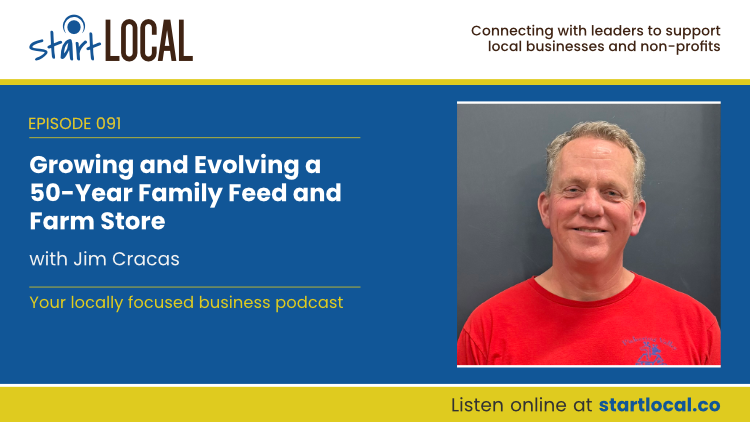
Whether it’s feeding a family pet or planting a backyard garden, many people in our community turn to local stores that help them care for the things that matter at home – and on the farm. We sit down with Jim Cracas, owner of Pickering Valley Feed and Farm Store in Exton, Pennsylvania, to talk about running a family business that has served Chester County for over 50 years. Jim shares how the store has grown from its roots serving local farmers to helping today’s pet owners, gardeners, and farmer owners. We also discuss the role his store plays in the community, from hosting pet adoption events to building long-standing relationships with customers and employees. Jim’s story offers a glimpse into what it takes to keep a local business strong over time.
Links
Pickering Valley Feed & Farm Store
- Website: pickeringvalleyfeed.com
- Facebook: facebook.com/pickeringvalleyfeed
- Instagram: instagram.com/pickeringvalleyfeed
Additional Links
Intro: Welcome to Start Local, where we talk with business owners, leaders of nonprofits, and other members of our community focused on doing business in and around Chester County, Pennsylvania. Each episode will provide insight into the local business scene and tell you about opportunities to connect with and support businesses and nonprofits in your local area.
The Southern Chester County Chamber of Commerce promotes trade, commerce, industry, and sustainable economic development while supporting a diverse and growing marketplace. The Chamber is proud to partner with the Start Local podcast to raise the profile of businesses and nonprofits throughout Chester County. Learn more about the chamber at scccc. That’s scccc.com
Liam Dempsey: Hey, hey, welcome to the Start Local Podcast. I’m Liam Dempsey, and I am here yet again, as always, with my good and faithful co-host Erik Gudmundsson. Erik, how are you, sir?
Erik Gudmundson: That introduction gets grander and grander every time. I don’t know, Liam, I’m doing very well, that I do know. And, uh, we’re not talking about food today for people, but we are talking about food for, for animals, so I still like the topic.
Liam Dempsey: Yeah, no, I’m excited for it. And it gets grander and grander, I think, because the longer I know you, the more I like you, the more I respect you. You’re good people. You’re a lot of fun to be around. And I get a lot of value from our friendship. So thank you for that.
Erik Gudmundson: Aw shucks. Well, the feeling is mutual.
Liam Dempsey: Oh, there you had it now, folks. That’s going to be in the transcript too.
So, turning to the guest, you just heard him laugh. We’re really pleased to welcome Jim Cracas. He’s the owner of Pickering Valley Feed and Farm Store. Pickering Valley Feed and Farm Store is right next in Pennsylvania at the corner of 113 in Gordon Drive. Welcome, Jim. Thanks for joining us today.
Jim Cracas: Thank you for having me. Glad to be here.
Erik Gudmundson: Jim, welcome. I’m excited to get into the conversation.
Jim Cracas: Good, so am I.
Liam Dempsey: Well, let’s do— that’s that. Let’s get right into the conversation.
Jim, you’re now the second-generation owner of Pickering Valley Feed and Farm, and that’s a store, for our listeners if they’re not familiar with it, uh, well, you sell animal food and farm-related products, is the big umbrella as I describe it. You’re based in Exton, and you’ve actually been at the same location for 50 years, the same actual building for 50 years. I was really surprised when I learned that. We’re gonna get to a detailed review of all your store’s products in just a bit, but let me start by asking you, what’s it like? What do you actually do at work as the owner? Where are you focusing your energies every day?
Jim Cracas: Well, I think the worst part of it is probably the stuff I do in the back. So if you’re talking about planning for events, if you’re talking about staff stuff, if you’re talking about buying or even the joyous fun of accounting. Um, those are all things that have to be done, so I do them. Um, my personal favorite part is to actually be out front talking to the people, interacting with customers, and trying to make sure my staff is greeting them the same way that I would greet them. And would interact with them the same way. So it’s a lot of it is a— that’s the part I’ve always felt that I do best with. The rest of it I have to do, so I do it. But that’s the normal part of my day. I mean, a lot of times I’ll start the day off upfront and then— but then in the middle of the day when I have more people here, then I have to get to the bones of the operation, which is— I have to do.
Erik Gudmundson: Well, Pickering Valley Feed and Farm has something like 19,000 square feet of indoor retail space. Then there’s even more retail space outside, especially during the growing seasons. It would take us entirely too long to walk through the entirety of your store, but could you please highlight what you sell at your store?
Jim Cracas: Well, as you’ve mentioned, we do a lot of food for animals, and that’s whether you’re talking about feeding your crickets or whether you’re feeding your crickets to something, or whether you’re feeding your dog, your cat, your horse, or your cow. So our slogan has always been the only place Noah could shop, because we really do feed pretty much everything. We’ve actually sold feed for elephants. So it’s We even had a customer that owned a zebra. So it’s— we do a lot of esotErik, but obviously the majority of people own dogs and cats and horses and things like that.
That being said, the other thing that we also do, as you also pointed out, is that we do have a lot of— we do use a lot of space outside for our lawn and garden. So we get a lot of plants in. At Christmas time, we sell Christmas trees. In the fall, we sell pumpkins. But we— our big thing is in the spring when we sell all the plants out front. And then even along the side of the building, we sell pond fish and pond plants. So it’s, it’s a— there we try to eke as much out of this space as we can. And it can be trying, but we’re getting better at it every year.
Liam Dempsey: So, as we shared at the opening, you’ve been around, your store has been around since 1977. And inevitably, if you’re still in business today, 50 years later, you’ve had to evolve. So how has the shop changed since its founding? Is it different products? I mean, no, it’s the same location. So what has changed?
Jim Cracas: Well, one of the biggest things you can change is that you were talking about the size of the store. I mean, when we started, we were 6,700 square feet. And now if you— and that’s all inclusive, that included the warehouse and everything. Now, if you include all of it, we’re 25,000 square feet. So that’s a sizable difference. Plus, we also have an off-site warehouse as well where we store even more stuff. So it’s grown considerably. We also now have a lot more employees to make all that happen.
But one of the biggest differences is when we first opened up, my— what, obviously I was here, but I was 8, so it’s a little bit different. Um, but my parents’ big goal was, is to, to— we had had a chicken farm, and we had also had, um, a farm. So we had a feedlot, we had some cows on our property where I grew up, we had 14,000 chickens where I grew up. So their big idea is to supply farmers in the area.
Well, obviously that has evolved because there aren’t as many farmers as there once were, the, um, so our biggest thing we probably did was is that we went ahead and we went from farming to pet. Although the most interesting thing in my opinion is that in the last 6 or 7 years, our sales of what I would consider farm, although it’s now more horse and, you know, gentleman farms, have gone up considerably. And I just think that’s an interesting change from what we’ve— what we’re used to.
Erik Gudmundson: That is an interesting change. And I say that as a gentleman farmer, so I’m one of those people exacerbating that trend for you.
Jim Cracas: Um, and we’re not complaining about that.
Erik Gudmundson: That’s okay. Well, as you shared, your store’s been around since 1977, and I imagine you’ve done a lot of things to stay relevant and also stay in business, you know, in addition to the things you mentioned, or maybe to get into some more of the specifics of it. So what else has changed since its founding? Different products, different manufacturers? I’m curious if there are some other macro trends you’ve been able to identify.
Jim Cracas: Well, back when we started, we had, I think, I wanna say we had 3 or 4 varieties of dog food. We now have 50 brands of dog food. Wow. So it’s obscene, the expanse of how many things we now offer. Don’t get me wrong, there’s a lot more that we don’t carry, but it’s surprising how many we carry. And we don’t carry them if they don’t sell. So it is something that the breadth of what we carry has gotten quite significant.
There was a time where we sold 50 or 60 bags of a single kind of dog food in a month, and now we don’t because we sell so many different kinds that it doesn’t— there’s not— it’s not as singularly focused because people want what they want and they’re not just going to take whatever you have. So we do have to change to that.
The other thing is that, for instance, like I said, we grew up on a chicken farm. I grew up on a chicken farm. One of the things that has really grown our business in the feed end of it, or the gentleman farmer business, is the number of people who now own chickens. You know, I own 14,000 of them, so I didn’t have quite the same— I don’t have the desire to have them in my house or near my house since I had them for 12 years. But it is a— it’s a large and growing market, and it’s some people do it because they want the eggs. They want to either know where they come from or they want to know, um, that they don’t have to worry about running out.
Um, but there’s also— I personally think the vast majority of them, they may even— even the ones who start that way, they become pets. The majority of who are selling— that’s another one that we’ve evolved. We used to order in for people, what they call meat birds. So people would raise them and eat them eventually. Well, I think part of it is that they realized how difficult that is. And also, once they raised them, they didn’t really wanna eat them. You know, because most—
Liam Dempsey: Yeah, that can get awkward in a hurry, especially if you have children, yeah.
Jim Cracas: Well, that’s right, most of them have names.
Liam Dempsey: Right, right, and probably not if they had 14,000 of them. I feel like—
Jim Cracas: Ours did not.
Liam Dempsey: Some of our guests have shared really interesting, and totally not super on point thing for our podcast to explore, but I would love to talk to you over a few beers about 14,000 chickens. But instead, I’m gonna jump into our next question, and it’s really about keeping your business afloat, right? So, since the pandemic, shops like Amazon have just exploded in what they can deliver to our house tomorrow. And even Chewy and Walmart are all doing it now. And if I suppose in some ways that works if we know exactly what we want and we need it. But how do you as a business, as a local business where you’re not in a position to get something to somebody on a regular basis tomorrow or same day, how are you differentiating yourself? How does your store do that?
Jim Cracas: Well, one thing I will say is we do a fair amount of delivery. However, it’s not the next day normally unless you call us on the right day. So in other words, you get a certain day of the week, they’ll be generally going to be in your area, and we deliver. So we do some of that. However, one of the things that I’m sure a lot of people— you’ve asked that question before, I’m sure— and a lot of people, their answer is we provide better service. And I, and I very much believe that’s true.
However, the other thing I will say is that I believe we provide a sense of community. And what I mean by that is when people come in, they’re not just looking for a product. I think it’s also that they look at us as friends. They get to know us, they’ve known us for years, or they come in, and we’re just— we tend to be very outgoing and gracious, and it allows people to develop a relationship with us. That was driven home most for me when I was actually, um, when I had, um, COVID, and I was actually put on a ventilator, and it was all over the internet that I was going to die. And in fact, it was actually announced that I was dead, but obviously, they were wrong. The, um, it was an interesting thing to see how many people reached out to find out how I was doing, and it was very uplifting because it really did make you realize that you’re truly part of a community. It’s not just a dollars and cents thing.
Erik Gudmundson: Yeah, the community aspect of it just seems incredibly valuable to me. And you talked about the depth and the breadth of products available at your store, and that’s, of course, impressive. But your customers are relying on you and your team for accurate information about how best to use this product or that, what feed is best for their dog with this condition or that. How do you ensure your team is educated on all the products that you’re selling?
Jim Cracas: Well, we do a lot with trying to educate the staff, whether it be an informal thing of when I’m talking to somebody about something, they’re standing nearby so they can pick that up as they go, or whether we have a vendor come in and actually do a formal sit-down training on a product. And when they— when I do have somebody come in to do that kind of thing, one of the things I’m very specific about is I do not want, it’s just about their product. And I don’t want them slamming somebody else’s product. I want actual education built in, not just, oh, we’re the best. I want to, I want to know why, and I want a scientific reason behind why. So it is one of those things that it’s, it may not be— we probably don’t do it as much as we should.
But one of the other things that you’ll find in— and that’s one of the things going back to the previous question, is that because we live in this area and we use the products we sell, we can, A, carry the products we know that work, and B, know how they’re going to work in your application because we live here. You’re not talking to somebody from Tennessee trying to figure out how to grow tomatoes in that soil when we don’t have that soil. So it’s something that I find that it’s— it adds a little bit of honesty to it. You’re not talking to an AI-generated algorithm. You’re talking to an actual person who’s actually done what we’re talking about.
Liam Dempsey: Jim, you own the building that houses your shop. You bought that in 2015. Right. So two questions for you then. Why did you decide to transition from occupant to owner? And maybe the bigger question is, how has the experience of being a building owner differed from your expectations in the 11 years since you bought the place?
Jim Cracas: Well, it’s an interesting story because we had actually gotten to the point where we were really getting too big for the space we were in. And it’s— I don’t know if it was a coincidence or if the gentleman who owned the building knew about it. Um, we had actually looked at buying it 5 years earlier. Before that, we’d even looked at moving down the street to a different location. That fell through. Um, so we’ve been kind of kicking that idea around. Um, but again, it was getting to the point that we just couldn’t grow anymore. And so we went ahead, and I started looking at other locations, and the guy who owned the building invited us out to lunch and said, ” Would you be interested in buying the building?” And so the answer was a quick, very quick yes. And we got it all— I got to get all the ducks in a row and everything else, and that took— it’s amazing to me, it took almost a year to get the whole thing done, but it’s not a small deal.
And the biggest change that happened is I’ve always had low blood pressure until I bought this building. So you go into debt up to about here, and all of a sudden, your blood pressure goes crazy. So nothing else to illuminate that. But anyway, the big thing that happened, it’s like I said, it was actually very fortunate in a couple of ways. One was that the— there was a space down the— down the sidewalk from us that was a big space, 6,000— over 6,000 square feet— that at the same time decided to buy the piece of property across the road from us. So they were moving out anyway. And then there was a little space in between us and I just moved them over to the side where I had a vacancy. And so we were able to open up the entire front of the building to use for our space, and some other things have changed in the back, and everything else.
So we’ve been able to really become much, much more efficient because we had an offsite warehouse where we were bringing stuff over every day and it was a lot of handling. And anytime you handle it, it’s expensive. So if we can keep it on site, it’s much, much better. So the stuff that’s at our offsite warehouse now is all big, bulky stuff where we bring an entire skid at a time. So it’s still not as efficient as having it all here, but the property values are what they are.
So it’s been a long journey. I told my wife when we did this, she thought I was crazy. And I said, it’s only gonna be, give me a year, 2 maximum, and I’ll have the whole place exactly how I want it. I know it needs a lot of work, but it’s gonna be fine. We’re gonna get it done quickly, and it’s gonna be no problem at all. It’s been over 10 years, and well, I’m still working on this building. So, so much for my theory.
Erik Gudmundson: Well, let’s talk about your time before you joined the family business. And I understand you served as an enlisted sailor in the Navy, specifically, you were on a nuclear submarine. So tell me a little bit about your role on the submarine and maybe how that has influenced some of your day-to-day activities or your larger directions there at the store.
Jim Cracas: Well, I was, uh, I was in high school, and I was looking at going to college, and I’ll be honest, I was a little bit lazy, never got around to filling out any of the applications. And this guy came by and said, would you think about joining the Navy? And I thought, well, that sounds dumb because I can barely swim and, uh, I get seasick. But I mean, other than that, what could go wrong?
And, uh, but then I thought about it. If I’m going to be in a submarine where I won’t get seasick as much, if I— if something happens, I’m gonna die. I don’t need to swim. It does— I really can’t make a difference. I mean, you can be a grade-A swimmer, if you’re stuck in a big metal tube down at the bottom of the ocean, I don’t think that really applies. So, um, what it really was is that they talked me into going into nuclear power. I tried taking the test. They said, you know what, you’re smart enough to go into nuclear power. So I said, ” Well, that sounds cool”. So I’ll do— and oh, and the other one that I really loved is they said, and you’ll basically have a degree when you come out because, you know, you’re going to go through 2 years of schooling before we let you run one of our nuclear power plants, which seems fair. I mean, you don’t exactly want some guy picking up a wrench and saying, okay, I’m ready to go.
And so I went in the Navy, joined up, did the whole thing, went through nuclear power school, and I learned a lot. It’s something that, you know, I got to see the world. I got to— because I grew up in Chester Springs my entire life. I lived in Chester Springs all 18 years of— I lived in Chester Springs. And so it wasn’t like I had seen the world. And I saw a lot of things that I saw on TV, but you know, you don’t necessarily realize that it’s real. You know, we get very spoiled living actually just in this country.
And going into other countries, whether it be in the Caribbean— because trust me, when a Navy submarine pulls in, you don’t pull into the same places that a cruise ship pulls into, if you get my meaning there. And you see some things that you just go, it’s truly amazing how spoiled we as AmErikans are just by being AmErikans. Um, and I’m not even saying that’s a bad thing, I’m just saying, but it’s, it’s nice to actually witness and realize and therefore appreciate the benefits we’re given.
But no, I had a great time. They sent us over to the Persian Gulf. I mean, I’m sorry, the first Persian Gulf War was about to start, and we were going on a med run, meaning we were gonna go spend 6 months in the Mediterranean running around in circles. And so they sent us over there a week early. I was like, “Oh great, make the trip longer. That’s great.” And they sent us over, and I happened to be on watch as the reactor operator when the, um, we went up to get messages, which means you stop, you surface, they transmit messages back and forth. We dove back down, and over the loudspeaker, the captain said, AmErika’s at war, all ahead flank cavitate, which means as fast as you can go, get this thing going as fast as it’ll go and do it, make as much noise as you want. So there’s none of this slow, gradual buildup. It was just, you know, full bore.
And I’m on watch and I’m sitting there and the guy next to me is the throttleman. He’s got this giant throttle. He’s throwing the thing open. We have a junior officer behind us that’s supposed to be running the thing. He’s turning green with concern. And I said, we had to tell him what we were doing. And it’s just like, we got— he gave us some suggestions. We’re like, we got this, sit down.
And but you get to it, all of a sudden you’re at 100% power, you’re doing all these things, it’s, it’s really cool. And you go, and your adrenaline’s coursing through you, you sit back down, you’re cruising along, and then all of a sudden you think to yourself, you know, we’re really not going that fast. So, it was quite the rush. And we got to the Rock of Gibraltar. Some guy comes on, so war’s over. It’s like, we did all this for that? I mean, we even brought nuclear weapons on board. I mean, this was under George Bush I. So when I always had, oh, he’s had to laugh when George Bush II, they were telling him he shouldn’t take nukes off the table. And my thought was, your daddy sure didn’t. But that’s here, neither here nor there.
But it was literally a 3-day war. And the thing that was terrible about it was that they canceled a bunch of port visits for us. We were supposed to go to France, and we were supposed to go to Egypt. I was like, these are going to be awesome. We still have to go to Italy, we still have to go to Israel. Those were, those were both, uh, Interesting. Although I got 8 hours in Rome and 8 hours in Jerusalem after— for a 6-month investment of my time. I thought that was kind of a poor ROI, but, you know, it is what it is.
Liam Dempsey: Let’s get back to your store. We’re off the nuclear submarine. We’re back in AmErika. We’re going to walk into your store. Can you walk us through kind of a breakdown of your sales and where your revenue streams are? Is it mostly pet food? Is it home and garden sales stuff? Does it vary season to season? Walk us through kind of the big picture of your revenue, if you wouldn’t mind.
Jim Cracas: Well, it certainly varies season to season because obviously lawn and garden have their heyday from April through June. We get another big bolt in September and October, but it’s nothing like what the first 3 were. Again, Wild Bird is gonna be another one that’s gonna be, right now, it’s a great product line to have because all that snow on the ground, they’re eating it up like there’s nobody’s business.
But if you look at it, we cover a lot of different groupings, if you will. If you look at dog and cat, both food and supplies, that is about 40%, over 40% of our business. If you look at lawn and garden, that’s about 20%. And if you look at the feed, that’s another 20%. And then when you figure wild bird is about 10%, that’s the, you know, that’s only 4 of probably the 10 that we have, but they cover 80, 90% of what we actually do.
So it is a, um, but so that’s the, the main crux of what we do. Um, and again, I’m putting certain things into groups that you may or not, whatever, but it’s, that’s, that’s my, um, my general thing. But as I stated there, dogs and cats are double any of the other categories. And so it’s, it’s a pretty, um, pretty pervasive part of our, of our store. But again, it’s also something that goes on 12 months out of the year. It’s not like your dog decides he wants to eat less on a certain day.
Erik Gudmundson: You also have an extensive section for lawn and pasture care, for all the stuff that those, those green plants want to eat. Uh, in fact, in fact, you carry a very specific blend of grass seed, I’ve noticed, that’s explicitly designated for different types of uses in this immediate area. Tell us how that works and why it’s different from buying a bag of grass seed from a big box chain store. Big box chain store.
Jim Cracas: Right. So one of the things that we do is we do have several mixes that we have that are what I would consider specific to this area. And one of the reasons I say that is some of the big box stores are going to have, even though they’ll try to make it sound like it’s to this area, and they’ll say it’s a Pennsylvania mix. Well, the problem with that whole argument s that, and they say, ” Why don’t you have a Pennsylvania mix?” Because Pennsylvania is a big state. And to try and tell me that the same stuff that’s gonna grow in Chester County is the same stuff that’s gonna grow in Potter County doesn’t make any sense.
But what I will say is that one of the lines that we carry, the big thing that we really do well with them is, the company that puts that together for us, they’re about 40 minutes away. Most of the people on the staff went to Penn State. So you’re talking about people from Pennsylvania, but they’re also from this area. So, they have the knowledge, and they picked the right kinds, and they’re for this area. Like I said, they don’t call themselves Chester County because, well, they sell to other areas, so they don’t wanna box themselves in. But the stuff we’re selling is very good for that.
We also have other companies too, like we have a company that’s very much a national brand, and it’s, but it’s a very, very good brand. They even have stuff that’s proprietary to them. So it’s something that I do also promote, that one as well, because it is a better quality. ‘Cause a lot of your companies are just gonna go with whatever the cheapest stuff is that year. And you’ll see the adjustment to it every single year, depending on what’s cheaper. The reason we adjust ours is that we found a better brand. We found a better variety of that particular thing. It’s not just because of the almighty dollar. And yet we’re still price competitive.
Erik Gudmundson: Well, I can tell you just a little anecdote on that. About a year ago, I won a lot of bets because, using your grass seed, I was able to get a lot of grass to grow in places that people told me it would not grow. Once they saw it. So, so hats off to you. Thank you.
Liam Dempsey: Yeah, good.
Jim Cracas: Yeah, we get a lot of that. It’s surprising how many people we hear that from that are— they’ve tried this or they’ve tried that and try the other thing, and it may even be something else. Like we have a product that we throw on top of the grass seed that might be the thing that makes the difference. But there’s a lot of factors that go into it and You know, I’m sure I’ll have somebody that’ll tell you that, “I put grass seed down, and it didn’t grow.” Did you water it? “Well, no.” Did you put any fertilizer on it? “Well, well, no, but it should have grown.” I was like, “Hmm, maybe you might wanna consider something along those lines.” Jim, in visiting your store on weekends, we’ve seen lots of puppies and cats and even a goat or two.
Liam Dempsey: I think my favorite was when I saw a pig on a leash. I absolutely love that. I don’t know what I came to the store for. I was at the better part of an hour just watching the pig be the pig. I loved it.
Jim Cracas: I love it.
Liam Dempsey: So your store partners with local pet rescues, I’ve since come to understand, to help get these animals adopted. Tell us about that. With whom are you partnering, and how does that all work?
Jim Cracas: So what we do is a lot of our rescues in the area, there are several rescues where you go to the rescue, and there’s a whole bunch of dogs that you can, or cats that you can look at, interact with, and enjoy. And then you pick one out if one, meshes with you.
The problem— there’s also, though, a different way of doing it, and that is where people actually, what they call, foster the dogs or the cats, and they foster them in their homes. The advantage of that is that they’re in an actual home environment. They’re interacting generally with those people’s pets. They’re interacting with those people’s children. They’re interacting with more of a natural environment for what you’re going to be living in. I’m not saying it’s better or worse. I’m just saying it’s different.
But the problem with buying it, with getting an animal from them, is you have to go to this person’s house, then you have to go to this person’s house, then you have to go to this other person’s house, and then you have to go to another person’s house, and then you got to figure out which one you like, and then you got to go back to that person’s house to see, did I like that one, or was— am I thinking of that one? And so it’s just— it’s more convoluted.
What we try to do is, uh, make it a little easier on the person looking for the animal. And so what will happen is that they’ll have a meet and greet, they call it, and they’ll come to the store. They’ll bring a whole bunch of different people, will bring their foster animals to the store, and then we’ll put something out, whether it be on social media or, um, just through signs that we put up announcing they’re going to be coming in previously in the week. And so normally try to do it either Saturday or Sunday.
And they come in, they’re here for a couple of hours, and if it’s nice weather, we put them outside so people can see them as they’re passing by, and they can pull in for that reason. Or if it’s not nice weather, which has been sort of the norm more, more than it used to be, um, they’re inside and that way they’re climate controlled and they’re not, you know, we’re not doing anything adverse.
But we do get a lot of people coming through. We normally see multiple pets that people are signing up to, to, uh, um, either adopt, or a lot of times I’ll even get other fosters that are willing to be fosters. So it’s a, um, it’s a good, it’s a good program.
And we use multiple groups. We use All 4 Paws, we use Angels Retreat, and we’ve been known to use Tulalip Canine. There are a couple of ones like that, that we that we tend to gravitate to because they tend to bring in a large enough number that it’s worth the customer’s point of coming out. So, and again, it’s a win-win because it gets— the dogs are more in people’s face. People come in to look at the dogs. A lot of times they already have another animal anyway. They either get to see us, or they need— they pick something up while they’re here.
And even some of the people come in, they don’t even necessarily want to get an animal, but they might give a donation to the people that are supplying the animals, whether it be food, whether it be money, whether it be whatever. So it just— but it gets, it gets to be at the top of people’s minds, and that allows for us to not have to— not us, but for the rescues to not have them sitting around for long periods of time, so therefore they can then go and rescue more dogs from bad situations.
Erik Gudmundson: Well, thank you for providing that exposure to local nonprofits. That’s fantastic. So I appreciate that. Back to the business side of the mix. A lot of people in business say if you’re not growing, you’re dying. So what are your plans for growth or maybe a little expansion in the foreseeable future?
Jim Cracas: Well, right now, even though I told you about 10 years ago, I bought the building because we were getting landlocked. We’re getting close to that again. But what we’re doing right now is we’re working more on efficiencies. So we’re trying to figure out how to get even more, like with the lawn and garden, how we can get more plants in and out. We’re trying to see which stuff moves, which stuff doesn’t. How can we do it in such a way that we can be as efficient as possible so that people get the freshest stuff possible, the prettiest stuff possible at the best price.
And one of the ways to do that is we get multiple trucks every single week in the season, obviously, to get that stuff in here. The— and we can adjust depending on, you know, what the weather’s been doing and therefore how it’s affected the sales. I’m always looking to expand into possibly opening a second store somewhere, but it has to be the right fit. It’s, it’s— I’ve tried, we tried once, it didn’t work out so well. I had more to do with the landlord than the location, but— and I was, and I was close to pulling the trigger on a different one, but I just, I didn’t know enough in advance and it was an auction and I got a little— I got to be honest, I got a little gun-shy when the number got kind of big. So it was— it, um, that all factors into these things. But, um, well, if, if you know of a place that you think it would work, you know, please don’t, don’t hesitate to let me know. I’m, I’m all ears.
Erik Gudmundson: I would just request to be a little farther away from my house, so I’m less tempted to buy more stuff.
Jim Cracas: I get what you’re saying. It’s a bad sickness.
Liam Dempsey: Say again? I cut you off.
Jim Cracas: I said it’s a good sickness to have.
Liam Dempsey: Jim, you said that you grew up in Chester County, grew up in Chester Springs even, and that your family had been here, you had farmed. So you’ve been at your current location for 50 years. So you live and trade in Chester County. That’s your well-being. And clearly you’re pretty successful at it. You’ve been in business for 50 years. You own the property that you’re on. How does Pickering Valley Feed and Farm support its local community? How does it give back?
Jim Cracas: So one of the things that we do is that we really do get involved with a lot of— we’ll help groups that are having fundraisers. They’ll come in, whether again, whether it be one of the rescues, whether it be a sports team, or something like that.
For years, we had the Girl Scouts here with their cookies. You know, we have the Boy Scouts come in with their popcorn. We also sponsor various teams, and it varies from year to year. We try not to be too— basically, what it is, is if somebody comes in and somebody we know and somebody we can get behind as far as we like the concept of what they’re doing, you know, we’re certainly open to that. We support horse shows, we support, um, various groups that are involved with different types of dog things. But again, we also do some sports stuff and things like that as well. So it’s not, you know, for schools. So it’s not something that we’re— we don’t— I don’t nail it down to a specific thing, but we’re— we try to spread the wealth as much as we can.
Erik Gudmundson: Well, having shopped in your store for years, we can’t help but notice that we often see the same employees, and this is not typical for most businesses these days, especially retail. How do you keep your employees there for so many years?
Jim Cracas: I’d say the obvious reason is because I’m just such a wonderful person. But no, it’s something that, one of the things that we do try to do and we’ve always tried to do is we try to stay flexible and we try to provide advancement, and we’d like to— we do pay people, like to try to pay people a living wage. It’s one of those things that it’s— if you provide flexibility, I find that means that they will probably provide flexibility when you need it. It’s a two-way street. And so if you, if you’re not willing to you meet them halfway, I don’t know why they would— you would expect them to meet you halfway.
So it is something that, um, it’s amazing to me how many people we have that are— I mean, we probably have out of the— you mentioned we have about 30 employees, we probably have 10 that we’ve had for over 20 years. I could be off on that number a little bit, but I’m just saying it’s surprising how many people we have had for such a long period of time. And it’s also interesting because the people we have tend to become rather committed to Pickering.
And what I mean by that is that they tend to have the best interests of Pickering Valley at heart. They’re not trying to get a fast one over on somebody because, again, they’ve been here a long time. Um, we even had a thing the other day. I had a problem. Somebody was calling us out online about something. And it was interesting to me because the, um, I had ex-employees who jumped to my defense and, you know, told them they don’t know what they’re talking about. Because, and actually the reason was, was funny, it was there was, um, we had that big snowstorm. I came in, I literally parked my car in front of the store, put the open signs on, took a picture and had somebody post it to Facebook. And somebody was giving me a hard time about that. I can’t believe you’re bringing people in and all that sort of thing. The only person I was bringing in was me.
And the point of the matter was, is why was I there? Well, first of all, I had to make sure the building wasn’t burning down, but also I have animals here. I can’t just say, ah, they’ll be fine, they don’t need to eat or drink. ‘Well, somebody has to come in.’ And before I could even really do anything or say anything, I was just impressed to see people who have not worked for me in years came to my defense as far as that sort of thing is concerned.
And I, you know, again, it’s one of those things that I feel good about because obviously they enjoyed their time working here. You know, yes, they moved on to something else, but it’s something that they’ve— they still respected the time they were here.
Liam Dempsey: Yeah, that’s a nice accolade. Yeah, that’s nice. So you’re a family business owner. We’ve talked about that. You have 30 employees. We’ve talked about that. We’ve talked about that you’re a commercial landowner. So what do you do when you’re not doing all those 3 things? How do you, how do you unwind? How do you get away from it at all?
Jim Cracas: Well, there’s not a whole lot of time left after that because I still, you I have a house, I have a wife, I have a couple of kids. But I do enjoy, you know, my wife and I go walk over at Valley Forge. My favorite thing is we do like to travel, so we don’t do it a lot. But it’s one of those things that a lot of times my travel is the same spot because my mother’s family is from New Hampshire. And so where most people like to go south, I actually like to go north. I like it colder. This cold weather we just had, doesn’t bother me a bit. The only time I complain is if my truck doesn’t start, and that’s just ’cause it’s costing me money. But it’s a, but no, I really do enjoy, I like going up to New Hampshire. For the first time ever, a couple years ago, we finally went to Europe. Well, let me rephrase it. The first time I didn’t have Uncle Sam paying for it.
Liam Dempsey: Right, not in a submarine, got it.
Jim Cracas: Exactly, exactly. It’s a slightly different travel. Surprisingly different. But it was a, you know, trying to do more of that. My son’s involved in the company now, and he’s just about to turn 30. And so he’s able to cover for me when I’m not here. So I am trying to pull back a little bit. I’m trying to do some other interesting things.
But, you know, I, I still do live in, I breathe this thing. Like in the month of May, for instance, the only time I’m not here is if it happens to be on a day that it’s raining because I finally say, okay, you know what, I’m going home, I’ve had enough. But, you know, 7 days a week, I can still do it. I’m 57, but I think I can still handle that.
Liam Dempsey: All right, so I have a silly question for you. On every visit to your store, I absolutely love the wonderful birdsong that comes from the wild birds that live in your store. As I’m going in to buy bird food for the birds that live in my backyard. I just love those little, little cute flyers. So I have to ask, was that intentional to let them in, or is it more that they came in to get a dry roof, a warm home, and all the food that they could possibly eat? And have you ever tried to get rid of them? Is that even possible?
Jim Cracas: Well, I don’t know that it is possible to get rid of them. It’s one of those things that I think it would happen no matter what. I will say that there was one bird that sort of came in, and a couple of people I had working for me were like trying to give it some food and stuff, and I was like, I don’t think that’s a good idea. And, um, well, well, now we have multiple generations of birds in our store.
I mean, the one that got me was the time that I saw an egg on the floor because I don’t know how it got there, but I don’t know if another bird pulled it out of a nest and threw it there, or if they laid an egg while flying. I’m not sure what exactly happened, ’cause it was like just smack dab in the middle. There was nothing around. And I thought, okay, this is a little, this is getting out of hand.
But again, there’s not a lot I can do. They’ve actually figured out if they hover in front of the sensor, how to open the door, both to go in and to come out. Yeah, no, it’s a little over the top, but the bright side is it forces us to dust.
Erik Gudmundson: I never considered that possibility. They say, you know, worry about artificial intelligence. I’m not worried about bird intelligence. So look out. Jim, name a local business or nonprofit that more folks should know about.
Jim Cracas: Well, I would say one of the biggest ones, it would be, um, are some of the ones that we actually deal with on a regular basis that come in here, and that would be You know, your All 4 Paws, your Angels Retreat, your, um, Mainline Animal Rescue that doesn’t come in but just right down the street from us.
There’s a lot of rescues in this area that do, that do good work. And, um, you know, obviously we’ve already all heard of the SPCA, and like I said, they do very good work as well. I’m not, I’m not taking away from anything for them. And But all of those are, are really a big plus because most of them— actually, I think pretty much all of them— won’t get rid of a dog that hasn’t been fixed. So you don’t see— you know, back when I was young living in this area, dogs running around getting other dogs pregnant was pretty much a normal thing that happened. Cats, oh good Lord, we had cats having babies all over the place. We’ve always had kittens that we would either, you know, try to find homes for just in the store itself.
And it’s funny to me because years ago when we first opened, that was something that was almost difficult to find homes for all of them. Now we put it on Facebook that we have kittens, and boom, they’re gone in a day or two. I mean, it’s just in they come and there they go. So it’s, it’s a, it’s almost like, I won’t say there’s a shortage, but it’s almost like there’s, um, we’re almost at that perfect balance now where there’s just not a lot of cats running around spreading disease and problems. They’re really It’s a controlled environment now, which is really where we want it to be.
Liam Dempsey: Well, we’ll be sure to put links about to all those organizations over on our website at startlocal.co. Jim, the way you talked about your team, the people that work for you, the way that you shared how those former employees were quick to try to help people see the reality of what working for Pickering Valley is, makes me wonder, are you hiring? And if so, where can I find out more about what positions are available?
Jim Cracas: Well, as we’re getting close to spring, we are actually starting to interview, starting to talk to people. So if anybody wants to put in an application, we basically have switched over to doing it online. If you would like a paper copy, you can come into the store and get one, but most of it we’re just doing online. And then if there’s something we find that, you know, what fits in with what we’re looking for, then we tend to reach out.
But it’s a— it’s not an exact science by any stretch of the imagination. I can’t give an exact job description for people. We’re not really those people, more of a jack of all trades. Of course, that also finishes up with master of none, but we’ve gotten pretty masterful at a lot of them. So it’s something that, you know, if somebody has a special skill, whether it be animal-related, whether it be lawn and garden-related or something like that, obviously, bring that up in the attachment so that we can take a closer look.
Erik Gudmundson: One final question for you today, Jim. How can our community support you and Pickering Valley Feed and Farm?
Jim Cracas: Well, I mean, I think they already do to a great extent. And one of the best things obviously, is supporting the community. Anytime you’re shopping at our store, you’re supporting your local community. And, I just think that’s better for everybody, whether you’re talking about tax revenue, whether you’re talking about employment in the area, or whether you’re talking about getting the right things for the right area. All of those things help by shopping local.
And again, part of it, I think, also is the— we actually enjoy the camaraderie of you guys coming in and talking to us, even if it’s not that you’re buying a huge amount of things or you’re just, you know, picking up one thing. It’s nice to interact with the community because, again, going back to that COVID situation, it’s one of those things that I really can’t stress enough that seeing that connection that we have with the community is one of the reasons we do this. And it’s a, um, and, and it shouldn’t just be us, it should be everybody in the community. So it really does, um, I find it to be a win-win because when you help your community, your community helps you.
Erik Gudmundson: Jim Cracas, owner of Pickering Valley Feed and Farm Store. Where can listeners connect with you and learn more about what’s happening in the store?
Jim Cracas: Well, I have an email. It’s just [email protected]. And, or you could give us a call, store number 610-363-8810. And I’m here most of the time. My wife will definitely vouch for that. And much more than she would like me to be. So you can always stop in. So, um, the— yeah, I, I would love to, love to talk to anybody. I— one thing you’ll notice, I tend to not run out of things to say.
Liam Dempsey: And I’m grateful for that, Jim. Thanks for joining us today here on the show. It’s been a real pleasure spending time with you, getting to know you, and getting to know a little bit about the store. Thank you.
Jim Cracas: Well, I appreciate you having me on, and, um, I like that you’re trying to support the local economy as well.
Erik Gudmundson: Thank you, Jim, and thank you also to my co-host, Liam Dempsey. I’m Erik Goodmanson.
The StartLocal podcast is published every 2 weeks. We invite you to subscribe to Start Local using your favorite podcast app or ask your smart speaker to play the Start Local podcast. You can visit the Start Local website at startlocal.co for show notes, including links mentioned on this show and summaries of past episodes.
We hope you join us for the next episode. Thank you for listening.