Podcast published: January 23, 2026
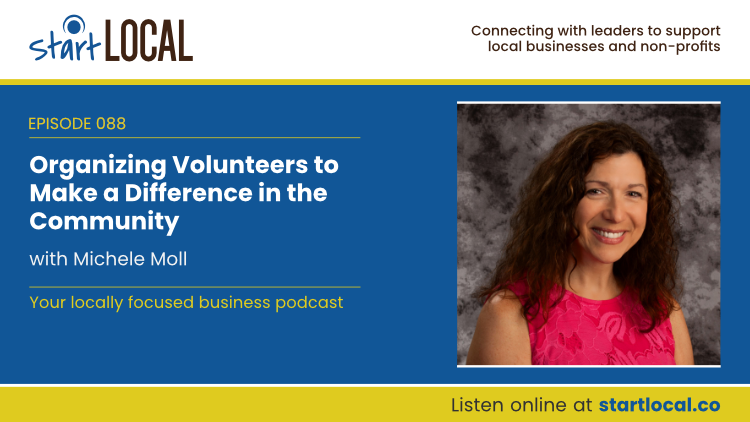
With so many nonprofit organizations working diligently to address the multiplicity of needs facing our community, there is a steady need for local volunteers to lend their support to their neighbors. We catch up with Michele Moll, Executive Director of RSVP Volunteers. Michele details the litany programs and services that RSVP Volunteer deliver across Chester County and beyond. We talk about how Michele, her colleagues, and their army of volunteers work to tackle local challenges in education, community support, and senior wellness.
Links
RSVP Volunteers
- Website: rsvpmc.org
- Volunteer Enrollment Form: rsvpmc.org/volunteer-enrollment-form
- Donation: rsvpmc.org/donate
- Upcoming golf classic: rsvpmc.org/golf-classic
- Facebook: facebook.com/RSVPvolunteer
- Twitter: x.com/RSVPVolunteers
- Instagram: instagram.com/rsvpvolunteer
- LinkedIn: linkedin.com/company/rsvp-volunteer
Additional Links
- Michele’s story at the West Chester Story Slam
- Edge of Cinema
- Shoplandia by Jim Breslin
- Longwood Gardens
Intro: Welcome to Start Local, where we talk with business owners, leaders of nonprofits, and other members of our community focused on doing business in and around Chester County, Pennsylvania. Each episode will provide insight into the local business scene and tell you about opportunities to connect with and support businesses and nonprofits in your local area.
The Southern Chester County Chamber of Commerce promotes trade, commerce, industry, and sustainable economic development while supporting a diverse and growing marketplace. The Chamber is proud to partner with the Start Local podcast to raise the profile of businesses and nonprofits throughout Chester County. Learn more about the chamber at scccc. That’s scccc.com
Liam Dempsey: Hey. Hey. Welcome to the Start Local podcast. I’m Liam Dempsey and I’m here today yet again with my good friend Erik Goodmanson. Hey, Erik, how are you?
Erik Gudmundson: I’m doing very well. It’s officially winter. It’s cold. And I think every other day I’m going to a work professional event for an economic briefing. So it’s clearly the month of January. February. We’re in the beginning of the year.
Liam Dempsey: Sweet Pennsylvania. Is it cold? That is for sure, folks. When we meet people in our community and listeners out and about in real life, Erik and I are pretty regularly asked what we actually do for work. Are we full time podcasters? And alas, the short answer to that question is no. We are part time podcasters. We are just doing this now and again.
Erik Gudmundson: Yeah, that’s true. You’ll probably detect that in some of the audio quality as we go. We do our best, we take it very seriously and we want to honor our guests, that’s for sure. But at the end of the day, our day job jobs are something different. We do this just out of our enjoyment and our love for the community. So by day, Liam, if I get this right, I’m gonna do your little elevator picture, see if I can get it right. You’re a web designer. You’re a marketing consultant.
Erik Gudmundson: You help businesses and nonprofits improve their web presence and communicate with their target audiences via their website, social media and email marketing. That’s a nice reminder at the beginning of the year. So hopefully I got that right.
Liam Dempsey: Yeah, you absolutely did. You did your homework. And so let me, folks, let me try to paint Erik with my verbal brush, folks. So Erik works in CyberSecurity and managed IT support services. And really what that means is he’s helping organizations in our area and kind of even beyond up and down the Delaware Valley. And he certainly has talked about beyond that over the years he’s shared with me, but he’s helping them with their cloud migrations, their ransomware prevention and general IT support needs. And Erik, how did I do for you? Did I get that right?
Erik Gudmundson: Yeah, you’re spot on. So now that you know what we do, and thank you for asking, but you know, that’s as close as you’re going to get for a commercial on the show, I think, ever. But that said, let’s get to the business of the day.
Liam Dempsey: Yeah, absolutely. Folks, we are so pleased to welcome Michele Maul. Michele is the executive director of RSVP Volunteers, founded more than 50 years ago and now based in King of Prussia. RSVP Volunteers serves our local community in oh so many ways, as we will soon discuss. Welcome, Michele.
Michele Moll: Thank you for having me.
Erik Gudmundson: Michele, I’m looking forward to this conversation because at these chamber events I alluded to earlier lately I’ve been seeing more and more representation from RSVP Volunteers. So the organization is definitely stepping more into the limelight, I feel. So I’m looking forward to getting into some of the details.
Michele Moll: Thank you.
Liam Dempsey: Yeah, I second that. I’ve heard of you folks for some time now, and we’re lucky and blessed to have so many businesses and nonprofits to talk to. But I’m really thrilled to finally get the chance to sit down with you and put a couple microphones in front of ourselves and have this recording. So let’s begin by helping our listeners kind of get their heads around RSVP Volunteers and how you support our local communities. I shared in the brief intro, your organization does a lot. You’re focused on a lot of different needs, but your programs fall into three big categories, as I understand it. Education, community support, and senior wellness. So if that’s correct, and it is great.
Michele Moll: Thank you.
Let’s start with education. Give us a brief overview of your education programs. What are they and who do they serve?
Michele Moll: Sure. Actually, if I can say that all of our programs share a common theme. We utilize volunteers to make a difference in the community. Our educational programs serve children as young as pre K. Through partnership with Head Start in both Chester county and Montgomery county, we provide volunteers in their classrooms to help children become prepared for kindergarten. We also provide parents with workshops to help them understand the importance of reading to their young children. Our elementary age programs serve children kindergarten through fifth grade. And we provide volunteers in the classrooms during the day.
But then also we provide out of school programming. So after school, our volunteers meet with students one on one, virtually helping them 30 minutes twice a week to build their comprehension and fluency. And then we have a summer program that works with the Students. Our students are matched with the same volunteer for the full semester, so they become more of a coach or a mentor working with the students. And actually we have great results. We had 92% of the children that participated in our program improve their comprehension. So it works. And then our math program serve children third grade through adults.
And this program uses a diagnostic tool called ixl. We are understanding what particular skills that student has missed. Fundamental building blocks of math. So the child may be enrolled in algebra, but they may never have mastered division or, or multiplication exponents. And so we are really filling in those gaps so that they can succeed later on in life. And that program is also virtual. They work with students one on one and it is 30 to 60 minute sessions twice a week, depending on the age. And then we also have a career presenter program.
We have a library of recordings of volunteers that share their experience with their career so that it opens doors for for students to learn topics like engineering or law or any type of career that they may not be exposed to. We also provide those volunteers in the classroom so they can talk to students directly.
Erik Gudmundson: That’s more than I expected. And so I’m now curious to hear what’s in that second pillar that Leah mentioned. Community support. Tell us a little bit about what your community support programs are.
Michele Moll: Sure. They are very diverse. So our community support starts with our digital literacy program. This program was designed and formed in 2020 and we help people learn how to use devices that they already own. For example, we help them understand how to access a health portal or participate in telehealth. We people that are looking for employment because as you know, these days in order to apply for a job, you need an email. Typically maybe you need to download an app and apply. And of course, interviews.
Typically the initial interview is via Zoom. So they need to be able to understand how to use technology. And then parents need to know how to use technology so they can communicate with their child’s teacher via email or access the school portals so they can then better support their children’s education. Another community support program we have is called Volunteer Executive Consultants. This program supports nonprofits in our community with free managerial consulting. Our volunteers are executive level volunteers that help nonprofits with a variety of different projects. Whether it be business planning, strategic planning, board development, fundraising. We work with them to help them improve their delivery of their missions for the community.
And then finally, our volunteer services program helps other nonprofits recruit and screen volunteers to be enrolled in their program so that they can better support.
Liam Dempsey: That’s awesome. Thank you for that, let’s get on to that third pillar, senior wellness programs. Give us an overview of those, please.
Michele Moll: Sure. Our senior wellness programs begin with our PA Medi program. That’s Medicare counseling. And RSVP is contracted through the Department of Aging in Montgomery county to provide Medicare counseling for seniors age 65 and older. The PA MEDI program is run in every county, though, so in Chester county, the Department of Aging chooses to do that in house. But RSVP is able to recruit and refer volunteers over to their PA MEDI program to help seniors. We serve over 3,000 individuals with Medicare counseling each year. Another facet of our senior wellness program is our digital literacy program, so it does overlap.
We provide senior fraud mitigation and prevention workshops for seniors. We offer one on one classes for seniors both in person and through workshops. We partner with senior centers to provide these workshops. We teach seniors how to utilize telehealth or online groceries and volunteering online because a lot of times older seniors often feel isolated. And volunteering itself has shown to offer health benefits for seniors, reducing social isolation and improving mood. And so we also recruit volunteers for other nonprofits that help seniors. For example, we have a large number of volunteers that participate in Meals on Wheels or Aging at Home services, whether it be transportation, shopping, or just friendly visiting.
Erik Gudmundson: That’s a lot of programs addressing a notable range of needs. I had no idea your range of services was so broad. How is your work funded?
Michele Moll: In a variety of ways. So about a third of our funding comes through a federal grant from the AmErikorps senior area. Now, AmErikorps senior is very controversial right now. The funding is very uncertain. So we do try to diversify our revenue sources and we are continuing to do that. This year we get another portion of our program from foundation grants, and then also local corporations support our work through eitc, which is the Earned Income Tax Credit and the Neighborhood assistance program, or NAP, which allows companies to get up to a 90% tax credit on their donation to a nonprofit. We also have an annual golf outing that supports our programs, and this year it’ll be June 8th at Brookside Country Club in Pottstown.
Liam Dempsey: The name of your organization is RSVP Volunteers, and I was reading on your website that you have more than 1200 active volunteers that are helping to deliver your program. And I also read in one of your annual reports or impact reports that in 2024-25 your volunteers contributed 43,000 volunteer hours. Those are some very impressive numbers, and it makes me think about how you manage that many People wanting to help. Can you share any tips, any techniques, any software recommendations? How does your team manage 1200 people putting in 43,000 hours?
Michele Moll: It’s a lot. And we are really fortunate to have so many people that want to help their neighbors. But really what it comes down to is strong systems and relationships. When we get a new volunteer, we try to set clear expectations so that when the volunteer starts, they know what they’re doing, they know why it matters, and they know who to turn to for support. We use a volunteer management software to manage scheduling and hours collection. But ultimately it’s that personal connection, staying engaged with the volunteers, showing appreciation for the volunteers and supporting them. And that’s what really keeps everything running smoothly.
Erik Gudmundson: Well, let’s talk specifically about your digital literacy and digital equity programs. With AI storming into our lives on practically every avenue it can, we expect the risk of being digitally left behind is growing. Here in Chester county, we have some unique challenges as well, where some people don’t even have availability to availability of high speed Internet access, let alone AI. So how are you delivering that program? And how can folks get involved either as volunteers or to improve their own digital literacy skills? And I’d also, if I could trouble you to please define what you mean by digital equity, since it can be stretched a lot of different ways.
Michele Moll: Absolutely. The way that we define digital equity is really that everyone, regardless of income level, should have access to technology. Today, Internet access is not a luxury. It’s more of a basic necessity, like telephone or electricity. So from the start, our digital literacy program has been continually evolving just as technology changes. We started the program back in 2020 when Covid shut down and we were getting a lot of telephone calls from seniors saying, we need help, we need a volunteer to deliver groceries to our doorstep. They had technical devices, but they didn’t know how to use them to order Instacart. So we started the program to be able to teach seniors how to use devices they already owned.
We started getting them to know how to use Zoom because they were becoming socially isolated during shutdowns. A lot of us were having cocktail Zoom parties when they were sitting at home alone. They didn’t know how to use text to communicate with their grandchildren or their children. So then it became really obvious that these issues were not just affecting seniors, but they were affecting lower income families whose children were trying to learn from home. We found that the children were unable or missing school online because their parents didn’t know how to use the device. They were digitally illiterate. So we opened up the program to all members of the community, regardless of age. And we started teaching them how to use these devices.
We got the parents to be able to log in to their children’s school portal to support their children’s education. They can now email the classroom teacher so they know when there’s issues and how to resolve them. And we also learned through partnerships that area school districts, like the Kennett school district, they really were looking towards more of a paperless communication. When they enroll a student in school, they are required to have an email address. The parents are where the registrar’s office will create an email address for them. But then if they don’t ever teach them how to access email, you have this huge group of people that are uninformed. So we’re even working with school districts to teach families how to use technology. I just like to give you a little example of how technology really affects everyone.
This was really an eye opener for me. It’s a real story about an older gentleman from Chester county that needed to secure a job for some extra income. He navigated through the job interviews and the applications. He was so excited to land a job at a big box store stocking shelves. He was excited for his first day of work. He gets to work and they sit him in front of a computer and they tell him that he needs to go through the store’s training program online. And he felt defeated. He felt like a failure.
And he never used a computer before. And he told them, unfortunately, he couldn’t keep the job. And he left. A couple weeks later, he runs into one of our digital navigators and he learns about our program that can provide free training one on one for him to learn how to use a computer. And he really felt like this was a gift from God, like he couldn’t believe that this was something that would be offered for free for him. We were able to secure him a device because he had none. We were able to teach him how to use the computer. And so these are things that help people day to day.
And introducing AI into this. AI is part of our lives now, whether we like it or not. And we are changing our workshops all the time, continuously to include things, because things change constantly. Scamsy ball. And so we have to update our workshops, our trainings all the time to keep up with the technology.
Liam Dempsey: RSVP Volunteers has been around for 50 years, more than 50 years, and it’s doing a lot of good work. But there are a lot of organizations around the Delaware Valley that are doing great work, more than we could possibly count. And as Erik and I alluded to earlier in the show, we think we’ve seen you and your colleagues out and about more at chamber events and other networking gatherings in and around Chester County. And my question is this really, is that more a reflection of our ability to notice things? So maybe you’ve been coming for years and we haven’t noticed, or are you getting out and about more? And if it’s the latter, if you and your team are making more of an effort to get out into the community, why are you doing so? What strategies are you looking to implement there?
Michele Moll: Great, great question. Actually, we are out and about a bit more. Last year we hired Maria Sampson. She’s our corporate relationship manager and she’s amazing and is continually out there looking for new partners for us while also deepening and strengthening our existing relationships. We’re really intentional about over delivering for our sponsors and we provide them with an ROI or a return on investment report that highlights their exposure and their volunteer engagement that we’ve generated for them each year. Our corporate partners are really a vital asset for our work. Their generosity, both financially and through their time and involvement truly makes a difference in our community. So Maria is out there really trying to strengthen our partnerships and relationships.
Erik Gudmundson: You collaborate with so many businesses and nonprofits across the region. As a leader, how do you navigate the balance of trying to open the door to the next opportunity while still servicing the existing programs in relationship you already have?
Michele Moll: It’s really a balancing act. We’re careful not to say yes to everything. We try to focus on opportunities that really align with our mission and the work that we’re already doing. Having a strong team and good systems helps us take great care of our existing partners while still leaving room to explore new relationships when they feel like a really good fit.
Liam Dempsey: You told us briefly about your Volunteer Executive Consultants program where RSVP as an organization offers non profit consulting. Can you tell us a little bit more about the specific learning opportunities that other local nonprofits can get involved in? What topics are you covering? What areas of expertise can you bring to the training room? And and then because it’s all about volunteers, how would somebody learn more about what qualifications you want? What makes a volunteer a good candidate to be a volunteer executive consultant with rsvp?
Michele Moll: Sure. Our volunteer Executive consultant program really has three different areas of focus. We do the one on one consulting with the clients and everything that we do at RSVP is free of charge. So the consulting is free. But we also we also offer workshops six times a year in September we offer a Meet the Funders workshop, which is one of our largest attended workshops. Putting a panel of funders together to be able to understand what it is that they’re truly looking for in applications and the best way to communicate with funders. We also do workshops on fundraising, board development, strategic planning, marketing. So there’s a variety of topics that we offer each year and then we also have expert hours through the Regional foundation center at the Free Library of Philadelphia.
So every month, on the fourth Wednesday of each month, our VEC volunteers are available. And this is virtually so anyone can can participate. They are available for 45 minute sessions to meet with nonprofit staff, board members, executive directors on a variety of topics. So this month the topic is starting a non profit and people can just pick their brains on different ideas or, or questions they have about starting a non profit. Next month the topic will be grant writing and in March the topic will be board development. But really any topic is on the table. So if they really don’t have questions about a particular topic, they can still sign up with the executive consultant expert hours and just ask questions of the consultants. Volunteers through the program typically are retired.
Michele Moll: However, we do have several volunteers that are still working and just want to give back to the community. And I’d say really any expertise is, is helpful. Anything that has to do with running a business, because honestly, running a nonprofit is really not much different than running a business. So they need strategic planning, they need operations, they need technical, and really the volunteers can pick and choose the projects that they want to work on. So it’s not a huge commitment.
Erik Gudmundson: Well, in addition to recruiting and organizing volunteers for so many programs, RSVP Volunteers supports a number of Chester county nonprofits by helping those organizations secure volunteers for their own initiatives. You were just alluding to that in your last answer. So tell us how that works. How can nonprofits benefit the most from that aspect of your work?
Michele Moll: Sure. We work with over 150 nonprofits in our footprint to provide volunteers for them. And we ask the nonprofit to complete a memorandum of understanding that outlines what both parties will be doing. We also asked them to complete a volunteer request form that includes details of the volunteer assignment and also what particular skills are required for that assignment. And then we can do our best to find the right individual to meet their needs. And we can’t guarantee that we’re going to fill every volunteer assignment, but we definitely do our best to match the best individuals with their assignment.
Liam Dempsey: In a previous conversation, Michele, you shared that RSVP Volunteers makes a real effort to ensure that at least some of your staff, some of your colleagues, are bilingual. What’s the thinking there? Why is having bilingual staff a real priority for your organization? Presumably that adds cost because you need to recruit people that are. So talk us through that a bit, would you?
Michele Moll: Yes, it’s actually just all tied into just trying to do our best to serve our community. Last year we received a grant from the Longwood foundation to cover the cost of a digital navigator to serve a four mile radius of Kennett Square. So we know that from the census that over 40% of the residents in the Kennett borough are Hispanic and a large number of them speak Spanish at home. So the bilingual staff allows us to best serve that community.
Erik Gudmundson: That’s an interesting point in that your organization works across Montgomery, Delaware and Chester counties, so you’re interacting with local government communities in those three counties. I’d imagine each community has its own flavor, if you will. How does RSVP volunteers navigate the differences that locality makes when implementing your programs?
Michele Moll: That’s a really good question because really there is no one size fits all approach to our work. We tailor our programs to meet the specific needs of each local community that we serve. For example, we partner with many different school districts. Each of those school districts have their own volunteer clearance requirements, for example. So we need to make sure that we understand those differences so that we can communicate those to the volunteers before they’re placed there. We also do this by staying engaged through nonprofit collaborative meetings through the local chambers that we see you at and regular communication with government offices like the Department of Aging. And we gain valuable insight into the community needs and then can respond in a thoughtful, informed way by doing that.
Liam Dempsey: Let’s change the focus of our conversation and make it all about you. He says, tongue in cheek. You’ve been executive director of RSVP Volunteers for 17 years now, just a little bit over. And I was reading on LinkedIn that you started as the executive director in 2008 and, well, that was a year and a lot has happened since 2008. A lot, a lot, a lot. And I guess we expect that your organization has had to change and evolve to respond to such change. Right? You wouldn’t be in existence for as long as you have if you just stuck to one path and kept to it. But you’re the leader.
Liam Dempsey: You’re the executive director. How do you approach organizational change? Or I suppose, asking another way, how do you keep yourself flexible as a leader and open to change?
Michele Moll: Well, the only constant that we know about is change, right? So I think that RSVP success over the years has been coming from the fact that we are able to stay agile and that we’re willing to plan for multiple scenarios instead of just assuming one path forward or that we like to do things the same way. I think also the fact that we tried to keep our staff cross trained so that we’re prepared to pivot when we need to. And that was specifically helpful during the COVID shutdowns. Early on in the shutdowns, many of our educational programs were paused because the schools closed down. But this is a crazy story, and sometimes it’s unbelievable that we actually lived through this. But in 2020, we actually had over 800 people sign up to volunteer with RSVP. In a regular year, we might have had 250 to 300. So think about that workload increase.
Well, we normally have two volunteer services, staff that are kind of the funnel. So a volunteer says, hey, I want to volunteer. They fill out a form. Then we have to run background checks on that volunteer. Then we do a personal interview with the volunteer to find out what they specifically want to do. Their talents, their interests, their availability. And then we place them in an assignment. Now think about 800 people coming through.
Liam Dempsey: That’s a lot.
Michele Moll: It’s a lot. But we went through and we screened every one of them and we individually interviewed every one of them, and we were able to support our community. And that’s because of the amazing staff that we have. They pivoted. They said, I know that I normally run an educational program, but you need me to do the interviewing. I’m going to do the interviewing. Or you need me to do the screening, I’ll do the screening. And we all help each other. And that’s really the way it has worked.
Erik Gudmundson: That’s an impressive accomplishment and great job on leading the organization through that because that was not easy. I have no doubt you mentioned the topic of background checks. And on that topic, we did our homework before this interview as well to get prepared. And we found a video of you online from 2018. And in that video, you shared a funny story about your sisters and some family chaos. And it was from a Westchester story Slam, which are. Which are always fun to watch. So we’re going to share the video of this talk so that our listeners can watch it.
We’re not going to give any spoilers away, but I’d like to ask, why did you, you know, what inspired you to get up on stage in front of a room full of strangers and talk about yourself? So what Makes you want to get involved with the, the story slam and tell such a personal story.
Michele Moll: First of all, I have to say that I can’t believe you found that video. I had completely forgotten about that. And it had, it made me laugh. But honestly, it made me laugh, too.
Liam Dempsey: When I watched it. It made me laugh, Liam.
Michele Moll: I couldn’t believe it. But I, I have always been a ham. I am, I, I admit it. From the time I was a kid, I’ve always loved to make people laugh. I’ve always been a storyteller. And I, you know, I, I think that I enjoy turning everyday moments into stories and especially by exaggerating them and, and just that chaos, that chaos was real. I mean, we lived through it. But brings me joy to see people, like, kind of relate to little tidbits and see themselves in a story. So it’s just my personality. I’m quirky.
Liam Dempsey: Well, shout out to Jim Breslin, the founder and organizer of Westchester Story Slam. And I think he did a Downingtown story slam as well. And Jim has a book out that came out years ago. The name escapes me, but it’s about his time as a producer at qvc, and it’s built on his. The story is a series of shorts around his time there over 17 years. So we’ll be sure to link to Jim’s book over in our show notes at startlocal co. And of course, we will absolutely link to Michele’s YouTube video. Those of us who attend a variety of networking events across different counties will know that it takes a while to travel from Montgomery or to Elko or Chester County.
Liam Dempsey: It’s a lot of land, a lot of roads there, and your folks, your teams, your volunteers are out there. And even though we might say that we’re from Philly, the Philly region is not homogenized in any kind of way. I mean, it is in some ways. We all like the Eagles, I suppose, and maybe the Phillies, too, and the Flyers. But Michele, tell us a little bit about yourself. What town do you call home? And what’s something unique about that community?
Michele Moll: I’m originally from Havertown, but I’ve lived in Westchester for the last 15 years, and that’s what I call home. And I’ll tell you the thing I love most about this area. Well, the Chester Count, Chester Valley Trail is my number one thing that I love about our area. To be able to get on a bike and ride and walk. And that is amazing to me also, just the feel in areas you feel like you’re in the country still, you can see like all these historic buildings, but yet you’re still close to downtown and the shopping and the restaurants. So I just think Westchester is amazing, amazing place to live.
Erik Gudmundson: When you’re not running a NonProfit or organizing 1200 volunteers or helping all sorts of other local nonprofits, where do you volunteer? What causes is near and dear to your heart?
Michele Moll: Well, unfortunately, I don’t get time really to volunteer much these days because my demands at at work or quite busy. And I am a new grandmom. I have a grandson and a granddaughter now.
Erik Gudmundson: Congratulations.
Michele Moll: Thank you. Most of my free time is really spent with the kids, but I’ll tell you, I’m extremely passionate about children’s literacy and food security. So we donate quite a bit towards those two causes. And the way I look at it is I really focus my time at work at empowering others to be able to volunteer and make a difference. So I feel like I am kind of of orchestrating others and helping them to be volunteering in the community.
Liam Dempsey: Michele, with programs that stretch across really so many service areas. We talked about all of them in this conversation earlier. But I’m curious. How do you shape and recruit a board that is going to understand the subtleties of the many diverse needs that your programs aim to address? How do you have a board that can come together and really understand the needs of the different communities in different regions, different ages, different languages? There’s a lot of different needs there. How do you get that board to deliver in ways to really take care of you, the community?
Michele Moll: Yes, because we do span a large area. We are very intentional about building a board that reflects the communities that we serve. We have up to 25 board members, and what we look for is diversity across race, age, professional service on geographic area so that our board brings multiple perspectives to the table. And that mix really helps us ensure that our leaders understand the nuances of our programs and the diverse needs in our communities that we work in.
Erik Gudmundson: I’m going to ask you a twofold question. It may seem like they’re not related, but maybe they are. I don’t know. We’re going to find out. My question is, how did you find out about this particular position that you occupy now at RSVP Volunteer, since you’ve been there a while now, how did you find out about that position? And then also tell us about a local business or nonprofit that more folks should know about?
Michele Moll: Actually, funny story about me finding this position. Actually. My background is in finance. I worked for a large mortgage insurance company for many, many years. And then I took some time off to raise my boys. And when I was taking the time off I really was involved in volunteering quite a bit. And when I decided to go back to work, I wanted to do something to really make a difference. And I found rsvp.
It has been an amazing fit for me, I’ll tell you that. It, it doesn’t feel like work because I truly enjoy it and I’m really passionate about it. And so yeah, that’s my story about finding RSVP and the people there are the most amazing people. The volunteers, the staff and the board members are just wonderful and a local business. I’ll I would have to say Edge of Cinema. Edge of Cinema is a creative studio that more people should know about. They’re located in Exton and we worked with their founder and creative director, Jeremy Schmidt last year to help us produce a short video that would really, truly bring our programs to life. And he was so helpful walking us through the whole process and really helped us pinpoint what was really important and where we should start.
So Edge of Sona, if you had heard them, check them out. They actually are located in the Exton Mall right now, I guess, until it closes down. And yeah, they’ve been extremely helpful.
Liam Dempsey: Well, we’ll be sure to include a link to their website [email protected] Michele, I expect that you’re absolutely looking for volunteers given that you have so many and you have so many programs with volunteers that can fill those. So if folks are interested in volunteering, where can they learn more? And before I let you answer, I’m also going to ask, are you hiring? Is RSVP volunteers looking for anybody and if so, where can folks learn more?
Michele Moll: We are always looking for volunteers. The best way to reach us is through our website. It’s RSVPMC like multicounty.org and they could also call us at 610-834-1040. They also can find us on Facebook. We do post a lot of our volunteer needs there and I definitely would encourage people to follow us on LinkedIn because we do post opportunities there, both about volunteer opportunities as well as when we are hiring. Right now we don’t have any openings, but if they Follow us on LinkedIn they’ll be able to find out about them early.
Erik Gudmundson: In addition to volunteering, how can the community support RSVP volunteers?
Michele Moll: One of the biggest ways that our community can support RSVP right now is through volunteering. We have a waiting list for students for our after school reading and math programs. These programs are 30 minute sessions that run from 3:30 to 6:00pm Monday through Thursday. So any additional volunteer that we bring on would allow us to serve one additional student who is ready and eager for the support. So please reach [email protected] to be able to volunteer. We would also welcome additional corporate partners because businesses can support RSVP through donations that are eligible for Pennsylvania tax credits and also by engaging their employees in meaningful volunteer opportunities that make a real local impact.
Erik Gudmundson: You answered a question that I wasn’t even going to ask, but I’m glad I have the answer now. MC stands for Multi County RSVP Multi county so people can find your website. Very good. And I shouldn’t be surprised that with your organization name RSVP Volunteers, you double down on volunteers. That’s what you really need to make more of an impact on the community. So thank you for sharing your answer on that. Michele Mall, Executive Director of RSVP Volunteers Is there anywhere else listeners should go to connect with you, learn more about your work and get involved with your programs? In addition to your [email protected] we can.
Michele Moll: Be found on social media on Facebook, LinkedIn, Instagram and Twitter.
Liam Dempsey: Michele, thank you so much for joining us today. What a pleasure to spend time with you, get to know you a little bit. And thanks again. I really appreciate it.
Michele Moll: Thank you so much for the opportunity.
Erik Gudmundson: Thank you also to my co-host Liam Dempsey. I’m Erik Gudmundson.
The Start Local Podcast is published every two weeks. We invite you to subscribe to Start Local using your favorite podcast app or ask your smart speaker to play the Start Local podcast. You can visit the Start Local website at startlocal.co for show notes, including links mentioned on this show and a summary of past episodes.
We hope you join us for the next episode. Thank you for listening.