Podcast published: January 9, 2026
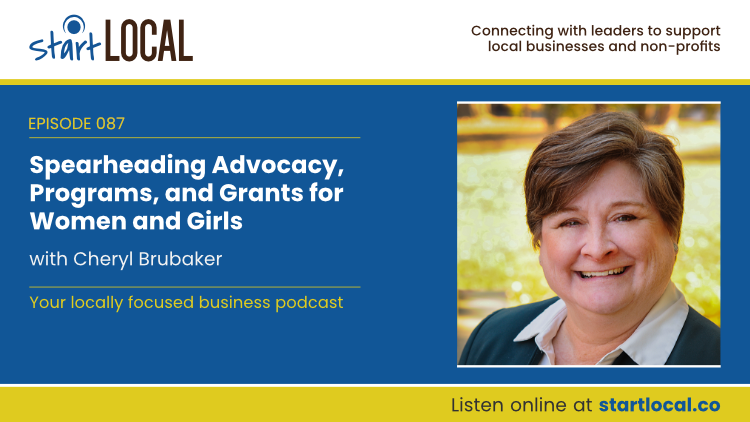
As of the 2024 census, women and girls comprise approximately half the population of Chester County, Pennsylvania. With that mind, we speak at length with Cheryl Brubaker, Executive Director of The Fund for Women and Girls. Cheryl details a number of the challenges that local women and girls face, and walks us through The Fund’s programs to address those challenges. She highlights The Fund’s focus on advocacy and helps us understand the direction of the organization’s current efforts.
Links
The Fund for Women and Girls
- Website: thefundcc.org
- LinkedIn: linkedin.com/company/the-fund-for-women-and-girls
- Facebook: facebook.com/thefundchesco
- Instagram: instagram.com/thefundchesco
- YouTube: youtube.com/@ChescoFund
- The Blueprint Report (4th edition)
- Impact Report (2023/2024)
Additional Links
- Kaly – clothing, gifts, and accessories
- Committee of Seventy
- Women Against Abuse
Intro: Welcome to Start Local, where we talk with business owners, leaders of nonprofits, and other members of our community focused on doing business in and around Chester County, Pennsylvania. Each episode will provide insight into the local business scene and tell you about opportunities to connect with and support businesses and nonprofits in your local area.
The Southern Chester County Chamber of Commerce promotes trade, commerce, industry, and sustainable economic development while supporting a diverse and growing marketplace. The Chamber is proud to partner with the Start Local podcast to raise the profile of businesses and nonprofits throughout Chester County. Learn more about the chamber at scccc. That’s scccc.com
Liam Dempsey: Hey. Hey. Welcome to the Start Local podcast. I’m Liam Dempsey. I am here today again with great pleasure to be in the company of my good friend, Erik Goodmanson. Erik, welcome dude. How are you today?
Erik Gudmundson: I’m doing well. Riding the roller coaster of winter weather that is Chester County, but I’m doing well.
Liam Dempsey: Yeah, it’s been a busy one from that point. Snow and cold and cold and snow and warm and it’s getting warmer. Yeah, I like that. I like that. I like the cold, but I like, I like the manageably not feel freezing to death cold.
Folks, today we are very pleased to welcome Cheryl Brubaker. Cheryl is the executive director of the Fund for Women and Girls. And as I’m reading from their website, the fund leads and unites the community through philanthropy and advocacy to ensure that women and girls have resources and opportunities to thrive.
Cheryl, welcome. Thanks for joining us today.
Cheryl Brubaker: Thanks. Thanks for the opportunity. I’m very glad to be with you.
Erik Gudmundson: Cheryl, it’s a pleasure to have you. I know I’ve enjoyed attending the inspiring Change Breakfas,, and you do a fantastic job with that every year. It’s become a legendary Chester County event. So it’s great to have you here in the podcast studio, one on one, we’re honored.
Cheryl Brubaker: Great.
Liam Dempsey: Cheryl, as I opened the organization’s name is the Fund for Women and Girls. Yet your organization does more than provide grants to local nonprofits. Give us a brief overview of your programs and how you and your colleagues deliver them.
Cheryl Brubaker: Sure. It starts with that goal of ensuring that women and girls have the resources and opportunities to thrive, just like it says in our mission. So while we do provide grants to those programs and services that help women, we also do our own resources and programs.
So, primarily looking at some of the bigger picture systemic issues. So whether those be advocacy programs, engaging youth directly in those programs, but we also work with adults in trying to change state policy, local policy, anything that will help create those resources and opportunities for Women and girls.
Erik Gudmundson: Local folks may well be aware of the Fund’s Blueprint report, a compilation and analysis of data from more than 80 state, local, and national resources. The report focuses on the status of women and girls. You’ve produced these blueprint reports four times since 2005. Walk us through the most recent report from 2022. And what can we learn about women and girls here in Chester County?
Cheryl Brubaker: So the report covers about eight different areas of essentially overall well-being for girls and women in Chester County. So everything from Violence and safety to health and reproductive health to wages, caregiving, family responsibilities, all of those opportunities as well.
And the stats that tend to grab people’s attention first are the actual wage disparity numbers. So, when we last did this report for women and for white women, they earned about 80 to 81% on the dollar to their equivalent non-Hispanic white male counterparts. However, for black women, it was closer to 46%, and for Latina women, it was 44%. And so that has really informed the Fund’s work because as we do our work, we’re trying to pay attention to the women and girls who are most impacted by these problems versus starting at the top and hoping it helps everybody. And so that’s been something that we’ve been paying attention to.
The other thing that’s interesting that we saw as a positive trend is that the political participation by women and girls has been increasing. It did, though an interesting sort of comparison of the four reports that we’ve done over the last 20 years. And what was interesting in that is that while there was incremental change in different areas, the primary area of improvement was in health insurance coverage, and that was primarily due to the Affordable Care Act.
So that’s been a really interesting thing for us to think about as we realize the importance of participating in policy, participating in our legislative opportunities to really use policy as a way to increase resources for women and girls, as we can see in that example. Unfortunately, that may be going backwards by the time we do our next report, but it does tell us the importance of policy and legislative action.
Liam Dempsey: So let’s keep focusing on today. And I mean that in a general sense, not immediately the day of this recording. We understand that the Fund recently changed its focus from addressing immediate needs to considering the sources of the problems that cause those local immediate needs. Walk us through that strategic shift. How and why did the Fund come to make this change? What led you to it, and what was that all about?
Cheryl Brubaker: It really started with the blueprint reports because exactly what I just referenced in terms of seeing that incremental change, but not really being able to see that significant progress in those areas that we wanted to see. And a former board member shared with me, the perspective at the time was, hey, we have these blueprint reports. We’re going to fund these nonprofit organizations, and then their work will improve the statistics in the blueprint report.
Unfortunately, direct services, first of all, the resources are never equivalent to the need. So the organizations involved in these direct services, like helping women who’ve experienced violence, helping women who are experiencing poverty, the need is so great that these women, these organizations serving these women, are so maxed out that they don’t have time to look at what’s actually causing the homelessness or the poverty or the domestic violence. How do we look upstream and see where are those problems? And so that’s where the fund felt we had an opportunity because we did have grant-making and advocacy in our mission. So what does it mean to actually take on some of that upriver change and be able to make a dent that way?
Erik Gudmundson: So with that new focus on advocacy and upriver challenges, how specifically does that affect the program’s initiative and the work of the Fund now?
Cheryl Brubaker: So instead of… That’s a really good question because instead of actually engaging people in the community, in philanthropy, so a big part of our programming before was about volunteers getting involved in the grant-making and deciding where the grants go. We’re now engaging the community as well in advocacy.
So that includes both our youth as well as adults, and that’s a key piece. We have close to 60 volunteers involved with our paid family leave advocacy that we’re doing. We have a group of about 18, I think, high school students who are working on getting legislation in place so that 16 and 17-year-olds could vote in school board elections. So this is the focus of the work that we’re doing programmatically while we still provide funding for those direct services, recognizing that those needs are still there. So we’re not abandoning it. We’re kind of expanding our scope, if you will.
Liam Dempsey: Let’s focus on girls for just a moment here. As you started to touch on there, you do have a number of programs specifically tailored for. For high school girls. Tell us about your Vote 16 PA program. You have a program called Next Gen Advisory Council, and I understand that you have a period poverty program as well. Period for women’s period. Rather than grammatical. Tell us about those.
Cheryl Brubaker: Yeah, so the Vote 16 actually came out of a civic engagement program we had previously for girls. And there was a group of girls, through their process of studying the blueprint report, looking at community needs, they really moved into this direction of saying, hey, we would really like to get involved with this and figure out how we can get the right to vote in our school board elections.
We kind of recognize that in this process, that civic engagement program ran for kind of the school year. We knew this was not going to be a one-year kind of commitment. So in agreeing to kind of support them in that, we knew this was going to be a multi year program. So that’s what kind of has evolved it along the way. And girls throughout the county are welcome to sign up for it, but we also are trying to look at potential partnerships in specific communities to be able to say whether it’s with the LGBTQ youth or whether it’s with Latina girls in Southern Chestnut, wherever it might be looking at intentional partnerships so that we are bringing all of the youth that are impacted to the table.
The Next Gen Advisory Council is an opportunity then for youth to give direct input into the structure and the programs we’re actually offering. So, when it comes to strategic planning, when it comes to those big organizational questions, these youth will have an opportunity to actually speak to the needs as well as the program when we do.
11:33 And then you mentioned period poverty, which in the state of Pennsylvania, there were funds made available for menstrual products within schools. However, in most schools, if they’re available, they’re in the nurse’s office, which is actually a logistical challenge for a lot of the students. And so we still see a good deal of truancy around girls having their periods, whether that’s in middle school or high school. And so this group of girls is currently looking at one specific school district, their school district, to kind of figure out how they can make improvements and make those products more accessible. Once they accomplish that, the goal is then that they can help other school districts through the same process.
Erik Gudmundson:We read on your website that you’re also advocating for paid family leave in Pennsylvania. Help us understand the challenge that paid family leave aims to address and why it’s a priority for the fund.
Cheryl Brubaker: So women often kind of fall into that, into poverty over something significant that happens. So whether it’s a child or a family member that gets terribly sick and they have to quit their job to take care of them, whether they get pregnant and have to quit their job because they are having a difficult pregnancy, regardless, a lot of times that right there becomes kind of the, the cliff that, that kind of they. That makes it hard then to get back back into, you know, A level of stability. And so what we know is that only 16% of women throughout the United States actually have access to like a paid maternity leave through their employer. And we know that one in four employed pregnant women go back to work within 10 days of giving birth, which is somewhat ironic in Pennsylvania because in Pennsylvania it’s actually illegal to remove a puppy from its mother for eight weeks. But we’re doing nothing to make sure that a child can stay with his or her mother for that period of time. And so by working towards getting paid leave as a state run program that would actually allow everyone to have access to some form of paid leave, whether it be for pregnancy, whether it be for caregiving purposes, whether it be due to domestic violence. It could be for a variety of different areas.
Cheryl Brubaker: And that’s what we’re trying to get in Pennsylvania.
Liam Dempsey: Can you revisit what you shared about the puppy that caught my attention? I’m not sure I heard you right. Would you say that again please, Cheryl?
Cheryl Brubaker: So in Pennsylvania it’s illegal to remove a puppy from its mother for eight weeks, but one in four women are going back to work 10 days after giving birth, not because they’re legally required to, but because they financially have to. So we’re not providing that financial safety net to allow them to have that eight weeks with their child in the same way that we say a puppy should have.
Liam Dempsey: Another focus of your advocacy is called Empower Her Vote as we approach the 250th anniversary of the USA. And I’m not even going to try to say whatever the sesquicential word is. I’m just going to say 250th anniversary. I’m mindful that we’re only 105 years into the right of women to vote. So you do the math out there, people in the audience. I can’t do that in my head. But that’s not even halfway. So again, going back to your website, Empower or Vote is a nonpartisan program, as I read, and it’s aimed at encouraging women to exercise their voting right.
Liam Dempsey: How does the program do that?
Cheryl Brubaker: So first I actually want to clarify that while 105 years does not sound very good, that actually didn’t even give all women the right to vote because many women of color did not have the right to vote until much later. And we’re still seeing a lot of threats to like the Voting Rights act and things like that that are limiting access to voting Show.
Liam Dempsey: Thank you for clarifying that. I appreciate that. Thank you.
Cheryl Brubaker: Yeah, yeah. And that’s part of the point of empower her vote because we want people to really understand the nuances and understand what access to voting really means. So there’s that educational component. We also want people to be informed voters so to really understand where the candidates stand on the issues and be able to vote on the issues that matter to you, not just who has the best TV commercial. And then the other part that we’re really looking at, it’s interesting because there’s an organization that we have borrowed material from and so forth called committee of 70 out of Philadelphia. And they talk about doing vote 365. So the idea is not just that you vote and you get your candidates in office, but but then you actually hold them accountable once they’re in office, which means we really have to understand how our government works. We have to understand how to actually get involved and participate in our local, state and federal government.
So empower her does a lot of education, a lot of awareness. We try to provide a lot of voting resources and also just call attention to the issue. We have a wonderful mural that was put together in Westchester that people may have seen on close to Walnut and Market street that was done on the hundredth anniversary of the 19th Amendment passing. And so just constantly keeping that in front of people. As to why it’s important to vote and to be an informed voter, let’s.
Erik Gudmundson: Stick with that voting theme and go back to initiative you mentioned a little earlier in this interview, which is Vote 16 PA I. That is the initiative that aims to push for the effort for the passage of legislation enabling 16 and 17 year olds in Pennsylvania to vote in school board elections. Tell us why that is an initiative worth pursuing. What are some challenges you’re facing with it and how do you go about efforts to affect that change in our state? Do you start on a trial basis with a certain school district? I mean, that’s a big, big task to tackle from, from my perspective. And a lot of people have a lot of major questions about it, I have no doubt.
Cheryl Brubaker: So, yeah, it’s interesting. It’s been interesting to get sort of general reactions. We have people who are very enthusiastic about it and other people who are very concerned about 16 year olds voting the school board members in. So ultimately, it is a lot about civic engagement because if you start engaging youth early at 16 and 17 on issues that matter to them, so there’s nothing closer to them than where they spend, you know, what is it, 40 hours a week or whatever it is in school. And if we get them engaged early, then they’re much more likely to be engaged at 18 in your state, local and federal elections. So one is a level of civic participation. The other is about giving voice to, especially for us, our focus is girls and giving them voice to the issues that matter and again to them and being able to speak to that. Now you mentioned the challenges and how, and we fortunately have a very strategic, creative, persistent director of advocacy and policy, Blake Emanuel, who is in the process of working with the group of students who are doing that.
And we’re going through and figuring out what does it actually mean to do this. And in Pennsylvania, it looks like we might have to start actually at the state level to have some changes made that would allow elections to be handled at a municipal level. So it gets a little complicated, as most things do at government levels. But we have to start at the state level and then hopefully that will open up the opportunities then for individual school districts to be able to make those decisions as they are ready.
Erik Gudmundson: That’s such an ambitious goal for my perspective, in the sense that’s, that’s a monumental change. And, you know, maybe I’m seeing it from my perspective, not yours, of course, but is there, is there at least effort or I should say benefit from going through that thought exercise, but, but not being able to actually go through it, or I’m curious, what advantages are you seeing it since that might be such a long term play or a long term ask?
Cheryl Brubaker: Sure. So. Well, first, I have to say I think all the easy solutions have been taken. We’ve already accomplished most of those in our communities. So at this point, it’s the big projects that are left. But that being said, the participants, whether they stay involved to whenever that end result happens or not, they’re gaining incredible experience and expertise from the standpoint of everything from public speaking to understanding how government works to, you know, we had a participant who stood up at her school board and offered public comment. She was the only community member in the room speaking to the board on an issue and she had great response. There happened to be two people in the room from, you know, local legislators who came up to her afterwards, offered their support.
So, you know, it was a great experience for her. But it’s learning how to work together, it’s learning how to speak to adults, speak to school boards, speak to officials, and also make your case. And so there’s a lot of life skills learned, especially those soft skills that aren’t necessarily taught in your math or, or algebra classes.
Liam Dempsey: CHERYL the Fund for Women and Girls has an impressive record of grant giving. According to your website, the fund has provided nearly 4 1/2 million dollars to more than 95 nonprofit organizations in Chester county alone. And that’s since the beginning of the organization. And to be candid, the recipients of those grants compromise a really impressive list of highly respected local nonprofits addressing an entire range of core needs for women and girls across Chester County. And with that context, I’m really curious, what does your grant making decision process look like? How do you decide in what levels to supply that support? I know you said earlier in this conversation that you have some volunteers that come in and help with us, but unpack that a little bit more. What does that look like?
Sure. So, first and foremost, we’re looking for organizations that are aligned with our goal of, of increasing resources and opportunities for women and girls. And I should clarify that we do define women and girls as anyone who has lived female experience. So that may include people working with trans individuals as well. In the process, what we’re looking for are organizations who are delivering those services, but hopefully also have some awareness of the bigger systemic issues or causes that are behind those problems. Because as we’re moving forward, we’re looking to kind of find ways, creative ways to leverage their audiences without putting an undue burden on those organizations as well. In the past, we have had volunteers directly involved in doing site visits and making specific decisions on that. It’s been interesting because we’re in the process of, of going through a transition on that as well.
Primarily because we want to do more strategic partnerships with organizations that will be more multi year. And really looking at what are the goals of the fund and how does this organization align with that. So we have a program alignment committee that is made up of board and volunteers who review all of our potential grant offerings and ultimately make the recommendations to the board for what those final grants will be.
Erik Gudmundson: That definitely helps us understand how you provide funding to other nonprofits. But how is your organization itself funded?
Cheryl Brubaker: The the fund really came about because of some very philanthropic women who wanted to see this mission happen. And to this day, the organization is really almost more of a vehicle for community members who want to make an impact. So when we say, oh, we gave X amount of grants, it’s really not the organization, it’s our donors who have given that money and made that happen. So we are entirely philanthropically funded from the beginning, from the original philanthropists, some of whom made some significant gifts to set up an endowment, but also from ongoing gifts that we need every year to do the programs and hopefully continue to grow the amount of grants that we’re able to give. So that’s individuals, foundations, corporations, but a lot of individuals who really make this work happen.
Liam Dempsey: Cheryl, I’m going to focus on your career here for a moment and from what I was reading on your LinkedIn profile and on your profile on your own organization’s website, that you have held leadership positions with organizations focused on supporting women and girls for a long time. You’re very experienced out there, you’ve been at it a long time. What draws you and keeps you focused on the well being of women and girls as a cause? I mean, clearly women and girls matter. But you know, why is it such a priority for you?
Cheryl Brubaker: For me, I think from early on I was the person who was always drawn to wherever the greatest need seemed to be. And I think that’s what drew me into work with women and girls and specifically women and girls who were facing significant obstacles, whether that was dealing with violence or extreme poverty. And so that’s always been kind of my passion. At the same time, it’s been interesting as I’ve over the years, there’s a book out called Half the Sky that really talks about how much we’re missing in our communities when we don’t resource women and girls to fully participate in our communities. And so there’s so much untapped potential there that women and girls could bring to the table if given the full opportunity. There was an astounding statistic that I am not going to remember off the top of my head, but it was something like over a billion dollars in productivity that the United States loses every year because we don’t have sufficient childcare resources. And so thinking about if women and girls were properly resourced, what they would be able to do not just to contribute to our economy, but to contribute to our communities and their well being.
Erik Gudmundson: That productivity statistic is very interesting to me. And I’m thinking back to your own blueprint report where you’re compiling so much data. Is there a particular statistic in your own reporting that has really stood out to you or surprised you? Something you didn’t expect to find?
Cheryl Brubaker: I think not unexpected, but I think I would come back to kind of that, that wage gap disparity. For me, that was one of the more compelling things to look at, not just from a standpoint of sexism, but also racism. And I think it was not. While it wasn’t surprising, I think it really solidified for me that we have to take a really holistic approach to the work we’re doing. We can’t look at gender through a very strict lens. We also have to look at it through base, through ability, through a variety of other areas in which women experience discrimination.
Liam Dempsey: So intersectionality.
Cheryl Brubaker: Exactly, Exactly.
Erik Gudmundson: Thinking about some of your positive impacts, the Funds impact report for 2024 and 2025 details your work for that period. Pull out a few highlights for us. What successes are you most proud of?
Cheryl Brubaker: So over the past year, I think the highlights that really stand out to me are first of all, the youth programs. We’ve had some incredible involvement with youth. We had an Advocacy in Action day last spring where we had four different local legislators participate in conversations with the youth where they got to talk about the issues that matter most to them. And I found the legislators really sort of soaking that up as an opportunity to hear from girls throughout the county. We also had our civic G girls who were, like I said, working on things like Vote 16, but also a variety of other advocacy projects. And then the grants that we gave away. Just looking when you, when you take a step back and reflect on the number of women and girls who have been impacted in some way through those grants and the funds that were provided to those organizations, whether it’s from a prevention standpoint of like violence prevention education to students in middle and high schools, whether it’s direct services to victims of domestic violence, whether it’s it’s cancer screening and gynecological exams provided for women, there’s a whole host of things that when you just sit back and look at that list, it’s really impressive what the organizations and nonprofits around the county are doing and that the fund is contributing to. And I think that is probably one of the biggest things that I walk away going, wow, this is it. It kind of adds up and it makes a difference.
Liam Dempsey: It definitely adds up. And it’s an impressive list of accomplishments. Especially when I start to think about the fact that there are four full time full timers on your team and you do have an additional part timer, but that’s a lot of work to get done. And I know it’s some grant giving and it’s the nonprofits that you’re collaborating with and supporting, but you’re doing a lot of legwork on your own. So I guess what I’m wondering is how do you get all the things done that you want to get done with a team of, I’ll say, four and a half?
Cheryl Brubaker: So the first thing I would say is we don’t get everything done that we want to get done. So we have wonderful dreams of all the things we would love to accomplish. And anybody who wants to help contribute to expanding our staff, we are very happy to do that. That being said, volunteers are a big part of what we do. So we have a fantastic board, we have very active committees that are doing a lot of the work for our boards and then our advocacy volunteers, our fundraising volunteers. So this is not something that are 4.25 staff are doing just by ourselves. That being said, we have a great team of staff and they’re very dedicated. So we’re all pretty committed to this mission and this work and willing to maximize our time for that with the.
Erik Gudmundson: Fund’S focus on advocacy. Tell us about the types of volunteers or maybe members of the community you’re looking to connect with to further promote your initiatives and make your job a little bit easier there at the fund.
Cheryl Brubaker: So first and foremost, with advocacy and when it comes to the policy advocacy, having a broad base of support is very important for that. And sometimes it can feel like I’m calling my legislator and sending emails. I never hear anything back. Does this really do anything? And what we’ve learned is that it does. When there is enough public pressure for a particular issue, legislators will take action. And they will, they will understand that. And it does more than if you have a staff member who is, you know, calling legislators every day and they’re like, okay, yeah, we know you, we know that’s your stick. You know, we know that’s your issue.
But when they have, you know, 60 volunteers contacting them and saying this matters in my community, that’s a very different experience. So definitely when it comes to our advocacy, and specifically with the paid family leave right now, that’s a big opportunity where we’re always looking for volunteers to help make phone calls, send emails, go to rallies in Harrisburg if you can, all of those opportunities. And then we also look for youth to get involved in our different programs as well. Like I mentioned, the vote 16. And we will be recruiting hopefully very soon for our next gen advisory council as well. So.
Liam Dempsey: Cheryl, I’m going to come back around to you again one more time. You’re 18 months into your role as the executive director for the fund there. And as you look back over what was probably, if not inevitably, a very busy period of work, what’s been your biggest achievement to date? And I’ll keep asking and ask a second question. What’s been the biggest challenge over those 18 months? So biggest achievement? Biggest challenge, please.
Cheryl Brubaker: I think the biggest achievement, I’m really bad at the achievement Because I feel like we’re just, we’re just tiptoeing into the work that we really want to do. But the, the. Probably the aspect that I most appreciated was really the chance to get to know all of this very loose network of volunteers, board members, community organizations, and even being able to go out and sit in on a couple of focus groups with clients of some of the nonprofit organizations that we fund. Really getting to hear on the ground how the issues are impacting these women and girls on a day to day basis. And through those, through listening sessions, through focus groups is really understanding and being able to take that information back to our board as they went through kind of a strategic prioritization of where do we focus our energy. Because there’s really big problems out there and we have a lot to do. And that’s where sort of the challenge falls. I like to quote our finance director from when I was at Women Against Abuse.
She used to say, we’re trying to tackle a $500 million problem with $5 million. And that’s the state of every nonprofit organization out there. We are trying to tackle problems that, that are big. The safety net in the United States is flows and our nonprofits need more resources to fill those holes. And so that’s probably the biggest challenge is how do we continue to raise the resources, not just for us, to accomplish the systemic change we want, but also to continue to help those nonprofits meet the very real needs that are coming in their doors every day.
Erik Gudmundson: Thinking about your answer there, I heard the word big several times in several different forms. I heard the word systemic. This is challenging, long term stuff that you’re working on. So reflecting on the history of the fund and your work there, what gives you hope about the status of women and girls as we look to the future? What keeps you going?
Cheryl Brubaker: For me, the hope always comes very on the ground when I work with women and girls directly, whether it’s again, like volunteers, clients, those direct service staff. And I see sort of the resiliency of the human spirit, the persistence, the dedication that gives me a lot of hope and being able to see progress locally. So for example, you know, in Chester county we have now a human relations commission. So if there are issues related to gender discrimination, we have a place to take that. That’s a big accomplishment to happen locally. So being able to really at a community level, be able to see progress happen and be a part of that progress and work with the individuals who are working towards that progress, that’s what gets me home.
Liam Dempsey: I’m Going to be a little more light hearted with this next question, if I can. Before we hit the record button, Cheryl, you were kind enough to share that you moved to Chester county to take your new role on to start the job at the Fun. So you’ve been in the community, you’ve been in chester county about 18 months or so. What’s your favorite thing about living here in Chester County? What makes you wake up every day and say, yeah, I’m glad I’m here. Aside from your role and your job and the great work you’re doing there?
Cheryl Brubaker: Wow, that’s a good question. I love Chester County. I have really enjoyed we moved to Westchester so I love the fact that we’re in the borough. I’m just far enough away from Gay street that I can sleep at night without being woken up, but at the same time I can walk pretty much everywhere I might want to go and I love that. And I have just found people really open, friendly, willing to work towards positive change. This is so silly, but our lovely rescue husky got away from me the other day and we had people stopping to try to help people helping to look for her. I mean it was just complete strangers, you know. And so I think that’s one of the things that I really appreciate about what the individuals I’ve gotten to know in Westchester and Chester county and also each there’s very distinct communities in Chester County.
Cheryl Brubaker: So like southern Chester county, so different than Coatesville, which is so different than Phoenixville, which is so different than Westchester. And I love that uniqueness and that diversity and really getting to know the different communities. And I think there’s so much more we can learn from each other as the communities continue to, to work together on some of these big issues.
Erik Gudmundson: On your travels throughout the county and as you’re working with different organizations, tell us about a local business or nonprofit that more folks should know about.
Cheryl Brubaker: So I will tell you. My favorite store that I’ve run across is this little women’s boutique in Westchester called Kaylee’s. She has the. I could just sit in her store all day and read all of the sayings on the coasters and the towels. I mean just so many fun tongue in cheek sayings and very feminist. One of the most feminist stores I’ve ever walked into. So that’s probably my, so far been my favorite that I’ve come across. Plus it’s run by a single mother so you know, doing her thing. I love it. I love supporting her and I love what she’s doing.
Liam Dempsey: Well, we’ll be sure to link to Kaylee’s shop on our website and link to everything that we’ve mentioned, all the organizations and materials that we’ve talked about on today’s show. That’ll be over at starlocal. Co Cheryl, Another question for the organization for you as the executive director, are you hiring and if so, where can folks learn about what positions you need filled?
Cheryl Brubaker: So I would love to be hiring so anybody out there who wants to help us grow our staff, that would be great. So we are not currently at this point have any openings, but we’re always interested in talking with people who are very committed to this work and we’re always interested in people getting involved at a volunteer level. Getting involved, like I said, with advocacy, our board, committees and so forth. So lots of ways to get involved.
Erik Gudmundson: Definitely you’re looking for people to get involved. I hear that loud and clear. How else can our community support the Fund for Women and Girls? Or to put a finer put on it, in terms of getting involved, what’s the easiest way for our community to get involved?
Cheryl Brubaker: So well one our website, I would say we have lots of opportunities on the website where people can go, whether it’s to read more about the issues, whether it’s to sign up to be a volunteer, whether it’s to make a donation and certainly as I mentioned, work entirely philanthropically funded. So always donations are always welcome. And I would also say helping to spread information, spread the word, help to pass along education. So we have an advocacy newsletter that talks about the different issues. We’re pretty active on both Facebook and LinkedIn so if people can help share our information and help get it out so that others can learn more about the fund but also about the issues that we’re working on.
Erik Gudmundson: Cheryl Brubaker, Executive Director of the Fund for Women and Girls. Where can listeners connect with you, learn more about your work and get involved with your programs? It sounds like your website and social media is a great place to start.
Cheryl Brubaker: Absolutely. That’s a great place to start. Berrett thefundcc.org Cheryl thanks so much for joining us today.
Liam Dempsey: I really appreciate our conversation, I appreciate your time and I really enjoyed learning about all the work that you and your colleagues are putting out in our community. Thank you.
Cheryl Brubaker: Thank you so much for the opportunity to be here. I love what you’re doing with this podcast and really helping the community learn all about our different organizations and businesses. So thank you.
Erik Gudmundson: We thank you, Cheryl, for coming on. We really appreciate it, and thank you also to my co-host, Liam Dempsey. I’m Erik Gudmundson.
The Start Local Podcast is published every two weeks. We invite you to subscribe to Start Local using your favorite podcast app or ask your smart speaker to play the Start Local podcast. You can visit the Start Local website at startloca.co for show notes, including links mentioned on this show and summaries of past episodes.
We hope you join us for the next episode. Thank you for listening.