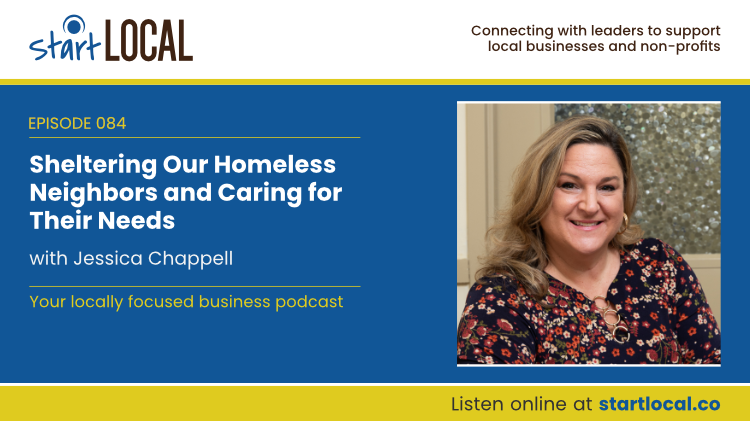
Podcast published: November 14, 2025
Despite the great wealth in Chester County, homelessness is a significant and persistent local issue. We sit down with Jessica Chappell, Executive Director of Safe Harbor of Chester County, to explore how her team provides shelter, meals, and compassionate support to adults experiencing homelessness. Jessica walks us through the realities facing the financially at risk population, the growing challenges around attainable housing, and the trauma-informed approach that guides the organization’s work. We discuss Safe Harbor’s partnerships, volunteer network, and the systemic pressures shaping homelessness in our county.
Links
Safe Harbor of Chester County
- Website: safeharborofcc.org
- Instagram: instagram.com/safeharbor_ofchestercounty
- Facebook: facebook.com/safeharborofchestercounty
- LinkedIn: linkedin.com/company/safe-harbor-of-chester-county-inc/
- Givebutter (Donations/Events): givebutter.com/safe-harbor-of-chester-county-inc
Local Nonprofits
- Chester County Food Bank
- West Chester Food Cupboard
- The Melton Center –
- PA 211
- Act Now
- Camp Dreamcatcher
- Crime Victims’ Center of Chester County
Additional Links
Related Episodes
- Nurturing Belonging and Celebrating Community with Children Impacted by HIV/AIDS with Patty Hillkirk
- Supporting Victims of Sexual Violence and Other Crimes with Christine Zaccarelli
Intro: Welcome to Start Local, where we talk with business owners, leaders of nonprofits, and other members of our community focused on doing business in and around Chester County, Pennsylvania. Each episode will provide insight into the local business scene and tell you about opportunities to connect with and support businesses and nonprofits in your local area.
The Southern Chester County Chamber of Commerce promotes trade, commerce, industry, and sustainable economic development while supporting a diverse and growing marketplace. The Chamber is proud to partner with the Start Local podcast to raise the profile of businesses and nonprofits throughout Chester County. Learn more about the chamber at scccc. That’s scccc.com.
Liam Dempsey: Hey. Hey. Welcome to Start Local. I am Liam Dempsey, and I am here today with my co-host and increasingly good friend. I think we are getting better friends, Erik, Erik Gudmundson. Erik, how the heck are you today?
Erik Gudmundson: I’m doing well. Honored you say such a thing. And I do agree. We’re having fun doing the podcast, and every episode we learn a little bit more fun facts about each other. We’re going to have to have trivia at one of these get-together nights sometime.
Liam Dempsey: Oh, that might be embarrassing for both of us. Maybe will do that on a night when only Joe Casabona can go to our networking event.
Erik Gudmundson: Good, good point. I withdraw that idea officially.
Liam Dempsey: Please. No one listened to this episode, or at least that part of it. But actually, folks, we absolutely want you to listen to today’s episode. We are very excited to welcome Jessica Chapel to the show. Jessica is the Executive Director of Safe Harbor of Chester County. Safe Harbor is a Westchester-based nonprofit serving the unhoused in the entirety of Chester County, Pennsylvania. Jessica, welcome to the Start Local podcast.
Jessica Chappell: Thank you. Thanks for having me, guys.
Erik Gudmundson: Jessica, it’s great to have you on. I really appreciated the tour you gave me of Safe Harbor, and I’m hoping we can give our listeners a bit of a virtual tour on this episode. So thank you for coming.
Jessica Chappell: Yeah, sure.
Liam Dempsey: Yeah, I would like to have a tour at some point. I feel like getting to know the nonprofits that support our community is always helpful. But let me jump into questions here, and I’m going to set the stage for our audience because they’ll know that we have recently spoken with Kelly Faust of Good Sam or Good Samaritan Services, and they’re another local nonprofit that helps the unhoused in our area. But Safe Harbor of Chester County supports the unhoused as well. So, tell us how your organization goes about its work.
Jessica Chappell: Sure. So thanks for having me on, number one. Appreciate it. We’ve been watching you guys and listening to you guys for a while. So we’re excited to have a chance to share a little bit about Safe Harbor.
So, Safe Harbor, I mean, we work really in partnership and in conjunction with many other agencies like Good Sam. I know Kelly well. You know, we run in a lot of the same circles and in many aspects, we support and serve certainly the same population and many oftentimes the same folks, the same people. We are part of sort of the housing continuum, we are for the unsheltered, literally, “street homeless” right? by HUD definition.
So the folks that are staying with us are coming to us off the street. And so that is one place where we are billed as an emergency shelter, a low-barrier shelter really meant to serve the community in every capacity in terms of being able to serve as many folks as we can and get them off the street. We have 40 beds, which means we serve 20 and 20. So we serve 20 single women and 20 single men.
Another way in which we are unique is that our residents are single, so they come in as singles. Though it’s interesting, oftentimes we do have couples. Right now, we have a few where there’ll be a male on the bottom floor and a female on the top floor, or even two sisters we recently served. So technically, we’re not serving family units. Even though we do, these are single beds, single occupancy, Congregate care setting.
Erik Gudmundson: And nonprofits assisting unhoused people often provide related or wraparound services in addition to those beds that you just mentioned. So, does Safe Harbor offer additional services? And if so, would you tell us about them?
Jessica Chappell: I would love to. I will say that I’ve been with Safe Harbor. I joined Safe Harbor in June of 2023, and at that time, we were sort of coming out, still coming out of COVID, Right? There was a lot of disruption with Congregate Care and COVID, and having many people in small spaces. And so that was a real challenge for Safe Harbor.
And then there was also a pretty significant transition just with the leadership team here at Safe Harbor. So when I landed here, I knew there were a few things that I wanted to very quickly try to do. And one of them was around the programs that we’re offering. So, Safe Harbor sort of had a reputation for dumping all of our folks out onto the street at 7 o’clock every morning because we did not have the funding, staffing, or capacity to keep 40 folks inside.
So, I knew that we were going to need to provide therapeutic, structured programming for our folks in order to allow them to be able to stay inside. And we did that. It took us a while to identify both funding and sort of build the program.
So, one of the things that I’m really proud of with Safe Harbor is our therapeutic day programming that actually started in June of 2024, where we offer a variety of programs throughout the day. And if we have residents here who are engaged in our programs, they’re able to stay in. So, for example, today they had a 9 o’clock class on. It’s called A Path Forward with Chris Pender, who is a speaker that we pay to come and work with our folks. And they’re getting ready to do some chi walking, which is not something we thought that our folks were going to be into, but they love it.
Learning about just sort of how to use your energy in a positive way and carry yourself in a positive way. So the therapeutic day programming is sort of everything you would expect, right? It’s job readiness, it’s computer literacy, and financial literacy. But we also try to do a lot of programs that are enriching for our folks, which I’d love to talk about, too.
And then, Erik, you asked about wraparound, which I think is actually a critical, critical component to what Safe Harbor is doing and what is going to be needed moving forward. It is extremely difficult to house single folks in Chester County. Dare I say almost nearly impossible? And so what we are seeing is our length of stay, the amount of time that our folks are with us, is continuing to grow. Right. So it went from 114, 114 days to 157 days. Last time I looked, it was up to like 178 days. People are going to be with us for longer. It’s going to be harder for us to move them through. So that just speaks to the urgent need for us to do something with our folks when they’re with us and make sure that we’re helping them build skills. And it also speaks to the critical nature of the wraparound program that we are building and providing. Right?
If you’re housed, what sort of supports can we provide both pre- and post-exit of Safe Harbor so that we can help you to stay housed. And that’s really what wraparound, you know, in a nutshell, looks like for us. It’s different for everyone. We do home visits for up to six months. We encourage our residents to come back for programming, to come back to volunteer. And you know, we create a resource manual so that folks have what they need, sort of in a one-stop shop. Where are you going to get your groceries at? Where’s your bus line to get to work? How do you fill your prescriptions? Who do you call in an emergency? How do you pay your bills? You know, all of those life skills that come second nature to us really need sort of training and delivery and reinforcement when we have somebody who’s been homeless, kind of getting back on that path to stability.
Liam Dempsey: Jessica, that was a really comprehensive answer. Thank you for that. I appreciate it. We read on your website that you are advocating that Safe Harbor is advocating for attainable housing. You’re doing so locally. You’re advocating for that locally. How do you define attainable housing, and how are you advocating for that?
Jessica Chappell: It’s a great question. I guess the best way to answer your question is sort of from a high level, right? So my job is to make sure that I am having a seat at the table for all of the very important conversations related to how Chester County is supporting our Alice population. If you’ve talked to other nonprofits, you’ve probably heard the word Alice. It’s essentially a nice word for the working poor, right? People who are employed but are still really on a cliff in terms of what they can and can’t afford and how they can and can’t live. And so certainly right now, with all of the changes that are happening in our country, being in tune and being at the table and having a voice at that table is incredibly important to me. So that is one of my focuses. There are lots of efforts to create attainable housing. But what that really means is that we’re talking about rents that are far and beyond, beyond, right? What our folks, our single Alice working folks, can afford.
And that is not something that will ever get fixed overnight. Affordable housing in Chester County has been, I think, top on the list for the past decade, if not longer. There are some long-term solutions. There are no immediate solutions.
One of the things that I am advocating for, and this may be because I came from behavioral health, right? I worked in behavioral health for like 24 years. There’s a very clear continuum in behavioral health. And so attainable housing to me looks like having a continuum so that people that are literally street homeless coming into shelter services can then move into transitional housing, right? Where they’re contributing some, but not all of rental, you know, rent for transitional housing that we’re able to provide them with continued supportive services so that they again, once they graduate through transitional housing, can move into what looks like long-term, permanent, sustainable, attainable, affordable housing.
That looks like our case management team, right? Knowing the ins and outs and the pockets of Chester County and the places and the landlords and really having partnerships with groups that can set our folks up for success in units where they sometimes receive subsidized rent, but most often not. So it’s really not an answer to your question in that, you know, attainable is pretty out of reach right now in Chester county. we are having some success, but it is not without the partnership of the county. Right. It’s working with other agencies. It’s coming up with dollars to support move-out costs and move-in costs. It’s finding pockets of subsidized support so that rents become realistic. And there are many people that have these needs, and there are very, very limited resources.
Erik Gudmundson: You mentioned that Safe Harbor has 20 beds for men and 20 beds for women. And I suspect you may have foreshadowed the answer to the question I’m about to ask you in your previous answer about attainable housing. But I think it’s an important answer because I want to dispel that myth out there. Tell us a little bit about who stays with you. Is it young people, or older folks? Paint a picture of who’s typically sleeping under your roof there.
Jessica Chappell: I love this question because I think this is probably one of the misunderstood parts of who is here with us. We do serve adults only, so typically it’s 18-year-olds and above. I was looking at some demographics last week. So from October to October, we served seven people under the age of 25, and we served 12 people over the age of 65. So just in terms of age, it really runs the gamut. Maybe not currently, but in terms of people that I’ve had. I’ve had a 19-year-old who was kicked out of his house because he came out as gay. I had a Westchester University graduate who graduated from college and didn’t have anywhere to go. I had an 82-year-old grandmother who became homeless when her spouse died.
I have a gentleman who works two jobs. I have a woman who became addicted to drugs during COVID. I have several folks who just never got back on their feet after COVID. 69% of the residents who are with me right now are working one or two jobs. So the folks that are here are your neighbors.
I do like to say that picture that you get in your mind right. When you think of a homeless individual, we call that a chronically homeless folk. Right. Somebody that’s experienced homelessness over and over or has been in this cycle for a long period of time. Yes, we do serve those folks, and we always will. Right? These are people who might come in and not stay or their capacity for shelter is kind of limited because of various reasons. We do our very, very best to serve those folks and to get them out of the cycle. But really, for the most part, it’s not that. Right. It’s folks that our Chester county residents, our constituents of this county and our district, like our neighbors and our friends.
And in this role, I can say that in the 2+ years that I’ve been in this role, one of the things that’s really struck me is if you were, there’s like everybody has been touched by homelessness, right? You either know someone or your neighbor was. I just, everyone that I speak to is like, Oh, my brother was homeless at one point. You know, my neighbor. This happens.
So these real-life stories really do happen. And people, people really face catastrophic consequences when there’s a flood, when there’s a fire, when there’s drug addiction, when there’s a family living in poverty, and somebody getting caught up in the juvenile justice system. Those are all precursors that lead to homelessness. So many of the folks that we serve have been on this sort of journey or path for a very long time. And all of them are fighting, all of them are trying to survive. All of them.
I had a gentleman this morning who was sleeping on our bench, and we, you know, we don’t like to see people sleeping on our bench. So I went outside and was engaging with him, and you know, he was hungry, he was cold. He had been in the street sleeping outside for several days. And that’s a real-life Monday morning. Hello, how are you? What can I do to help you? Reality of running a homeless shelter? And so then that becomes instead of prepping for my podcast, right, I’m on the phone with 211 and we’re brewing some coffee for him and we’re giving him breakfast and we’re getting him some warm clothes and we’re trying to figure out how we can make sure that he doesn’t have to sleep on the street in the cold tonight. Again, human, right? Just a very human element to what we’re doing.
So long, long answer to that question. But it’s like everyone, everyone is here. People that you would have no idea if you spoke to them, did not, did not have their own house. I have people who are waiters and waitresses in Westchester restaurants, right? I have DoorDash drivers. I have people who are working in all of our local businesses, engaging in all of our local markets, and are still really in survival mode, trying to survive.
Liam Dempsey: And just to give a little bit of reference for folks listening that this morning when I woke up, the phone told me it was 36 degrees outside. So the gentleman sleeping on your bench outside your front door there had a very cold night.
Jessica Chappell: He was cold, and I could tell immediately he was cold. And the first thing I said was, Can I get you a hot cup of coffee and bring it inside? And he looked at me and said, Thank you so much. Come on inside, dude. Like, it’s okay. You know, he might look a little. Right. I think if somebody else walked by him, they might think, Oh, right, there’s a scary homeless person. He’s not. It’s not. I mean, I don’t know anything about him, but I can tell you he’s just a human. And I’m going to bring him inside and give him a hot cup of coffee, and see what I can do to help him. We need more people like that in the world, especially right now. I just think that that’s really critical, that human element.
Liam Dempsey: In a previous conversation, Jessica, you shared with me that there are 21 of you who work at Safe Harbor. Can you break that down for us? Tell us about what roles you have and what different functions and services the individual team members provide.
Jessica Chappell: So we are a small operation. Sometimes I say skeleton crew, though I don’t like to say that. But it’s true, right? I mean, with most nonprofits, you know, we all wear many hats, and so I’m lucky that I have the budget and the capacity to have the amazing staff that I do.
So we have eight, like, management-level staff. So I do have a department of two, which is my sort of development team, right? They’re the fundraisers, advisors, and event coordinators. So I have a senior director of finance and growth, and then I have a development director. And they are really the ones that are in charge of helping, guiding us to make sure that we can pay the bills and continue to operate.
So many amazing things come out of that department, but it’s just a department of two, right? And so the $1.6 million budget that we raise every year falls pretty heavily on myself, of course, and those two folks who are doing our grant writing are doing all of our events and fundraising or making connections with corporations, et cetera.
And then the other real big part of my management team is my case management team. So I have a director of integrated care, and then we have two case managers who provide intensive care case management. The Director of Integrated Care was a new position that I created. And so she oversees resident care. And I would say I have had an incredible and seen an incredible impact on what that role has done, like within the homelessness system, right? Because we’re really trying to make sure that when folks are referred to us, that we have the information that we need to really help them, right? If somebody’s coming to us from jail or a hospital or the street, what meds are they on, what services are they receiving? What do we need to do to make sure that we can continue their path? And are they appropriate? Can we take them? Do they need to go into substance abuse treatment first, or do we need to bring them in so that we can get them on the path to substance abuse treatment? Mental health is a huge issue. And so making sure that we have the capacity to support, serve the level of individual right is really important.
And so my case management team is critical to Safe Harbor and is critical to making sure that we are serving people, as many as we can, as appropriately as we can, in the best ways possible. And that looks different for everybody, differently from behavioral health.
This population is incredibly varied, right? I mean, I have people who need the Office of Aging. I have people who need CYF. I have people who need the Department of Mental Health and IDD. I have people who need job training, right? So, like, it’s a total mishmash of people and needs. And I’ve been just calling it a vulnerable population, right? Because everybody has got something here. Either they’ve experienced chronic trauma, tor hey’ve got mental health issues, substance abuse issues. Nobody is experiencing homelessness just in a vacuum. And so the criticalness of being able to have a team with trauma training and skills to help address the very complex issues is really important.
And then the third department, I would say, is our kitchen department. So we provide about 40 to 43,000 meals a year to our residents. And then we also do a community lunch, which serves between 10 and 12,000 community members each year. So we provide three meals a day, 24/7, 365, for up to 40 residents. And so my kitchen manager and her partner in crime are also really critical to the operations of Safe Harbor.
I have a volunteer manager who helps oversee our volunteer operations, which is also a really big part of what Safe Harbor does. We see between 250 and 300 new volunteers each year. And they keep us going, right? They’re our backbone.
And then the other big part of who we are and what we do are our shelter staff, which are essentially almost like direct care staff that you would think of at a group home or maybe a residential facility where we have folks that are here in the evening and overnight, basically to provide support, monitoring, safety, whatever is needed for our folks that are here with us. So that’s a mixture of full-time and part-time folks that come in. Some of them work during the day with us. Most of them come in for evening and overnight shifts.
Erik Gudmundson: That was an incredibly comprehensive answer, particularly when I think about what your budget is per year. And so you mentioned your skeleton crew is divided into all those departments. And if they are a skeleton crew, which they’re stretched very, very thin, and they must have very big capes on their backs because that’s an amazing impact you have for such a small budget.
I want to focus on one part of your answer, though. You mentioned you make 43,000 meals a year and distribute 12,000 lunches per year on top of that, if I understood correctly. How do you make that happen with such a small staff and a relatively small budget?
Jessica Chappell: So we rely heavily on our partners. So Chester County Food Bank, Westchester Food Cupboard, Food Rescue Agencies, retail rescue, where local grocers and, you know, big box stores are able to provide us with much of the food that we feed our residents.
We also rely on agencies, church agencies, and local restaurants that have licensed kitchens, because we’re able to receive donations from licensed kitchens. So for our lunches, for example, we may have a church that volunteers every Monday to pack 60 lunches, and then they donate them to Safe Harbor, and then we are able to then provide them to the community. It’s usually a mixture. We keep a calendar that keeps track of any donations that we’re receiving for lunch or dinner, and then we make up the difference, essentially. So I have a mighty team of two who, the other tricky thing with the food is a lot of times we talk about, you know, menu planning and, you know, budgeting and how can we do this all, right? You would think it’s like a real refined system, but in truth, we’d never know what we’re gonna get. And so that’s a challenge too. It’s like, okay, we just got five huge 30-pound bags of catfish fillets. What do we do with that? Right? We have to learn how to cook catfish, or we’ve got little baby shrimp or chicken, you know, whatever it is.
So we’re kind of always pivoting our kitchen operations around what is donated to us. We do more cooking in the kitchen now than we ever have because of some changes that the board of health made back in April of 2024 that impacted our kitchen operations pretty significantly. So, we’re cooking. They’re cooking right now. They’re cooking for the week. They’re packing lunches. We often have volunteers who’ll come in and pack lunches for us and serve lunches. So if you hear the doorbell ringing in the background, that’s our community lunch. Right. They ring the bell, and we have a variety of volunteers who get to engage with the community.
We also put out a community cart that can have really any, you know, right now, I think there’s gloves and hats and things like that on there. So when we get access of certain goods, we will put it out for the community as well. There are certain restrictions on what we can put out. So, adhering to those restrictions, we will put out whatever we can for the community, too, during community lunch.
So I would say the long answer is like, it’s a huge conglomerate of a variety of people that contribute to our food operations. And I’d also love to just say that right now we’re hearing so much about food insecurity, so much about how getting no SNAP benefits are going to impact our neighbors.
For Safe Harbor, we are going to be impacted because our residents are no longer going to have food stamps, and so they’re going to rely on us more to feed them. Right. We also think that we’ll see many more people coming for community lunch because they don’t have food stamps anymore.
So where it’s vitally important to support the food bank and the food cupboards, they are the ones that are feeding us. Right. They are the ones who are donating food and feeding our folks as well. So, we really are working in partnership with so many people.
Liam Dempsey: The ending of the SNAP program, you know, the federal subsidies for families of low income to get food, has been in the news lately, and it’s certainly yet another instance of the challenges for all nonprofits from a funding perspective. The federal government has dramatically changed, and as we’re seeing on a near-daily basis, continues to change how it supports nonprofits.
The state of Pennsylvania, of course, has its own challenges with our Pennsylvania government yet to pass a budget for this year, to record this conversation in late October 2025. All of this is to set up a context to ask you the following question, Jessica: How is Safe Harbor funded? You mentioned you have a $1.6 million budget. Where does that money come from?
Jessica Chappell: So it’s similar to many other agencies in that we have a fairly diverse funding portfolio, which has really helped Safe Harbor. Right. Safe Harbor’s been around since 1994. So when we were founded, we were getting ready to celebrate our 30th birthday. We are lucky in that our founders and the people who have been stewarding this nonprofit were wise. Right. And so we have financial resources and financial stability right now. Right? And that is because we’ve been around for 30 years. And so those dollars that have been invested into our endowment, into you know, our different savings plans have allowed us to have a cushion.
But really, we rely and start at zero each year. And so individual donors, righteous individuals, make up about 20% of our budget. Foundations, corporations, and faith-based, make up about another 20%. So really, public funding, which is the county, the Commonwealth, is about 26%. We receive no federally funded dollars right now. But because of the state budget impasse, our dollars, our state dollars, were just actually, I think it’s going to be effective November 15th. It’s going to be cut in half. So the reimbursement that we’re getting based on our invoicing to state dollars is going to be, is currently cut by 25%. We just got notice that it’ll be cut in half. So about 26%, county, commonwealth, and then about 47% of our budget comes from private foundations, corporations, and individuals. Sort of a mishmash of those things. 13% from events. We do run lots of events at Safe Harbor.
And yeah, so the other bigger funder that we have is Fair, which most of your housing and homeless providers will probably talk about. That’s 19% of our budget. And that’s another, you know, that we anticipate all of those dollars being impacted by what’s happening federally. So in one way, when I got here, I was like, Why do we not get more money from the government? And really started angling to do that because it is really a very reciprocal relationship. Right. I mean, we’re doing work for the community, and so we’re going to rely on the government to help support us in doing that work. And I was pretty surprised that there wasn’t a NAS0 added to the line item that I was looking at when I saw our first budget. In a way, I’m grateful, right? That Safe Harbor has a great reputation where we’re able to steward this budget based off of private foundations, corporations, and individuals. Those are the backbone. Those are the folks that support us.
And then of course, we have a part-time grant writer, and we do a lot of work and get a lot of funding through various grants.
Erik Gudmundson: Jessica, I want to ask you one more question on the budget, and it’s this. In advance of today’s conversation, you shared that the cost to house a single person is $117per day. So I’d like to know how that number was determined. And here at the end of 2025, we are expecting costs to go up or down significantly anytime soon?
Jessica Chappell: So I don’t really like that number, I’ll be honest. So that number was based on a 2024 budget, which was 1.7 million in 2024 divided by. Right. Average length of stay and how many people we serve. There wasn’t some like a magic formula. So that’s where that number came from. It just really came out of our capacity, what we serve from a capacity standpoint. I know, in talking with my director of finance, that that number is going to increase.
It’s going to increase for a few reasons. One, we are going to see folks be here for longer. Many of the folks who are here have been here anywhere from six months to 12 months. That is very new for Safe Harbor. Safe Harbor used to have 120 day. You can stay here for 120 days. That was the rule that I walked in on. I am not going to exit people into homelessness because there is some magic date on a calendar that says your 120 days are up. Specifically, if the folks that are here are working towards whatever it is that they need to be working towards. Right. People who are complying with the rules, engaging in the programming, looking for jobs, and engaging in treatment. I don’t care to say 120 days are up. Sorry, goodbye. In fact, we haven’t. And so what we see is that our folks are staying with us for longer, and that we’re going to continue to do. But ultimately, what that does (I’m getting off topic here) but ultimately what that does is by not being able to move folks out of our shelter, by being, by allowing people to stay in the shelter for longer, it creates like a bottleneck. Right. If we’re not able to move people through, we can’t take more people in. And where do those people have to go? And so it becomes this gigantic systemic issue. You know, drill it down to the county level. We’re going to have more homeless folks on the street. If I’m not able to move, you know, a certain amount of people every month to open up beds.
Anyway. So, back to your question, Erik. Our costs are going to go up because our length of stay is going to go up, our food costs are going to go up, our operating budget is going to go up and the amount of dollars that we spend to support our Residents, bus passes, SEPTA passes, you know, SNAP benefits, applications to housing, all of those things are going to increase by at least 15 to 20%, we anticipate.
Liam Dempsey: Prior to your role at Safe Harbor, you worked in behavioral health. You shared that with us earlier in this conversation. And checking on LinkedIn, it looks like you were there for more than two decades. How has that experience shaped your work and leadership of Safe Harbor?
Jessica Chappell: So, I think in every way, right? I worked for a for-profit, privately owned, family-owned business that grew rapidly over the 20+ years that I was there. I served in the capacity of executive director for about 13 of the 24 years that I was there. I think the most important thing for me is that was I worked in like the disability world is probably the best way to explain it. People who had catastrophic injury, brain injury, stroke, you know, any kind of neurological impairment. And so what I really specialized in was home and community-based rehab, you know, making things real life for people so that when they went back home after rehab, when they went back home after having an injury, that they could relearn how to do life right.
And I also learned very early on sort of what it meant and felt like to serve individuals who were disenfranchised and marginalized. And so I think in every way that role really shaped me to become a passionate advocate for people who are different, who have different needs, and also to be a servant leader. Right.
So, I take a lot of pride in servant leadership and being a servant leader and sort of recognizing the power in the greater good. So I think when I joined Safe Harbor, I really came with a different lens, and I very quickly wanted to change how we were talking to the residents, how we were talking about the residents, how we were talking in front of the residents. That was one of the first things I did because we needed to do that. We needed to humanize the people that we were serving. And that really came out of my love for the disabled community and working with people who also had been fighting most of their lives to regain or to find their place in the world because they were differently abled than other people.
Erik Gudmundson: Thinking about everything that you’re doing there, and it is so important and I love the way you connect it back with humanity and just boiling it down to that very, very simple level. What do you do to get rid of all this stress? What do you do when you’re not working to relax and just sort of do something that’s important, shall we say?
Jessica Chappell: Yeah, it’s, it’s a great topic right now. I think we need like a 10-day conference on this topic. You know, what are we as nonprofits doing, especially moving forward, just the heaviness of everything is critical. I would say, honestly, in the past 2+ years that I’ve been here, I haven’t done a great job, Erik. It’s the hardest that I’ve ever worked in my life. It’s also the most, most fulfilling two years of my life, right?
And so I have three teenagers, and so most of my outside of Safe Harbor life looks like, you know, chasing after my teenagers and keeping them, keeping them going. We do have a beautiful camper on the beach in Maryland. And that is really our happy space where my husband takes me down, and puts me on a float out in the water and puts an anchor on the float, and I sometimes get a book and even a cocktail, and I sit out there and float.
On Saturdays and Sundays, watch the boats go by. One of the really rewarding things for me, though, I will say, is with my teenagers having this sort of full circleness of my kids and my staff’s kids and Westchester University’s kids, where my daughter goes and where I went and Westchester East kids, their honor society and their clubs, right? They come to the shelter, and I welcome them always. My kids stop by just to say hi. Sometimes they come in and volunteer. Critically important, right, that we’re showing the younger generation how to put their hands back in their pocket and not have them out like this, right? And how to understand that, you know, the value and importance of doing good things for other people and giving back.
So that’s actually something that I’m really proud of, and you know, have been able to engage in quite a bit, I would say, in sort of my free time. My boys play football. So right now, when I’m not at Safe Harbor, we’re on a playoff run right now. So we’re playing football. If we’re not playing, we’re getting ready to play.
Liam Dempsey: Well, good luck with the playoffs. We understand that Safe Harbor benefits from more than 300 volunteers helping out every year. So with that context, I got two questions. What roles can volunteers fill at Safe Harbor? And secondly, how do you recruit 300 people a year to volunteer for your organization?
Oh, okay. So the roles vary. First, I’ll say I have a volunteer, a volunteer manager, right? She’s called my community engagement manager. She doesn’t just do community, and she doesn’t just do volunteers, but that’s a big part of what she does. And so there is a cost associated with that. Right. I need to hire somebody to manage all of these volunteers and make sure that we’re stewarding their efforts in the best way possible for Safe Harbor. Many of our volunteers support our kitchen, so they do that either through donations, by coming in and serving.
Many of our volunteers support our operations by doing fundraisers and third-party drives, by making donations to the shelter. We have a lot of people that come in and just provide what we call shelter support, which could look like last week we had a new desk, right? And I was able to reach out to one of my volunteers and say, can you come help us put this desk together? We have people who help us with maintaining our donation room, inventories.
We have a garden with a community partnership with the Melton Center. And so a lot of our volunteers in the summer help steward our garden, from which we harvested 152 pounds of produce this summer. That goes right into the mouths of our residents. We have volunteers who help with events. So it really sort of runs the gamut from maintenance to programming.
We have a lot of volunteers who come in and offer various programs to our residents, resources, teachings, you know, Bible study, AA, financial literacy, you know, all of those things often come from people with subject matter expertise who want to share.
And in terms of how do we get them, I honestly think that this has a lot to do with just who Safe Harbor is in the community. Right. We are sort of a long-standing anchor institution in Westchester, and there are many, many people who have their DNA in and on this building. There are many people that care very deeply about Safe Harbor. And it just sort of begets, right. It just sort of goes from there. There’s no magic sauce. I think it just has to do with doing good work, being community-facing, and making real, true connections with partners.
And also being surrounded by people who understand the importance of giving back. And a community that understands the importance of what we’re doing, I think, also really helps. But we have software, and so oftentimes when people say they want to volunteer, we send them a link and say, you can sign up here and you can check out what we’ve got. And then if they have questions, they might connect with Shalia, who can sort of help match up their, you know, their desires with our needs and kind of go from there.
Erik Gudmundson: That’s wonderful. You have such a large volunteer base. I want to ask a quick question, if I could, about your client base. You mentioned earlier that one has to get declared unhoused or homeless in Chester County. So would you briefly tell me what that process looks like? And is there a technical distinction between unhoused and homeless in the eyes of the county?
Jessica Chappell: So, I’ve learned a lot about how this system works, and it’s really driven by HUD, right, because federal dollars trickle down to the state, federal dollars trickle from the state to the county. And so the work that the county does needs to align with HUD’s processes and procedures. And so, somebody getting into Safe Harbor looks like, first step is calling 211, which is our human needs network. Anybody can call 211 with any human need. You could be hungry, you could need a baby stroller, you could be facing eviction, you could need rental assistance, or you could be facing homelessness. So most often you call 211. And then from there is where things get a little bit more ambiguous, right? There are certain time frames where the county has a street outreach team that goes out and covers the entire county.
And what that street outreach team does is they basically have to meet the individual where they slept to be able to verify that this individual slept in a. Right. And then there’s a couple of sentences that are HUD-defined words like in a place that’s not meant for habitation by humans, et cetera, et cetera, and that they are literally unhoused, they are literally street homeless by HUD definition.
That process can be hard. It can be hard for street outreach because we’re, they’re going out and trying to find people who don’t have one singular place to be. It just sometimes can be. It can feel like a battle just getting somebody in the door. Right.
But essentially, street outreach goes out, verifies the individual. There’s a countywide system; they make a referral to Safe Harbor that says, Hey, Janet’s been verified. We’re referring her to Safe Harbor. And then we take over from there. Just in terms of our assessment and screening and getting them in the door.
The one thing that I will say that we do is 36 of our 40 beds sort of connected to the 211 system. So in the big county system, when we look at overall homeless beds, how many are filled, how many are open? Safe Harbor posts 36 beds. We have 40 beds. So we keep two of those beds, two females and two males, offline, meaning they’re side door beds.
And so for people that don’t qualify for the county’s definition of homelessness, which also means you have to be a Chester county resident, you have to be able to demonstrate that you’re a Chester county resident through either a piece of mail or a state ID, which many of our folks, that can be a huge challenge anyway. It just allows us to be able to bring people in who are hitting barriers or don’t technically qualify through the 211 system.
You know, certainly in the county system, you know, if somebody comes from Montgomery County or from Bucks County, our county wants to help them get back to their county of residence. Right. And so that’s part of the reason why there are rules like that in place. You know, my goal is to make sure that nobody’s on the street that has to be. And so even if it’s temporary, we’re able to at least bring a few folks in that are what we consider side door. That’s the sort of county criteria.
Liam Dempsey: Yeah. That’s an important role that you’re playing there, and helping with that. Thank you for that. Thank you for that. In the interest of time, I want to just touch on the fact that you shared that Safe Harbor is a trauma informed shelter. And that’s a phrase we’ve heard a couple of times in previous conversations, notably with Patty Hillkirk from Camp Dreamcatcher and Christine Zaccarelli from Crime Victims’ Center of Chester County. I’m going to ask a difficult one of you, Jessica, because we don’t have a lot of time left, and I’m going to ask you to be very succinct in your answer. But what does trauma informed mean to Safe Harbor and how does that affect, how does that trauma informed understanding affect the work that you’re doing?
Jessica Chappell: Okay. I think the best way to describe being trauma-informed is recognizing other people and your own biases and needs. Meeting people where they are, creating an environment where people feel safe, so that progress can be made. And that includes how we talk to about what our environment looks like, sounds like, what our tone of voice, our demeanors look like and sound like. It’s really everything from the moment that they walk across our threshold, making sure that we are approaching them in a certain way. Right? There are books on being trauma-informed. We are training our staff to continue to respond in trauma-informed ways. The fact that the population that we’re serving, every single person has experienced acute trauma for sure, the majority of them have experienced chronic, sometimes even generational trauma. And so it’s a huge deal for us to follow the sort of evidence base that says this approach with this population is best. And that’s what we try to do, create evidence-based interventions and practices that are supported to give our folks the optimal chance. Right. Of staying here and getting on the path.
Liam Dempsey: Thank you.
Erik Gudmundson: Jessica, you mentioned a number of other nonprofits here in the county that you work with. But is there a local nonprofit or even a business that more folks should know about?
Jessica Chappell: Yeah. So I thought about this because I have heard you ask this question on other podcasts. I would love to shout out to formerly Act in Faith, now called ACT Now. And I want to explain why
ACT Now fills the gaps. They are an agency that, when we can’t pay for a new phone or for eyeglasses, the kinds of things that you don’t think about that are so critical, that is where ACT Now steps in. So they fill gaps and advocate for our folks. And so we work in partnership with ACT Now on a daily basis, and they support every single agency that has to do with housing and homelessness in their amazing efforts in what they do. They are grassroots, and they are doing the dirty work is what I will say. You know, homelessness is not pretty. It’s not glamorous. And so having an agency like Daknow in our corner is critical. We also partner with them. We’re going to be doing Better than Bacon, which is a fundraiser at Uptown Knower Center. And I think this is probably the third or fourth year that Safe Harbor and ACT Now are both recipients of the money that is raised. And so we partner in those kinds of ways as well.
Liam Dempsey: Just a quick question for you for can. Are you hiring? I expect that if you’re looking for volunteers or you have 300, you’re probably always taking them. So are you hiring? And where can folks interested in volunteering come and find more?
Jessica Chappell: So we are hiring for some of our evening and overnight shifts. We do not have any management positions open right now, but we are always looking for good local folks who want to come in and help provide support to our residents in the evening and overnight. The best place to go would probably be our website, where a lot of our, you know, our link to the volunteer hub and many of the links to different ways to support Safe Harbor can be found.
Erik Gudmundson: How can the local community support you and the work you’re doing at Safe Harbor?
Jessica Chappell: You know, I think that we, you know, we are like many other nonprofits in that raising dollars is probably right. Number one, you know, finding ways to support us financially is really what keeps our doors open. And that looks like lots of different things, right? That could look like doing a shoe drive so that we can get shoes onto our folks instead of having to buy shoes. That might look like coming and providing a program for free that we don’t have to pay for, donating toilet paper and paper tackle so that we don’t have to purchase them. It doesn’t always have to look like writing us a check. Right? There’s a lot of ways that we can impact our bottom line.
The other thing, you know, we mentioned at the beginning, you guys coming by, I love having people come by. We do a ton of tours, and so just coming by and seeing and learning about Safe Harbor, our history, and our goals, we have some very big goal and aspirations in the next several years that we are hoping to accomplish, and we want to share that with everybody as well.
Erik Gudmundson: Jessica Chappell, executive director of Safe Harbor of Chester County, where can listeners connect with you to learn more about you, Safe Harbor, and all the wonderful things you’re doing?
Jessica Chappell: So, probably you could always give me a call. Come to Safe Harbor. I would say, you know, LinkedIn is a great place to connect. I certainly try to do what I can on LinkedIn to make sure that our partners are connected. It’s a great place to share information. So I would say, you know, hit me up on LinkedIn. I’m very interested right now in talking to other nonprofits and learning how people are impacted and coming up with creative and innovative solutions to the problems that we are facing collectively as a county moving forward. So that’s going to be one of my goals moving forward.
We are also going to be launching a capital campaign, and so we are going to be looking to build a structure over our parking lot so that we can increase both our bed capacity, how many people we can house from a shelter standpoint, but also provide transitional housing for folks. And so that is on our five-year plan as well.
Liam Dempsey: Jessica, thank you so much for joining us today. It’s been an absolute pleasure hearing your insight and walking through your experience, and learning more about the great work you’re doing. Thank you.
Jessica Chappell: Thank you very much.
Erik Gudmundson: Jessica, thank you so much for coming on. It’s been a pleasure talking with you, and hopefully, everyone has learned a little bit more about all the wonderful things you’re doing there at Safe Harbor.
Jessica Chappell: Thanks, guys.
Erik Gudmundson: Thank you also to my co-host, Liam Dempsey. I’m Erik Gudmundson.
The Start Local podcast is published every two weeks. We invite you to subscribe to Start Local using your favorite podcast app or ask your smart speaker to play the Start Local podcast. You can visit the Start Local website at startlocal.co for show notes, including links mentioned on this show and summaries of past episodes. We hope you join us for the next episode. Thank you for listening.